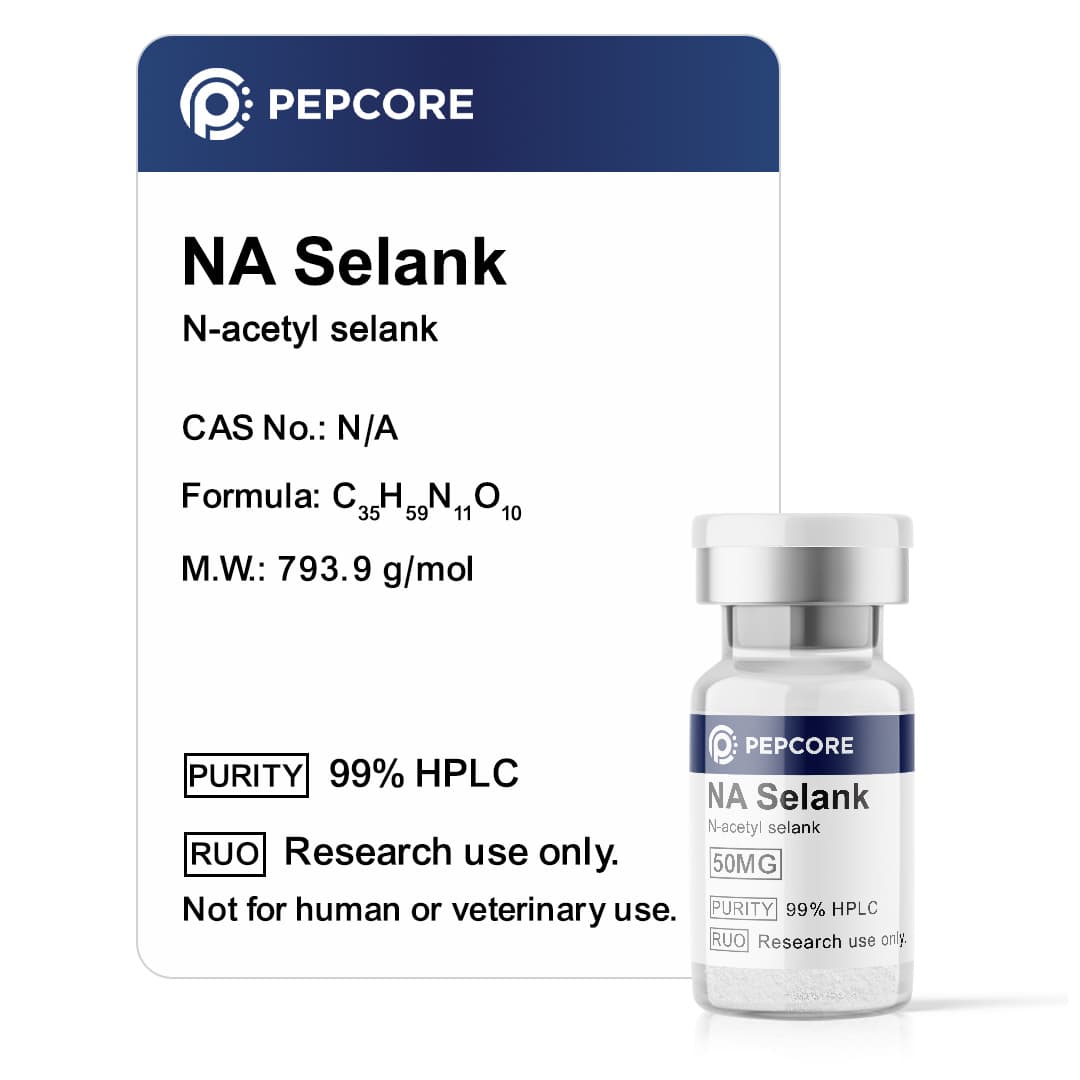
NA Selank 50 mg
Nur für In-vitro-Laborforschung. Nicht für den menschlichen Verzehr, veterinärmedizinische, diagnostische oder klinische Anwendung bestimmt.




Beschreibung
This 50 mg vial of NA Selank is supplied as a higher-content format for extended-study research applications. NA Selank (N-acetyl Selank, Ac-Selank) is the N-terminally acetylated analog of Selank, the synthetic heptapeptide developed at the Institute of Molecular Genetics of the Russian Academy of Sciences and built on the tuftsin-derived core sequence Thr-Lys-Pro-Arg-Pro-Gly-Pro. By capping the free N-terminal amine of the threonine residue with an acetyl group, NA Selank preserves the parent sequence while modifying its enzymatic stability and side-chain interaction profile. It is classified as a chemically stabilized tuftsin-derived synthetic heptapeptide studied alongside native Selank in GABAergic, neuropeptidergic, and adaptive-signalling research models.
The mechanism of action of NA Selank follows the same conceptual framework as Selank, with several distinguishing features attributable to N-terminal acetylation. Capping the N-terminal amine removes a major substrate recognition site for plasma and brain aminopeptidases, which extends the functional half-life of the peptide in laboratory preparations relative to the parent compound. The modification also reshapes the local electrostatic and steric environment around the threonine and lysine residues, which research models indicate can modify the GABAergic-binding profile, the interaction with enkephalin-degrading enzymes, and the engagement with tuftsin-related immune signaling pathways. As with native Selank, NA Selank is investigated for its influence on T-helper cell cytokine balance, expression of brain-derived neurotrophic factor (BDNF), and downstream signaling cascades relevant to stress adaptation and neuro-immune communication.
Research interest in NA Selank peptide spans enzymatic stability and proteolytic-degradation profiling, comparative GABAergic and neuropeptidergic signaling versus native Selank, immune-modulatory cytokine signaling, and gene-expression profiling in central nervous system tissue. Transcriptomic work on the parent compound has shown that Selank administration affects the expression of genes involved in GABAergic neurotransmission in rodent brain tissue (Volkova et al., 2016, Frontiers in Pharmacology), and NA Selank is studied in parallel to characterize how N-terminal acetylation reshapes these molecular readouts. These findings position NA Selank as a research tool for dissecting how N-terminal chemistry influences tuftsin-derived peptide function in integrated neuro-immune research workflows.
The peptide is supplied as a lyophilized powder to ensure optimal stability during storage and handling.