
Weight Management
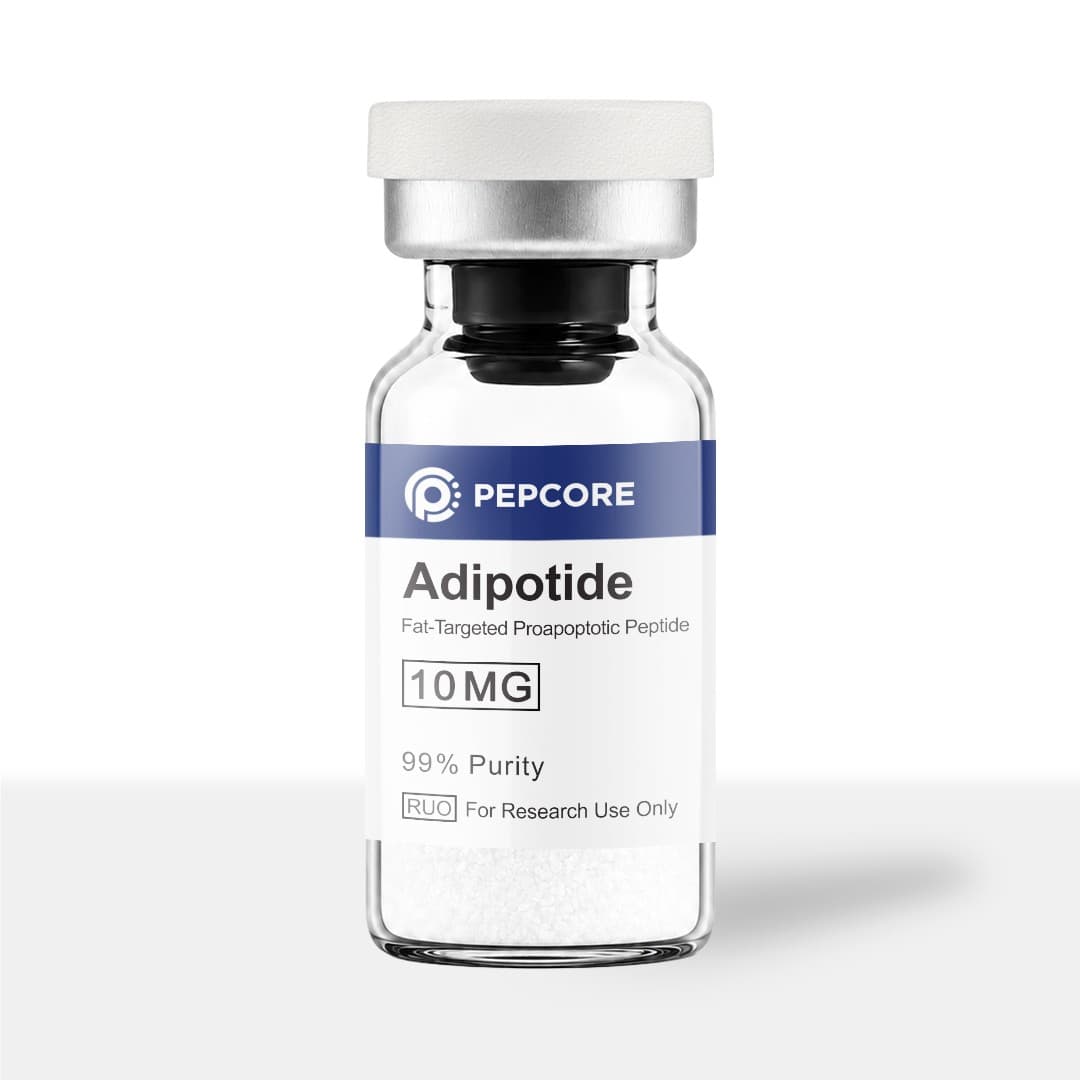
Adipotide (FTPP)
In Stock
Amount (mg)
Bacteriostatic Water
Insulin Syringes
Alcohol Swabs
Quantity
1
Price€69.00
Fast delivery, dispatched same day before 14:00
Tracked delivery, door to door
Shipped discreetly
Secure payments



Order before 14:00 for same-day shipping
Order now, ships today
OrderedToday
ShippedToday
Delivered24-25 November
Adipotide (FTPP) is a lab-made peptide mimic built as a two-part molecule, joining a fat-tissue homing sequence to a cell-disrupting segment with a small linker. It is best known in research for its targeted, address-and-payload design, which is what makes it stand out from simpler peptides.
It also has a research base, with lab work exploring how its homing piece interacts with receptors like prohibitin and annexin-A2 (Salameh et al., 2016, JCI Insight). That makes it a common reference compound in vascular-targeting studies.
Research Applications
•Ligand-directed vascular targeting research
•Prohibitin and annexin-A2 receptor studies
•Chimeric peptide design research
•Structure-activity laboratory models
Supplied as a lyophilized powder for stability.
Scientific Background
Ligand-directed peptidomimetic research has investigated engineered chimeric peptides that combine tissue-selective homing motifs with effector domains to support structure–activity research on receptor-mediated tissue-vasculature engagement. The CKGGRAKDC cyclic peptide motif was identified through in vivo phage-display research as a sequence that engages prohibitin and annexin-A2 on the endothelial surface of adipose-vasculature research models.
Adipotide (FTPP) was developed as a synthetic chimeric peptidomimetic by linking the CKGGRAKDC homing motif to the D(KLAKLAK)₂ proapoptotic effector domain through a Gly-Gly spacer. The D-amino-acid stereochemistry of the effector domain confers resistance to enzymatic degradation in research models, while the cyclic CKGGRAKDC motif provides selectivity for the prohibitin/annexin-A2 receptor complex expressed on adipose-vasculature endothelial cells.
This structural design has made adipotide a widely studied reference compound for laboratory investigations of ligand-directed vascular-targeting research, prohibitin/annexin-A2 receptor engagement, and downstream mitochondrial-membrane research in adipose-vasculature endothelial-cell research models. Research interest spans adipose-vasculature research, endothelial-cell research, prohibitin/annexin-A2/CD36 complex research, and structure–activity research on chimeric peptidomimetic design.
Structure
Peptide ClassSynthetic chimeric peptidomimetic with cyclic homing motif and D-stereochemistry proapoptotic effector domain
Amino Acid SequenceCys-Lys-Gly-Gly-Arg-Ala-Lys-Asp-Cys-Gly-Gly-D(Lys-Leu-Ala-Lys-Leu-Ala-Lys)₂
Sequence DesignationCKGGRAKDC-GG-D(KLAKLAK)₂
Key ModificationCyclic disulfide bridge in CKGGRAKDC homing motif; D-amino-acid stereochemistry in (KLAKLAK)₂ effector domain
Molecular FormulaC₁₁₁H₂₀₆N₃₆O₂₈S₂
Molecular Weight2557.2 g/mol
CAS Number859216-15-2
SynonymsFat-Targeted Proapoptotic Peptide (FTPP), Prohibitin-Targeting Peptide 1 (TP01)
Mechanism of Action
Prohibitin/Annexin-A2 Receptor Engagement
Adipotide interacts with the prohibitin/annexin-A2 receptor complex on adipose-vasculature endothelial cells in research models. Research models indicate that the cyclic CKGGRAKDC homing motif engages this receptor complex with selectivity over vasculature-endothelial cells in other research-tissue compartments, supporting ligand-directed engagement research.
Receptor-Mediated Internalization
Upon receptor binding, adipotide engages receptor-mediated internalization pathways in adipose-vasculature endothelial-cell research models. Downstream, this is associated with intracellular delivery of the D(KLAKLAK)₂ effector domain, which is extensively studied in chimeric peptidomimetic research as an upstream regulator of mitochondrial-membrane research endpoints.
Mitochondrial-Membrane Engagement by the D(KLAKLAK)₂ Effector
Laboratory research studies have characterized the D(KLAKLAK)₂ effector domain as engaging mitochondrial-membrane research endpoints in research models, modulating mitochondrial-membrane integrity and downstream caspase-pathway signaling. This engagement is an active area of structure–activity research and is investigated as a defining feature of bifunctional chimeric peptidomimetic design.
Prohibitin/Annexin-A2/CD36 Complex Research
Research models have investigated the broader prohibitin/annexin-A2/CD36 trimolecular complex on adipose-vasculature endothelial cells, which engages fatty-acid transport research pathways. Adipotide research has supported mechanistic mapping of this complex in adipose-vasculature research and comparative pharmacology with other ligand-directed peptidomimetic research compounds.
Conclusion
Adipotide (FTPP) represents a structurally engineered chimeric peptidomimetic that has become a central reference compound in ligand-directed vascular-targeting research. Its combination of a cyclic CKGGRAKDC adipose-vasculature homing motif, a D(KLAKLAK)₂ proapoptotic effector domain, and a Gly-Gly spacer makes it a valuable investigational laboratory peptide for studying receptor-mediated internalization, prohibitin/annexin-A2 receptor engagement, and chimeric peptidomimetic structure–activity research models.
References
•Salameh A et al. (2016). Prohibitin/annexin 2 interaction regulates fatty acid transport in adipose tissue. JCI Insight. PubMed
•Kim DH et al. (2010). Peptide designed to elicit apoptosis in adipose tissue endothelium reduces food intake and body weight. Diabetes. PubMed
•Gao Z et al. (2022). Endothelial Prohibitin Mediates Bidirectional Long-Chain Fatty Acid Transport in White and Brown Adipose Tissues. Diabetes. PubMed
•Staquicini FI et al. (2011). Vascular ligand-receptor mapping by direct combinatorial selection in cancer patients. Proceedings of the National Academy of Sciences of the United States of America. PubMed
•Hossen MN et al. (2010). Ligand-based targeted delivery of a peptide modified nanocarrier to endothelial cells in adipose tissue. Journal of Controlled Release. PubMed
Research Use Disclaimer
This product is intended for research and laboratory use only. It is designed exclusively for in vitro research purposes. All information provided is for educational and research reference only. This product is not intended for human or animal use. It is not a drug, food, or cosmetic and must not be marketed, labeled, or used as such. Use and handling are restricted to trained and qualified professionals.
What is Adipotide (FTPP)?
Adipotide (FTPP) is a lab-made peptide mimic built as a two-part molecule, joining a fat-tissue homing sequence to a cell-disrupting segment with a small linker. It is supplied as a lyophilized powder for laboratory research use only.
What is Adipotide (FTPP) used for in research?
In research, Adipotide (FTPP) is studied in areas such as: Ligand-directed vascular targeting research, Prohibitin and annexin-A2 receptor studies and Chimeric peptide design research. Related compounds in our Weight Management range include Tirzepatide and SLU-PP-332.
Where can I buy Adipotide (FTPP)?
Adipotide (FTPP) is available from Pepcore, shipped from the Netherlands to every European country with tracking. A certificate of analysis is available on request.
How is Adipotide (FTPP) reconstituted?
With bacteriostatic water, added slowly down the inside of the glass rather than onto the powder, then swirled gently, never shaken. Bacteriostatic water is optional when you order: you can add a 3 ml vial (+€4.99) or a 10 ml vial (+€12.99), or leave it out. Use our peptide calculator to work out the concentration for your vial size.
How is Adipotide (FTPP) stored, and how long does shipping take?
Lyophilized Adipotide (FTPP) is kept cool, dry and away from light. Once reconstituted, the solution is refrigerated at 2 to 8 °C, see our peptide stability guide. Orders leave the Netherlands the same or next business day: 1 to 2 business days to the Netherlands and Belgium, 2 to 7 to Germany, France, Spain, Italy and Luxembourg, 3 to 8 to the rest of the EU, free from €250, see shipping.
Amount (mg)10 mg
Bacteriostatic Water3 ml or 10 ml, optional
Insulin Syringes10× 1 ml insulin syringes, 10× 0.5 ml insulin syringes, None
Alcohol SwabsYes, No
TestingThird-party HPLC/MS
CAS859216-15-2
Netherlands & Belgium: 1-2 business days, €8.49-€12.99
Germany: 2-7 business days, €12.99
France, Spain, Italy & Luxembourg: 2-7 business days, €14.90
Rest of the EU: 3-8 business days, €14.90
Poland: 3-8 business days, €15.99
Sweden: 3-8 business days, €15.99
Switzerland, Norway, United Kingdom & other European countries outside the EU: 5-10 business days, €15.99
Canary Islands: 7-12 business days, €24.99
Free shipping on orders from €250
For laboratory and research use only.
Not for human or veterinary use, diagnosis, or treatment.
To be handled only by qualified personnel in a controlled lab setting.
By placing an order, you confirm you have read and agree to these research-use terms.


€69.00