
Hair & Skin
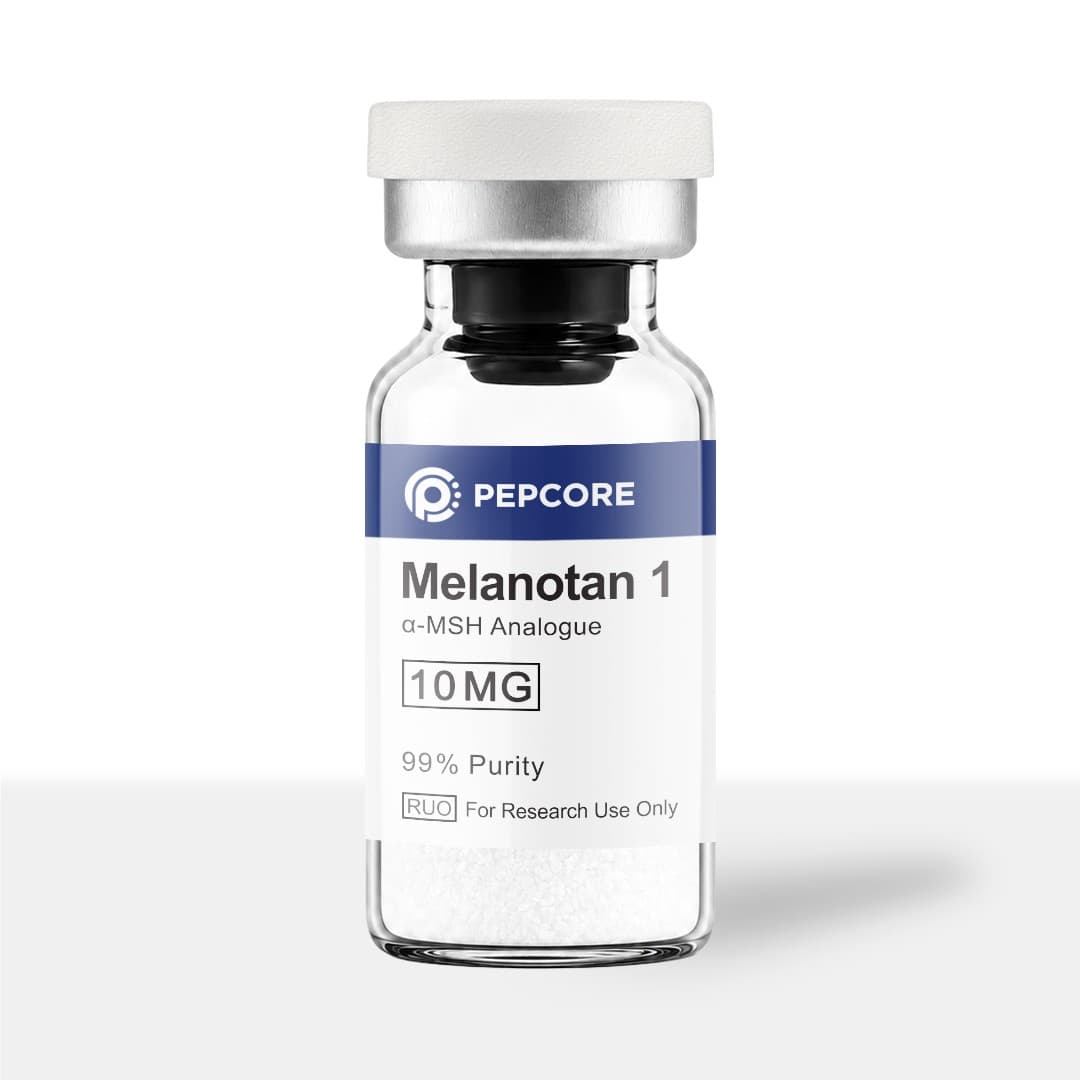
Melanotan 1
In Stock
Amount (mg)
Bacteriostatic Water
Insulin Syringes
Alcohol Swabs
Quantity
1
Price€59.00
Fast delivery, dispatched same day before 14:00
Tracked delivery, door to door
Shipped discreetly
Secure payments



Order before 14:00 for same-day shipping
Order now, ships today
OrderedToday
ShippedToday
Delivered24-25 November
Melanotan 1 is a lab-made peptide built from 13 amino acids, designed as a close analog of the natural alpha-MSH hormone. It is best known in research for its activity at the melanocortin-1 receptor (MC1R), and its straight, linear chain is what marks it out among MSH analogs.
It also sits on a solid research base, with work exploring how it binds and signals at melanocortin receptors (Sawyer et al., 1980). This is why it often serves as a reference compound in melanocyte and receptor studies.
Research Applications
•MC1R receptor pharmacology research
•Melanocyte-signaling studies
•Alpha-MSH analog structure research
•Melanocortin receptor-binding work
Supplied as a lyophilized powder for stability.
Scientific Background
Melanotan-1 was developed as a linear synthetic analog of alpha-melanocyte-stimulating hormone (alpha-MSH), an endogenous 13-amino-acid melanocortin peptide derived from proopiomelanocortin (POMC). Native alpha-MSH exhibits limited enzymatic stability in laboratory research environments, with a short plasma half-life that constrains its use as a research probe. This stability limitation motivated the engineering of structurally modified linear analogs.
The Melanotan-1 scaffold introduces two key amino-acid substitutions relative to native alpha-MSH. First, methionine at position 4 is replaced with norleucine (Nle4), which eliminates a methionine-oxidation site and improves stability in laboratory research solutions. Second, phenylalanine at position 7 is replaced with its D-enantiomer (D-Phe7), which confers resistance to enzymatic degradation and extends the molecule's pharmacokinetic profile in research models.
Together these substitutions produce a research compound that is reported in structure-activity research as substantially more potent than native alpha-MSH in cellular adenylyl cyclase research assays, while retaining the linear 13-amino-acid backbone characteristic of the parent peptide. This profile has made Melanotan-1 a widely used reference compound in laboratory research studies of MC1R receptor pharmacology, melanocortin-receptor structure-activity research, and comparative GPCR pharmacology across the melanocortin-receptor family.
Structure
Melanotan-1 Structure
Peptide ClassSynthetic linear alpha-MSH analog research peptide (melanocortin-receptor agonist)
SequenceSer-Tyr-Ser-Nle-Glu-His-D-Phe-Arg-Trp-Gly-Lys-Pro-Val
Residue Count13 amino acids (linear)
Key Structural FeaturesNle4 substitution, D-Phe7 substitution
Molecular FormulaC₇₈H₁₁₁N₂₁O₁₉
Molecular Weight~1646.8 g/mol
CAS Number75921-69-6
Research CodesNDP-MSH, NDP-alpha-MSH, afamelanotide
Mechanism of Action
MC1R Receptor Engagement
Melanotan-1 engages melanocortin-1-receptor (MC1R), a class A G-protein-coupled receptor broadly investigated in melanocyte-signaling research and laboratory research models of melanocortin-receptor pharmacology. Laboratory research studies report nanomolar binding affinity at MC1R in cellular research models, with retained binding affinity at MC3R, MC4R, and MC5R in comparative receptor-binding research (Frandberg et al., 1994).
Modulation of Cyclic AMP Signaling
Upon MC1R engagement, Melanotan-1 modulates Gαs-coupled adenylyl cyclase activity, producing intracellular cyclic AMP accumulation. Structure-activity research has reported this analog as substantially more potent than native alpha-MSH in cellular adenylyl cyclase research assays, making it a frequently used reference compound in melanocortin-receptor signaling research (Sawyer et al., 1980).
Nle4 and D-Phe7 Substitution Pharmacology
The Nle4 substitution eliminates a methionine-oxidation site, while the D-Phe7 substitution confers resistance to enzymatic degradation in cellular research models. Together these modifications extend the molecule's biological half-life and produce a prolonged receptor-engagement profile relative to native alpha-MSH in laboratory research studies.
Downstream MITF and Melanogenic Gene Research
MC1R-coupled cAMP accumulation modulates protein kinase A (PKA) activity, CREB phosphorylation research, and downstream microphthalmia-associated transcription factor (MITF) signaling research in cellular research models. Melanotan-1 is investigated as a probe compound for examining these downstream melanocyte-signaling cascades in laboratory research environments.
Conclusion
Melanotan-1 represents a linear 13-amino-acid synthetic analog of alpha-MSH that has become a widely used reference research compound in MC1R receptor pharmacology research. Its Nle4 and D-Phe7 substitutions, characterized cAMP signaling profile, and structure-activity data across the melanocortin-receptor family make it a valuable investigational laboratory peptide for studies of melanocortin-receptor pharmacology research and class A GPCR signaling research models.
References
•Sawyer TK et al. (1980). 4-Norleucine, 7-D-phenylalanine-alpha-melanocyte-stimulating hormone: a highly potent alpha-melanotropin with ultralong biological activity. Proceedings of the National Academy of Sciences of the United States of America. PubMed
•Frändberg PA et al. (1994). Evidence for alternate points of attachment for alpha-MSH and its stereoisomer [Nle4, D-Phe7]-alpha-MSH at the melanocortin-1 receptor. Biochemical and Biophysical Research Communications. PubMed
•Hadley ME et al. (1985). [Nle4, D-Phe7]-alpha-MSH: a superpotent melanotropin that "irreversibly" activates melanoma tyrosinase. Endocrine Research. PubMed
•Hadley ME, Haskell-Luevano C (1999). The proopiomelanocortin system. Annals of the New York Academy of Sciences. PubMed
•Schiöth HB et al. (1996). Characterisation of the melanocortin 4 receptor by radioligand binding. Pharmacology & Toxicology. PubMed
•Yang Y (2011). Structure, function and regulation of the melanocortin receptors. European Journal of Pharmacology. PubMed
Research Use Disclaimer
This product is intended for research and laboratory use only. It is designed exclusively for in vitro research purposes. All information provided is for educational and research reference only. This product is not intended for human or animal use. It is not a drug, food, or cosmetic and must not be marketed, labeled, or used as such. Use and handling are restricted to trained and qualified professionals.
What is Melanotan 1?
Melanotan 1 is a lab-made peptide built from 13 amino acids, designed as a close analog of the natural alpha-MSH hormone. It is supplied as a lyophilized powder for laboratory research use only.
What is Melanotan 1 used for in research?
In research, Melanotan 1 is studied in areas such as: MC1R receptor pharmacology research, Melanocyte-signaling studies and Alpha-MSH analog structure research. Related compounds in our Hair & Skin range include PT-141 and Melanotan 2.
Where can I buy Melanotan 1?
Melanotan 1 is available from Pepcore, shipped from the Netherlands to every European country with tracking. A certificate of analysis is available on request.
How is Melanotan 1 reconstituted?
With bacteriostatic water, added slowly down the inside of the glass rather than onto the powder, then swirled gently, never shaken. Bacteriostatic water is optional when you order: you can add a 3 ml vial (+€4.99) or a 10 ml vial (+€12.99), or leave it out. Use our peptide calculator to work out the concentration for your vial size.
How is Melanotan 1 stored, and how long does shipping take?
Lyophilized Melanotan 1 is kept cool, dry and away from light. Once reconstituted, the solution is refrigerated at 2 to 8 °C, see our peptide stability guide. Orders leave the Netherlands the same or next business day: 1 to 2 business days to the Netherlands and Belgium, 2 to 7 to Germany, France, Spain, Italy and Luxembourg, 3 to 8 to the rest of the EU, free from €250, see shipping.
Amount (mg)10 mg
Bacteriostatic Water3 ml or 10 ml, optional
Insulin Syringes10× 1 ml insulin syringes, 10× 0.5 ml insulin syringes, None
Alcohol SwabsYes, No
TestingThird-party HPLC/MS
CAS75921-69-6
Netherlands & Belgium: 1-2 business days, €8.49-€12.99
Germany: 2-7 business days, €12.99
France, Spain, Italy & Luxembourg: 2-7 business days, €14.90
Rest of the EU: 3-8 business days, €14.90
Poland: 3-8 business days, €15.99
Sweden: 3-8 business days, €15.99
Switzerland, Norway, United Kingdom & other European countries outside the EU: 5-10 business days, €15.99
Canary Islands: 7-12 business days, €24.99
Free shipping on orders from €250
For laboratory and research use only.
Not for human or veterinary use, diagnosis, or treatment.
To be handled only by qualified personnel in a controlled lab setting.
By placing an order, you confirm you have read and agree to these research-use terms.


€59.00