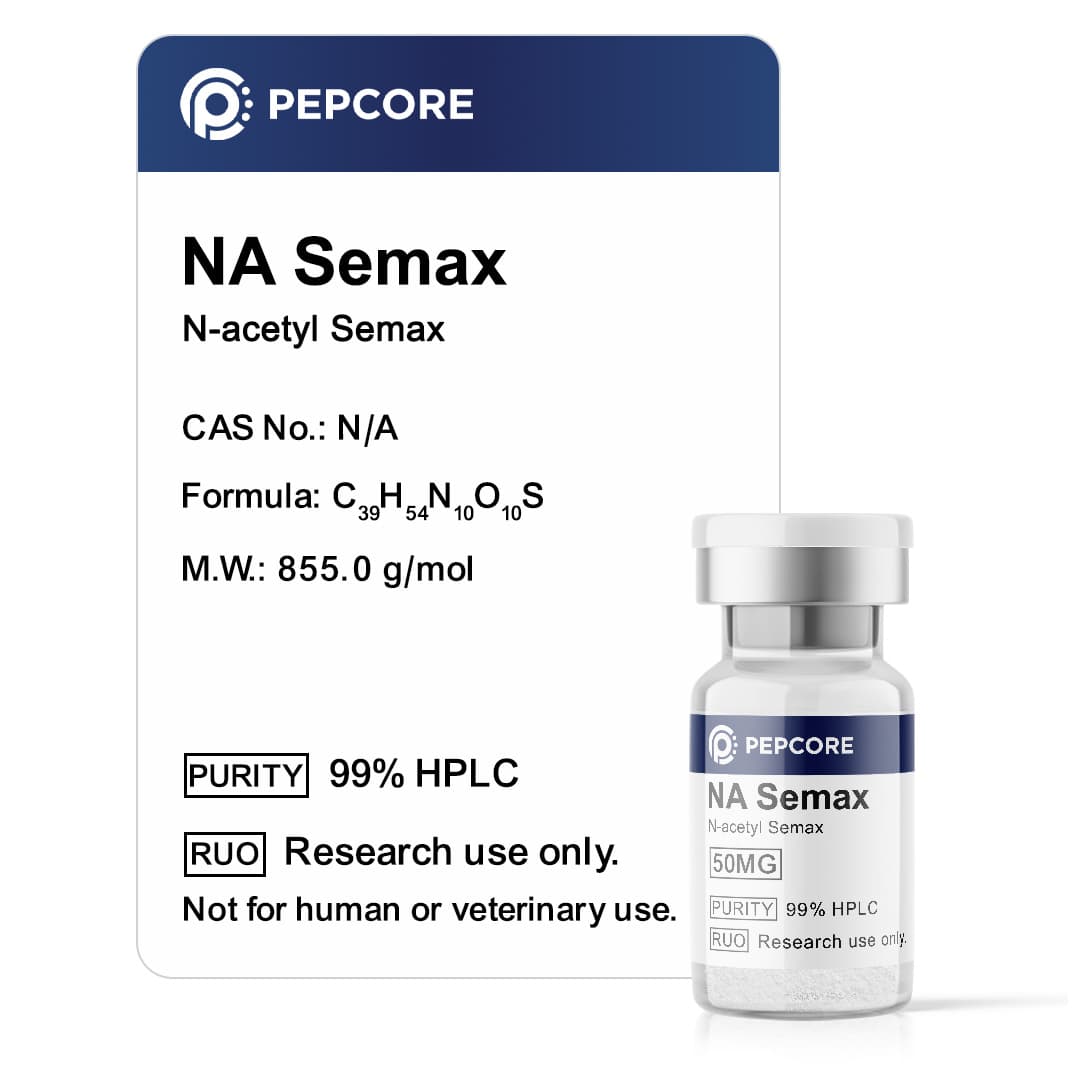
NA Semax 50 mg
For in-vitro laboratory research use only. Not intended for human consumption, veterinary, diagnostic, or clinical use.




Description
This 50 mg vial of NA Semax is supplied as a higher-content format for multi-aliquot research applications. NA Semax (N-acetyl Semax, Ac-Semax) is the N-terminally acetylated analog of Semax, the synthetic heptapeptide derived from the ACTH(4-10) fragment of adrenocorticotropic hormone. By blocking the free N-terminal amine through acetylation, NA Semax preserves the parent sequence while modifying both its metabolic profile and its coordination chemistry. It is classified as a chemically stabilized synthetic neuropeptide analog studied in parallel with native Semax across neurotrophic, neuropeptidergic, and metal-binding research models.
The mechanism of action of NA Semax is closely related to that of Semax, with several distinguishing features attributable to the N-acetyl modification. Acetylation of the N-terminal methionine residue increases resistance to aminopeptidase-mediated cleavage in plasma and tissue homogenates, extending the functional half-life of the peptide in laboratory preparations. The modification also alters the metal-binding behavior of the molecule: the free alpha-amino group present in native Semax serves as a primary anchoring site for transition metal ions such as Cu(II) and Zn(II), and its removal in NA Semax shifts coordination toward the imidazole nitrogen of histidine and other backbone donor atoms. Research has shown that this restructuring of the metal-binding geometry modifies copper-binding affinity and stoichiometry, with downstream consequences for redox behavior and receptor-level interactions in the melanocortin and neurotrophic-signalling pathways studied for the parent compound.
Research interest in NA Semax peptide spans plasma stability and proteolytic-degradation profiling, transition-metal coordination chemistry of ACTH-derived neuropeptides, comparative receptor and neurotrophic signaling against native Semax, and adaptive-signalling responses in central nervous system tissue models. A detailed coordination-chemistry analysis demonstrated that N-terminal acetylation profoundly alters the copper-binding properties of Semax, with measurable consequences for its biological activity in laboratory models (Magrì et al., 2016, Journal of Inorganic Biochemistry). These findings have established NA Semax as a useful research tool for dissecting the contributions of N-terminal chemistry to neuropeptide function and for studying chemically stabilized ACTH(4-10) analogs alongside the parent molecule.
The peptide is supplied as a lyophilized powder to ensure optimal stability during storage and handling.