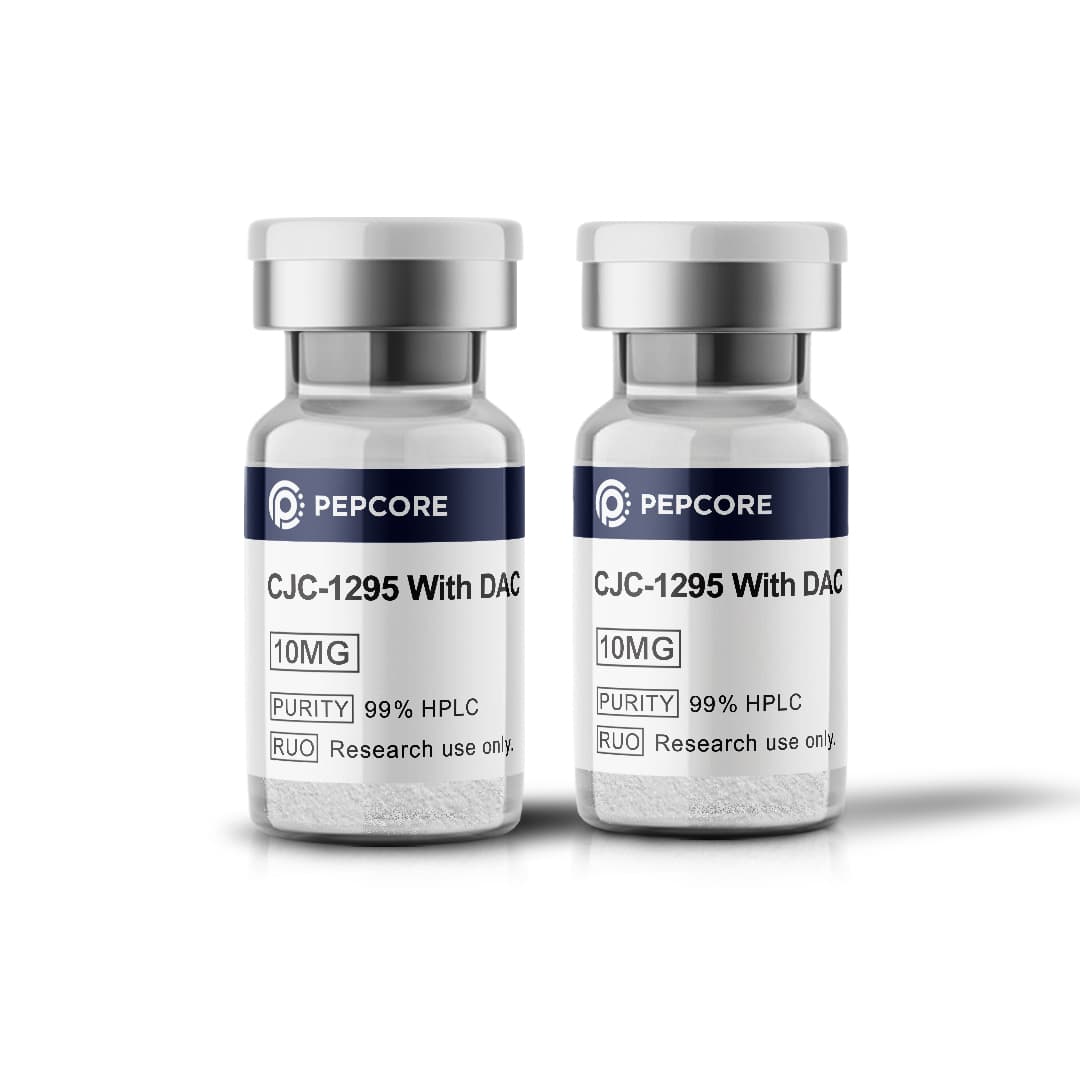
2x CJC-1295 With DAC Bundle
Nur für In-vitro-Laborforschung. Nicht für den menschlichen Verzehr, veterinärmedizinische, diagnostische oder klinische Anwendung bestimmt.




Description
This bundle brings together 2× CJC-1295 With DAC in a single research bundle, priced around 15% below buying each vial separately. Each peptide is supplied in its own individual vial, so reconstitution and handling stay fully independent per compound.
Every vial is lyophilized research-grade powder at ≥ 99% HPLC purity, with a Certificate of Analysis available on request.
For laboratory research use only. Not for human or veterinary use.
CJC-1295 With DAC
CJC-1295 With DAC is a synthetic 30-residue analog of growth-hormone-releasing hormone (GHRH) engineered with a Drug Affinity Complex (DAC) modification. The DAC component is a maleimidopropionic acid (MPA) linker attached at the C-terminal lysine, which forms a covalent bond with a free cysteine residue on circulating serum albumin in research models. This albumin-bioconjugate design extends plasma residency from minutes for native GHRH(1-29) to several days in laboratory species, making CJC-1295 With DAC an investigational laboratory peptide for GHRH-receptor signaling research and somatotropic-axis research models.
Laboratory research studies have positioned CJC-1295 With DAC as a reference compound for examining sustained engagement of GHRH receptors on pituitary somatotroph cells. Research models have characterized its binding kinetics, downstream adenylyl-cyclase and cyclic-AMP signaling, and the resulting modulation of growth-hormone-pathway investigation, providing comparative data versus shorter-acting GHRH analogs such as sermorelin and Mod GRF (1-29) (Jetté et al., 2005, Endocrinology).
Beyond pituitary receptor pharmacology, CJC-1295 With DAC is investigated in cellular and animal research models that explore somatotropic-axis signal transduction, hepatic IGF-1 expression research, hypothalamic-pituitary feedback regulation, and age-associated changes in GHRH-receptor responsiveness. The peptide's albumin-binding side chain is also a frequent subject of pharmacokinetics and protein-binding research, including comparative studies versus non-acylated GHRH(1-29) analogs. See also: CJC-1295 No DAC 10 mg, Ipamorelin 10 mg, Sermorelin 5 mg
Scientific Background
2x CJC-1295 With DAC Bundle combines 1 research compounds: CJC-1295 With DAC. Scientific background for each component is documented below.
CJC-1295 With DAC
Growth-hormone-releasing hormone is a 44-residue hypothalamic peptide that engages the GHRH receptor, a class B G-protein-coupled receptor expressed on pituitary somatotroph cells, and participates in growth-hormone-pathway investigation. For many years, research on GHRH analogs was limited by the very short plasma half-life of native GHRH(1-29), which is rapidly inactivated by dipeptidyl peptidase-IV (DPP-IV) cleavage and other proteolytic mechanisms. This kinetic limitation constrained laboratory investigations of sustained somatotropic-axis signaling and motivated the design of structurally modified analogs with improved plasma stability.
CJC-1295 With DAC was developed as a synthetic GHRH(1-29) analog incorporating four amino-acid substitutions (D-Ala², Gln⁸, Ala¹⁵, Leu²⁷) that confer resistance to proteolytic degradation, together with a C-terminal lysine bearing a maleimidopropionic acid (MPA) Drug Affinity Complex. The MPA group reacts selectively with the free cysteine-34 residue of serum albumin to form a stable covalent bioconjugate in research models, anchoring the peptide to a circulating carrier protein.
This dual structural strategy, sequence stabilization combined with albumin bioconjugation, has made CJC-1295 With DAC a widely studied reference compound for laboratory investigations of GHRH-receptor signaling kinetics, prolonged somatotropic-axis engagement, hepatic IGF-1 expression dynamics, and pharmacokinetic modeling of acylated peptide analogs. Research interest spans pituitary somatotroph signaling models, endocrine feedback research, and comparative pharmacology versus non-DAC GHRH analogs.
Structure
2x CJC-1295 With DAC Bundle is supplied as a homogeneous lyophilized mixture. Structural details for each compound:
CJC-1295 With DAC
Synonyms: CJC-1295 (DAC-conjugated), DAC:GRF
Mechanism of Action
Each compound in 2x CJC-1295 With DAC Bundle engages distinct biochemical targets. Mechanism of action per compound:
CJC-1295 With DAC
1. GHRH-Receptor Engagement on Pituitary Somatotrophs
CJC-1295 With DAC engages the GHRH receptor on pituitary somatotroph cells, a class B G-protein-coupled receptor. Research models indicate that this engagement modulates Gαs-coupled signaling and adenylyl-cyclase activity, producing intracellular responses that have been compared with native GHRH(1-29) in laboratory studies (Jetté et al., 2005, Endocrinology).
2. Modulation of Cyclic AMP and Downstream Kinases
Upon receptor engagement, CJC-1295 With DAC modulates intracellular cyclic AMP accumulation. Downstream, this is associated with protein kinase A activation and CREB-mediated transcription, both of which are extensively studied in somatotropic-axis research as upstream regulators of growth-hormone gene expression in pituitary somatotroph models.
3. Albumin Bioconjugation and Extended Plasma Residency
The Nε-maleimidopropionyl-lysine modification enables covalent binding to the free cysteine-34 residue of serum albumin in research models. This structural feature is investigated in pharmacokinetics research as the basis for the peptide's extended plasma residency in laboratory species and is a frequent subject of comparative research versus non-acylated GHRH analogs.
4. Preserved Pulsatile Signaling Pattern
Laboratory research studies have characterized CJC-1295 With DAC as engaging the GHRH receptor in a manner that preserves the underlying pulsatile pattern of growth-hormone secretion in research models, rather than producing constant tonic stimulation. This pulsatile-preservation profile is an active area of structure-activity research.
Research Applications
Conclusion
CJC-1295 With DAC represents a structurally engineered GHRH(1-29) analog that has become a reference compound in somatotropic-axis research. Its combination of sequence-level stabilization (four amino-acid substitutions) and albumin bioconjugation through a maleimidopropionyl linker makes it a valuable investigational laboratory peptide for studying class B G-protein-coupled receptor pharmacology, growth-hormone-pathway investigation, and extended-residency peptide design.
References
Published references for each compound in 2x CJC-1295 With DAC Bundle, listed by component:
CJC-1295 With DAC
Ähnliche Produkte
Artikel, die Sie interessieren könnten

Semaglutide vs Tirzepatide: Research Comparison
Comparing semaglutide's selective GLP-1 action with tirzepatide's dual GIP/GLP-1 agonism, and w…

BPC-157: A Comprehensive Research Overview
BPC-157 is a 15-amino-acid peptide derived from gastric juice. A look at its structure, mechani…
Peptide Longevity Research: Cellular Aging Overview
Senescence, telomere shortening, mitochondrial decline: how research peptides give scientists n…