
Muscle Growth
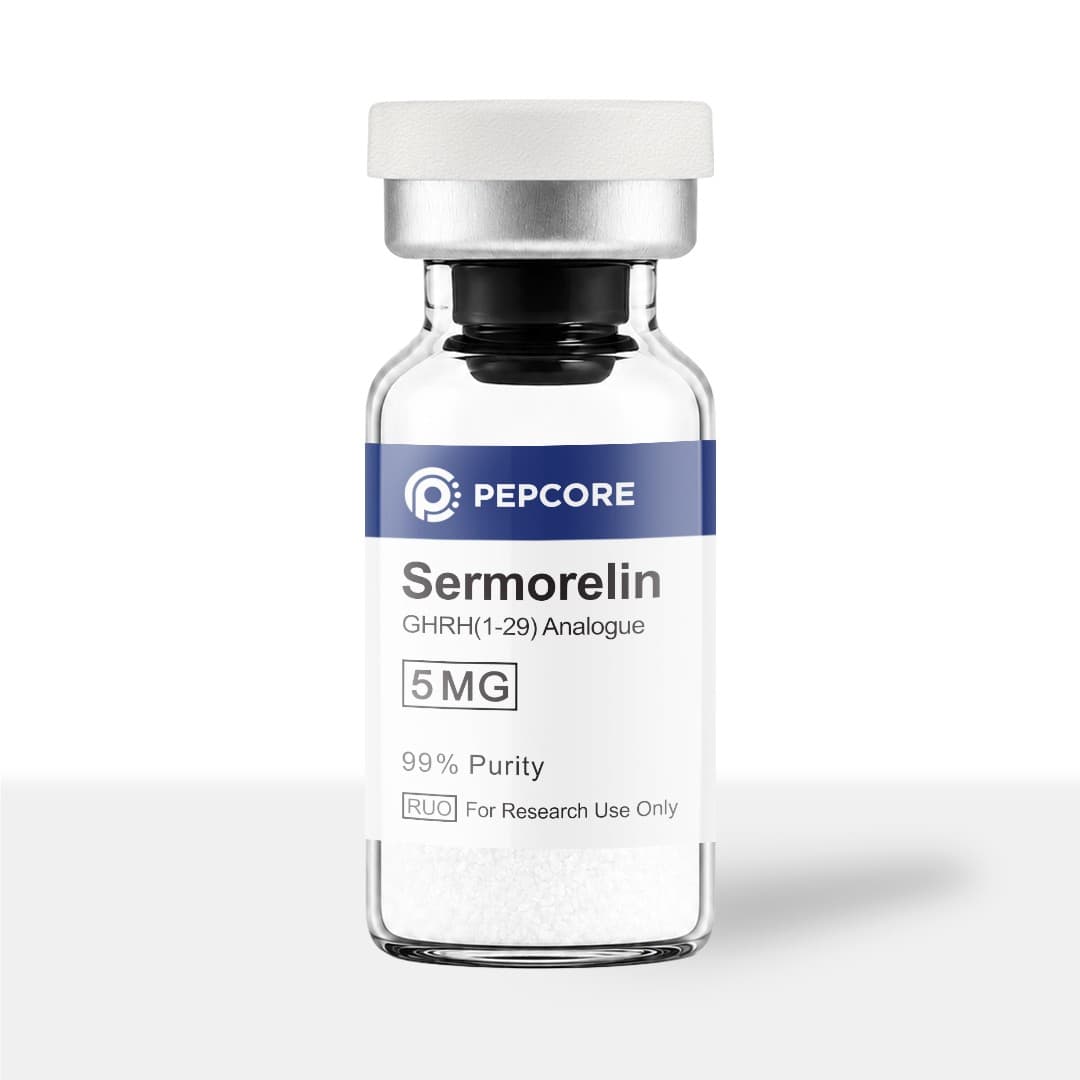
Sermorelin 5 mg
In Stock
Amount (mg)
Bacteriostatic Water
Insulin Syringes
Alcohol Swabs
Quantity
1
Price€44.00
Fast delivery, dispatched same day before 14:00
Tracked delivery, door to door
Shipped discreetly
Secure payments



Order before 14:00 for same-day shipping
Order now, ships today
OrderedToday
ShippedToday
Delivered24-25 November
Sermorelin is a lab-made peptide built from 29 amino acids, modeled on the active front portion of growth-hormone-releasing hormone (GHRH). It's best known in research for acting on the GHRH receptor in the pituitary, which makes it a handy tool for studying the growth-hormone axis.
It also has a solid research footing, with work exploring how it switches on receptor signaling inside cells (Prakash & Goa, 1999, BioDrugs). That's a big part of why it turns up so often as a reference peptide in this area.
Research Applications
•Growth-hormone axis research
•GHRH receptor studies
•Pituitary signaling models
•cAMP and PKA pathway research
Supplied as a lyophilized powder for stability.
Scientific Background
Growth-hormone-releasing hormone is a 44-amino-acid hypothalamic peptide whose N-terminal fragment retains full receptor-binding activity. Early structure-activity research identified GHRH(1-29)-NH2 as the minimum sequence capable of fully engaging the GHRH receptor on pituitary somatotrophs. Sermorelin was developed as a stabilized synthetic analog of this fragment for research use.
Subsequent investigation positioned Sermorelin as a useful tool compound for studying receptor-mediated cAMP/PKA signaling, somatotroph cellular biology, and the pulsatile output characteristic of the somatotropic axis. Because it engages GHRH-R rather than supplying exogenous growth hormone, Sermorelin has been used to investigate receptor-level pharmacology and downstream IGF-1 signaling research in a manner that preserves endogenous feedback dynamics.
This positioning at the intersection of receptor pharmacology, somatotropic-axis research, and IGF-1 signaling research has made Sermorelin a peptide of considerable interest in laboratory investigations of GHRH-receptor signaling and growth-hormone-pathway regulation.
Structure
Peptide ClassSynthetic GHRH(1-29) analog (GHRH-receptor agonist)
Amino Acid SequenceTyr-Ala-Asp-Ala-Ile-Phe-Thr-Asn-Ser-Tyr-Arg-Lys-Val-Leu-Gly-Gln-Leu-Ser-Ala-Arg-Lys-Leu-Leu-Gln-Asp-Ile-Met-Ser-Arg-NH2
Molecular FormulaC₁₄₉H₂₄₆N₄₄O₄₂S
Molecular Weight~3358 g/mol
CAS Number86168-78-7
PubChem CID16129620
SynonymsSermorelin acetate, GRF(1-29)-NH2
Mechanism of Action
GHRH-Receptor Engagement
Sermorelin binds the GHRH receptor (GHRH-R), a class B G-protein-coupled receptor expressed on anterior-pituitary somatotrophs. Receptor engagement activates Gs-coupled adenylate cyclase, elevates intracellular cAMP, and engages PKA-dependent signaling cascades involved in growth-hormone-pathway research.
cAMP/PKA Signaling Research
Through cAMP/PKA pathway activation, Sermorelin is investigated as a probe for downstream phosphorylation events, CREB-mediated transcriptional research, and somatotroph cellular signaling in laboratory models of somatotropic-axis regulation.
Pulsatile Somatotropic-Axis Modulation
Because Sermorelin engages the same receptor as endogenous GHRH, it is investigated in models where preservation of pulsatile somatotropic output is relevant to receptor-level research, including studies of somatostatin-GHRH balance and age-associated changes in pituitary responsiveness.
IGF-1 Signaling Research
By modulating upstream somatotropic-axis activity, Sermorelin is investigated as a tool compound for studying downstream IGF-1 signaling research, including PI3K/Akt and MAPK pathway engagement in cell-culture and animal research models.
Conclusion
Sermorelin represents a structurally defined GHRH(1-29) analog research peptide that engages the GHRH receptor to support investigation of cAMP/PKA-coupled somatotropic-axis signaling. Through receptor-level engagement rather than exogenous hormone supply, it serves as a useful research compound for examining growth-hormone-pathway dynamics, IGF-1 signaling research, and pulsatile receptor output in controlled laboratory models.
References
•Prakash A, Goa KL (1999). Sermorelin: a review of its use in the diagnosis and treatment of children with idiopathic growth hormone deficiency. BioDrugs. PubMed
•Ishida J. et al. (2020). Growth-hormone secretagogues: history, mechanism of action, and receptor pharmacology. JCSM Rapid Communications.
•Thorner MO et al. (1995). Neuroendocrine regulation of growth hormone secretion. Neuroscience and Biobehavioral Reviews. PubMed
•Mayo KE et al. (1995). Growth hormone-releasing hormone: synthesis and signaling. Recent Progress in Hormone Research. PubMed
•Frohman LA, Kineman RD (2002). Growth hormone-releasing hormone and pituitary development, hyperplasia and tumorigenesis. Trends in Endocrinology and Metabolism. PubMed
Research Use Disclaimer
This product is intended for research and laboratory use only. It is designed exclusively for in vitro research purposes. All information provided is for educational and research reference only. This product is not intended for human or animal use. It is not a drug, food, or cosmetic and must not be marketed, labeled, or used as such. Use and handling are restricted to trained and qualified professionals.
What is Sermorelin?
Sermorelin is a lab-made peptide built from 29 amino acids, modeled on the active front portion of growth-hormone-releasing hormone (GHRH). It is supplied as a lyophilized powder for laboratory research use only.
What is Sermorelin used for in research?
In research, Sermorelin is studied in areas such as: Growth-hormone axis research, GHRH receptor studies and Pituitary signaling models. Related compounds in our Muscle Growth range include Tesamorelin and Ipamorelin. Further reading: Tesamorelin: what it is and what it does.
Where can I buy Sermorelin?
Sermorelin is available from Pepcore, shipped from the Netherlands to every European country with tracking. A certificate of analysis is available on request.
How is Sermorelin reconstituted?
With bacteriostatic water, added slowly down the inside of the glass rather than onto the powder, then swirled gently, never shaken. Bacteriostatic water is optional when you order: you can add a 3 ml vial (+€4.99) or a 10 ml vial (+€12.99), or leave it out. Use our peptide calculator to work out the concentration for your vial size.
How is Sermorelin stored, and how long does shipping take?
Lyophilized Sermorelin is kept cool, dry and away from light. Once reconstituted, the solution is refrigerated at 2 to 8 °C, see our peptide stability guide. Orders leave the Netherlands the same or next business day: 1 to 2 business days to the Netherlands and Belgium, 2 to 7 to Germany, France, Spain, Italy and Luxembourg, 3 to 8 to the rest of the EU, free from €250, see shipping.
Amount (mg)5 mg
Bacteriostatic Water3 ml or 10 ml, optional
Insulin Syringes10× 1 ml insulin syringes, 10× 0.5 ml insulin syringes, None
Alcohol SwabsYes, No
TestingThird-party HPLC/MS
CAS86168-78-7
Netherlands & Belgium: 1-2 business days, €8.49-€12.99
Germany: 2-7 business days, €12.99
France, Spain, Italy & Luxembourg: 2-7 business days, €14.90
Rest of the EU: 3-8 business days, €14.90
Poland: 3-8 business days, €15.99
Sweden: 3-8 business days, €15.99
Switzerland, Norway, United Kingdom & other European countries outside the EU: 5-10 business days, €15.99
Canary Islands: 7-12 business days, €24.99
Free shipping on orders from €250
For laboratory and research use only.
Not for human or veterinary use, diagnosis, or treatment.
To be handled only by qualified personnel in a controlled lab setting.
By placing an order, you confirm you have read and agree to these research-use terms.
AI recommendations
Often bought together


€44.00