
Muscle Growth
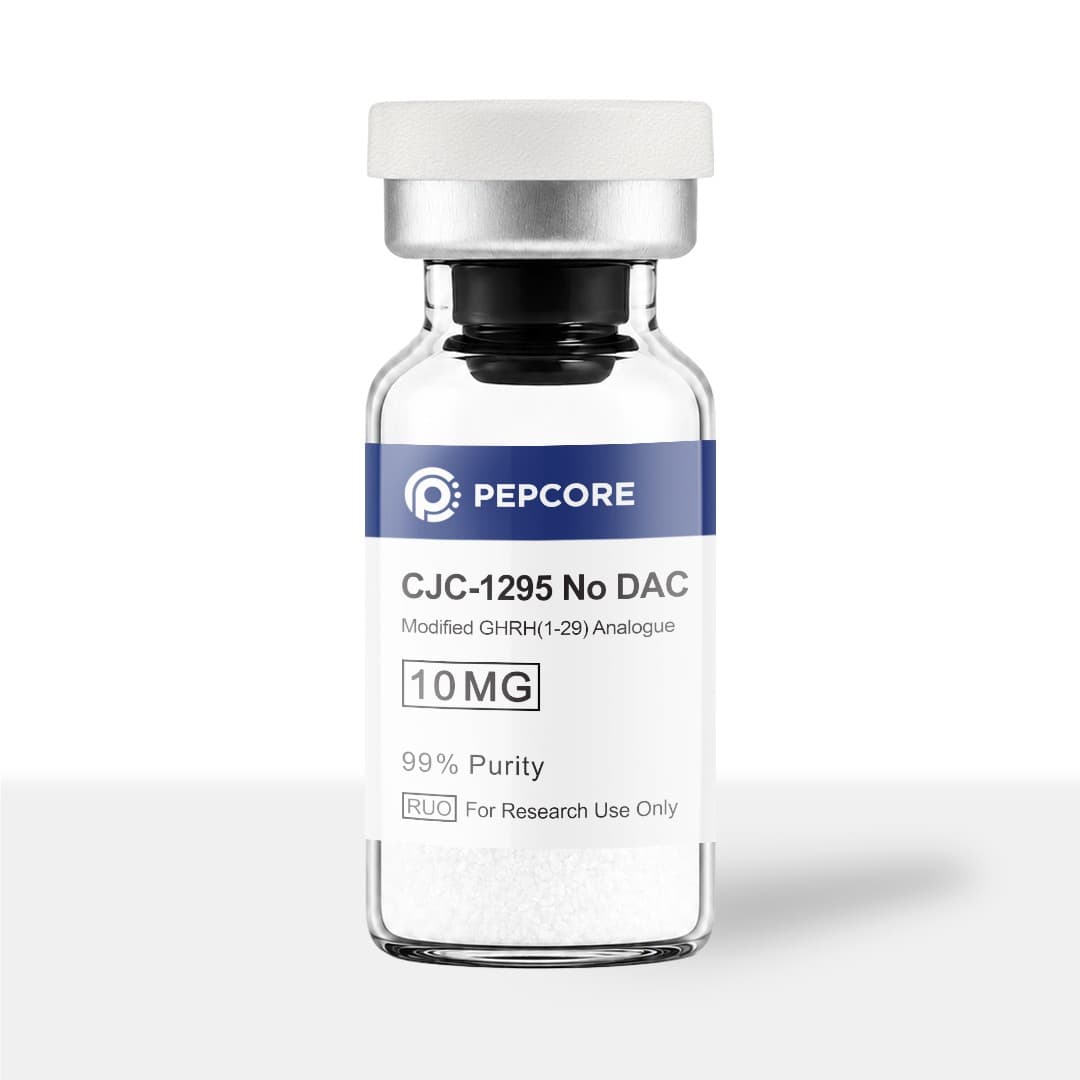
CJC-1295 No DAC 10 mg
In Stock
Amount (mg)
Bacteriostatic Water
Insulin Syringes
Alcohol Swabs
Quantity
1
Price€64.00
Fast delivery, dispatched same day before 14:00
Tracked delivery, door to door
Shipped discreetly
Secure payments



Order before 14:00 for same-day shipping
Order now, ships today
OrderedToday
ShippedToday
Delivered24-25 November
CJC-1295 No DAC, also called Modified GRF (1-29), is a lab-made peptide built from 29 amino acids that copies a short piece of the body's growth hormone-releasing hormone (GHRH). It is best known in research for its role in growth-hormone signaling, and it skips the albumin-binding linker found in the DAC version while carrying a few amino-acid swaps that make it more stable.
It also has a real research base, with work exploring how GHRH-type peptides interact with the pathways that control growth-hormone release (Ionescu & Frohman, 2006, JCEM). That makes it a common reference compound in this kind of study.
Research Applications
•Growth-hormone signaling research
•GHRH analogue studies
•Peptide stability research
•Endocrine pathway models
Supplied as a lyophilized powder for stability.
Scientific Background
Growth-hormone-releasing hormone is a hypothalamic peptide that engages the GHRH receptor, a class B G-protein-coupled receptor expressed on pituitary somatotroph cells, and participates in growth-hormone-pathway investigation. Native GHRH(1-29), also known as sermorelin, retains full receptor engagement in research models but is rapidly inactivated by dipeptidyl peptidase-IV (DPP-IV) cleavage at the N-terminal Tyr-Ala bond and by other proteolytic mechanisms, producing a plasma residency window of only a few minutes. This kinetic constraint limited laboratory investigations of GHRH-receptor signaling dynamics and motivated the design of sequence-stabilized analogs.
CJC-1295 No DAC was developed as a synthetic GHRH(1-29) analog incorporating four amino-acid substitutions: D-Ala at position 2 (DPP-IV resistance), Gln at position 8 (asparagine-rearrangement resistance), Ala at position 15 (enhanced receptor engagement), and Leu at position 27 (methionine-oxidation resistance). Unlike the DAC-conjugated variant, CJC-1295 No DAC lacks the C-terminal maleimidopropionyl-lysine albumin-binding linker, producing a plasma residency window of approximately 30 minutes, substantially longer than native GHRH(1-29) but much shorter than the multi-day window of the DAC-conjugated analog.
This intermediate-residency profile has made CJC-1295 No DAC a widely studied reference compound for laboratory investigations of pulsatile GHRH-receptor engagement, somatotropic-axis pulse-amplitude research, and comparative pharmacology versus both native GHRH(1-29) and the DAC-conjugated analog. Research interest spans pituitary somatotroph signaling models, hypothalamic-pituitary feedback research, and structure-activity studies on GHRH analog design.
Structure
Peptide ClassSynthetic GHRH(1-29) analogue (Modified GRF 1-29)
Residue Count29 amino acids
Key ModificationsD-Ala² (DPP-IV resistance), Gln⁸ (asparagine-rearrangement resistance), Ala¹⁵ (enhanced receptor engagement), Leu²⁷ (methionine-oxidation resistance)
Amino Acid SequenceTyr-D-Ala-Asp-Ala-Ile-Phe-Thr-Gln-Ser-Tyr-Arg-Lys-Val-Leu-Ala-Gln-Leu-Ser-Ala-Arg-Lys-Leu-Leu-Gln-Asp-Ile-Leu-Ser-Arg-NH₂
Molecular FormulaC₁₅₂H₂₅₂N₄₄O₄₂
Molecular Weight~3367.9 g/mol
CAS Number446036-97-1
SynonymsMod GRF (1-29), Modified GRF (1-29)
Mechanism of Action
GHRH-Receptor Engagement on Pituitary Somatotrophs
CJC-1295 No DAC engages the GHRH receptor on pituitary somatotroph cells, a class B G-protein-coupled receptor. Research models indicate that this engagement modulates Gαs-coupled signaling and adenylyl-cyclase activity, producing intracellular responses comparable to native GHRH(1-29) but with extended plasma residency due to the sequence-level modifications (Ionescu & Frohman, 2006, JCEM).
Modulation of Cyclic AMP and Downstream Kinases
Upon receptor engagement, CJC-1295 No DAC modulates intracellular cyclic AMP accumulation. Downstream, this is associated with protein kinase A activation and CREB-mediated transcription, both of which are extensively studied in somatotropic-axis research as upstream regulators of growth-hormone gene expression in pituitary somatotroph models.
Sequence-Stabilized Plasma Residency
The four amino-acid substitutions confer resistance to DPP-IV cleavage and other proteolytic mechanisms, extending plasma residency from minutes for native GHRH(1-29) to approximately 30 minutes in research models, without the multi-day extension produced by albumin bioconjugation in the DAC-conjugated variant.
Pulsatile-Preserving Signaling Pattern
Laboratory research studies have characterized CJC-1295 No DAC as engaging the GHRH receptor in a manner that produces discrete pulse-amplitude signaling in research models, rather than the prolonged tonic engagement profile of the DAC-conjugated analog. This pulse-preserving profile is an active area of structure-activity research and is investigated as a contributor to comparative somatotropic-axis dynamics versus longer-residency analogs.
Conclusion
CJC-1295 No DAC represents a sequence-stabilized GHRH(1-29) analog that occupies an intermediate-residency position between native GHRH(1-29) and the DAC-conjugated variant. Its four amino-acid substitutions confer resistance to proteolytic degradation without the multi-day extension of albumin bioconjugation, making it a valuable investigational laboratory peptide for studying pulsatile GHRH-receptor engagement, somatotropic-axis pulse dynamics, and structure-activity relationships in GHRH analog design.
References
•Ionescu M, Frohman LA (2006). Pulsatile secretion of growth hormone (GH) persists during continuous stimulation by CJC-1295, a long-acting GH-releasing hormone analog. The Journal of Clinical Endocrinology and Metabolism. PubMed
•Jetté L et al. (2005). Human growth hormone-releasing factor (hGRF)1-29-albumin bioconjugates activate the GRF receptor on the anterior pituitary in rats: identification of CJC-1295 as a long-lasting GRF analog. Endocrinology. PubMed
•Teichman SL et al. (2006). Prolonged stimulation of growth hormone (GH) and insulin-like growth factor I secretion by CJC-1295, a long-acting analog of GH-releasing hormone, in healthy adults. The Journal of Clinical Endocrinology and Metabolism. PubMed
•Alba M et al. (2006). Once-daily administration of CJC-1295, a long-acting growth hormone-releasing hormone (GHRH) analog, normalizes growth in the GHRH knockout mouse. American Journal of Physiology - Endocrinology and Metabolism. PubMed
•Campbell RM et al. (1994). Enhanced stability and potency of novel growth hormone-releasing factor (GRF) analogues derived from rodent and human GRF sequences. Peptides. PubMed
•Timms M et al. (2019). An immuno polymerase chain reaction screen for the detection of CJC-1295 and other growth-hormone-releasing hormone analogs in equine plasma. Drug Testing and Analysis. PubMed
Research Use Disclaimer
This product is intended for research and laboratory use only. It is designed exclusively for in vitro research purposes. All information provided is for educational and research reference only. This product is not intended for human or animal use. It is not a drug, food, or cosmetic and must not be marketed, labeled, or used as such. Use and handling are restricted to trained and qualified professionals.
What is CJC-1295 No DAC?
CJC-1295 No DAC, also called Modified GRF (1-29), is a lab-made peptide built from 29 amino acids that copies a short piece of the body's growth hormone-releasing hormone (GHRH). It is supplied as a lyophilized powder for laboratory research use only.
What is CJC-1295 No DAC used for in research?
In research, CJC-1295 No DAC is studied in areas such as: Growth-hormone signaling research, GHRH analogue studies and Peptide stability research. Related compounds in our Muscle Growth range include Tesamorelin and Sermorelin.
Where can I buy CJC-1295 No DAC?
CJC-1295 No DAC is available from Pepcore, shipped from the Netherlands to every European country with tracking. A certificate of analysis is available on request.
How is CJC-1295 No DAC reconstituted?
With bacteriostatic water, added slowly down the inside of the glass rather than onto the powder, then swirled gently, never shaken. Bacteriostatic water is optional when you order: you can add a 3 ml vial (+€4.99) or a 10 ml vial (+€12.99), or leave it out. Use our peptide calculator to work out the concentration for your vial size.
How is CJC-1295 No DAC stored, and how long does shipping take?
Lyophilized CJC-1295 No DAC is kept cool, dry and away from light. Once reconstituted, the solution is refrigerated at 2 to 8 °C, see our peptide stability guide. Orders leave the Netherlands the same or next business day: 1 to 2 business days to the Netherlands and Belgium, 2 to 7 to Germany, France, Spain, Italy and Luxembourg, 3 to 8 to the rest of the EU, free from €250, see shipping.
Amount (mg)10 mg
Bacteriostatic Water3 ml or 10 ml, optional
Insulin Syringes10× 1 ml insulin syringes, 10× 0.5 ml insulin syringes, None
Alcohol SwabsYes, No
TestingThird-party HPLC/MS
CAS446036-97-1
Netherlands & Belgium: 1-2 business days, €8.49-€12.99
Germany: 2-7 business days, €12.99
France, Spain, Italy & Luxembourg: 2-7 business days, €14.90
Rest of the EU: 3-8 business days, €14.90
Poland: 3-8 business days, €15.99
Sweden: 3-8 business days, €15.99
Switzerland, Norway, United Kingdom & other European countries outside the EU: 5-10 business days, €15.99
Canary Islands: 7-12 business days, €24.99
Free shipping on orders from €250
For laboratory and research use only.
Not for human or veterinary use, diagnosis, or treatment.
To be handled only by qualified personnel in a controlled lab setting.
By placing an order, you confirm you have read and agree to these research-use terms.


€64.00