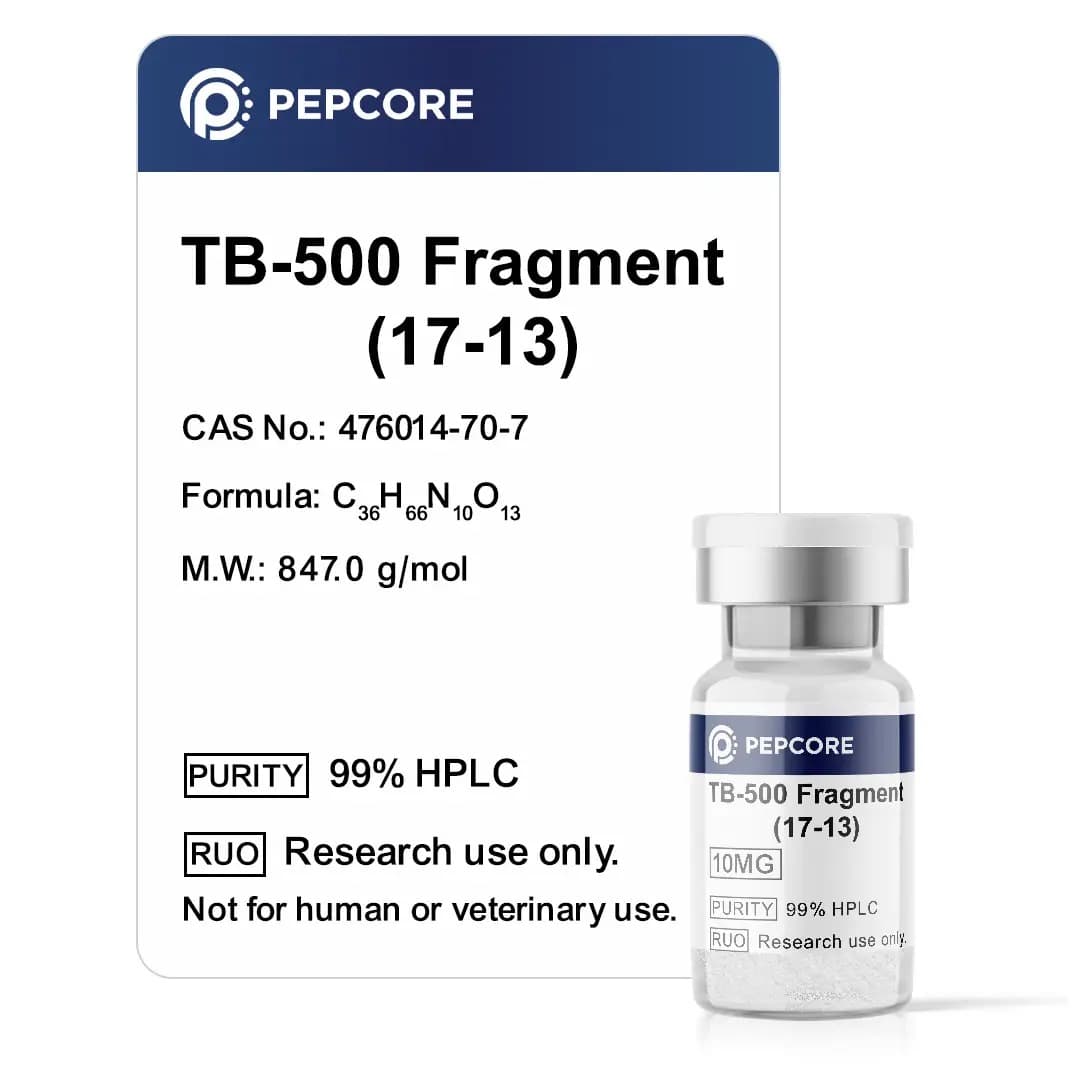
TB500 Fragment (17-13)
For in-vitro laboratory research use only. Not intended for human consumption, veterinary, diagnostic, or clinical use.




Description
TB500 Fragment (17-13) is a synthetic heptapeptide corresponding to residues 17-23 of thymosin beta-4, the central actin-binding motif of the parent 43-residue sequence. With the amino acid sequence LKKTETQ, this research peptide is supplied as a defined active-site fragment for use in actin-binding research, structure-activity research, and cellular-process research in controlled laboratory settings.
The LKKTETQ sequence has been characterized in laboratory research studies as the region of thymosin beta-4 that contributes most directly to monomeric G-actin engagement. Mutational and structural research has mapped this heptapeptide to the central actin-binding region of the parent molecule, and synthetic LKKTETQ has been investigated as a discrete research compound that retains key actin-binding research activity in cellular models (Sosne et al., 2003, FASEB Journal; Sosne et al., 2010, Annals of the New York Academy of Sciences).
In laboratory research studies, TB500 Fragment (17-13) is used to investigate how an isolated actin-binding domain compares to the full-length thymosin beta-4 sequence in cytoskeletal dynamics research, cellular-process research, and inflammatory-pathway research. The defined seven-residue structure also makes it a useful comparator in structure-activity research alongside TB-500 and other Tβ4-derived research peptides.
The peptide is supplied as a lyophilized powder to ensure optimal stability during storage and handling.