
Muscle Growth
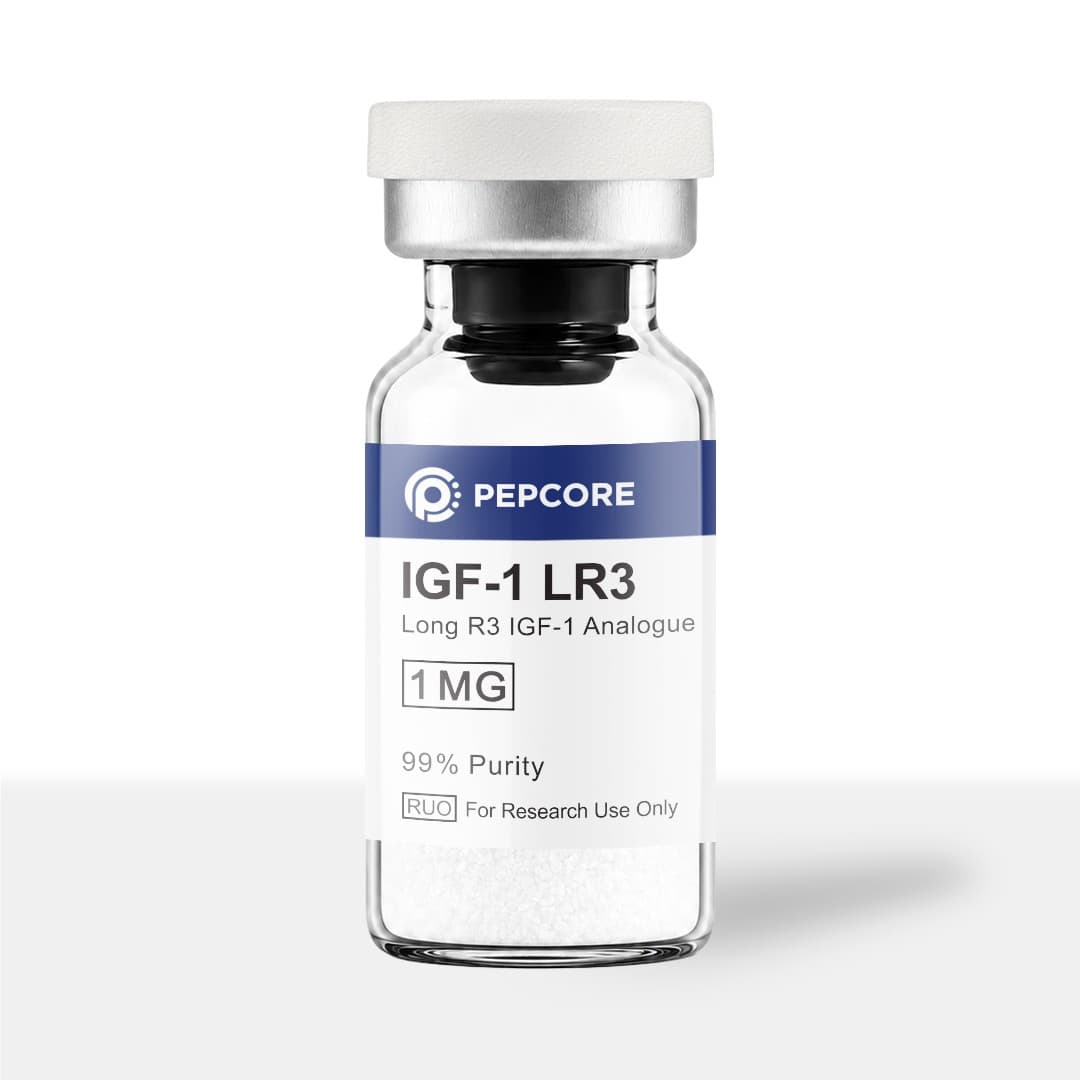
IGF-1 LR3 1 mg
In Stock
Amount (mg)
Bacteriostatic Water
Insulin Syringes
Alcohol Swabs
Quantity
1
Price€89.00
Fast delivery, dispatched same day before 14:00
Tracked delivery, door to door
Shipped discreetly
Secure payments



Order before 14:00 for same-day shipping
Order now, ships today
OrderedToday
ShippedToday
Delivered24-25 November
IGF-1 LR3 is a synthetic, modified version of insulin-like growth factor 1, built as an 83-amino-acid chain with an extra section added to one end and a single swapped building block. It is best known in research for how it activates the IGF-1 receptor, and what sets it apart is that it largely sidesteps the binding proteins that normally hold IGF-1 in check.
It rests on an established research base, including early work characterizing how this kind of analog behaves with its binding proteins (Tomas et al., 1992, Biochemical Journal). That is why it often turns up as a reference compound in growth-factor signaling studies.
Research Applications
•IGF-1 receptor signaling research
•PI3K and Akt pathway studies
•Reduced binding-protein interaction models
•Growth-factor analog research
Supplied as a lyophilized powder for stability.
Scientific Background
Native IGF-1 is a 70-amino-acid polypeptide whose circulating availability is governed by a family of six IGF-binding proteins (IGFBP-1 through IGFBP-6). Because more than 99 percent of circulating IGF-1 in laboratory research models is bound to IGFBPs, the free, receptor-engageable fraction is limited, complicating receptor-level investigation.
IGF-1 LR3 was developed in the early 1990s as an engineered IGF-1 analog combining two structural modifications: an Arg³ substitution (replacing the native Glu³ in the IGFBP-binding region) and a 13-residue N-terminal extension (MFPAMPLLSLFVN). These modifications produce an 83-amino-acid analog that retains full IGF-1R receptor affinity while exhibiting markedly reduced IGFBP binding, extending receptor-engageable availability in research models.
This positioning at the intersection of IGF-1-receptor pharmacology, IGFBP-binding research, and PI3K/Akt signaling research has made IGF-1 LR3 a peptide of considerable interest in laboratory investigations of IGF-1-pathway dynamics, cellular signaling research, and cell-culture research models.
Structure
IGF-1 LR3 Structure
Peptide ClassSynthetic 83-amino-acid IGF-1 analog; IGF-1-receptor agonist research peptide
Structural Modification13-amino-acid N-terminal extension (MFPAMPLLSLFVN) + Arg³ substitution
Molecular FormulaC₄₀₀H₆₂₅N₁₁₁O₁₁₅S₉
Molecular Weight~9111 g/mol
CAS Number946870-92-4
PubChem CID168009904
SynonymsLong R3 IGF-1, LR3 IGF-1
Mechanism of Action
IGF-1 Receptor (IGF-1R) Engagement
IGF-1 LR3 binds the type 1 insulin-like growth factor receptor (IGF-1R), a transmembrane receptor tyrosine kinase. Receptor engagement triggers autophosphorylation of intracellular tyrosine residues and recruits IRS-1, IRS-2, and Shc adapter proteins for downstream signaling research.
PI3K/Akt Signaling Research
Through IGF-1R engagement, IGF-1 LR3 is investigated as a probe for PI3K/Akt pathway activation, including mTOR-coupled signaling and downstream phosphorylation cascades involved in cellular signaling research, protein-pathway research, and laboratory models of cell-survival signaling.
MAPK/ERK Signaling Research
IGF-1 LR3 engages the Ras/Raf/MEK/ERK cascade through IGF-1R-coupled Shc/Grb2/SOS signaling, supporting research into MAPK pathway activation and downstream transcriptional research in cell-culture research models.
Reduced IGFBP Binding Profile
The Arg³ substitution and N-terminal extension reduce IGF-1 LR3 affinity for IGFBPs, increasing receptor-engageable availability in research models. This extended bioavailability supports laboratory investigation in research designs where sustained IGF-1R engagement is methodologically required.
Conclusion
IGF-1 LR3 represents a structurally engineered IGF-1 analog research peptide that engages the IGF-1 receptor while exhibiting reduced IGFBP binding. Through PI3K/Akt and MAPK/ERK signaling research applications, it serves as a useful tool compound for examining IGF-1 signaling research, receptor tyrosine kinase pharmacology, and extended-bioavailability receptor engagement in controlled laboratory research models.
References
•Tomas FM et al. (1992). Insulin-like growth factor-I (IGF-I) and especially IGF-I variants are anabolic in dexamethasone-treated rats. The Biochemical Journal. PubMed
•Francis GL et al. (1992). Novel recombinant fusion protein analogues of insulin-like growth factor (IGF)-I indicate the relative importance of IGF-binding protein and receptor binding for enhanced biological potency. Journal of Molecular Endocrinology. PubMed
•Stremming J et al. (2022). Sheep recombinant IGF-1 promotes organ-specific growth in fetal sheep. Frontiers in Physiology. PubMed
•Feng L et al. (2022). Aerobic exercise and resistance exercise alleviate skeletal muscle atrophy through IGF-1/IGF-1R-PI3K/Akt pathway in mice with myocardial infarction. American Journal of Physiology - Cell Physiology. PubMed
•Pollak M (2008). Insulin and insulin-like growth factor signalling in neoplasia. Nature Reviews Cancer. PubMed
Research Use Disclaimer
This product is intended for research and laboratory use only. It is designed exclusively for in vitro research purposes. All information provided is for educational and research reference only. This product is not intended for human or animal use. It is not a drug, food, or cosmetic and must not be marketed, labeled, or used as such. Use and handling are restricted to trained and qualified professionals.
What is IGF-1 LR3?
IGF-1 LR3 is a synthetic, modified version of insulin-like growth factor 1, built as an 83-amino-acid chain with an extra section added to one end and a single swapped building block. It is supplied as a lyophilized powder for laboratory research use only.
What is IGF-1 LR3 used for in research?
In research, IGF-1 LR3 is studied in areas such as: IGF-1 receptor signaling research, PI3K and Akt pathway studies and Reduced binding-protein interaction models. Related compounds in our Muscle Growth range include Tesamorelin and Sermorelin.
Where can I buy IGF-1 LR3?
IGF-1 LR3 is available from Pepcore, shipped from the Netherlands to every European country with tracking. A certificate of analysis is available on request.
How is IGF-1 LR3 reconstituted?
With bacteriostatic water, added slowly down the inside of the glass rather than onto the powder, then swirled gently, never shaken. Bacteriostatic water is optional when you order: you can add a 3 ml vial (+€4.99) or a 10 ml vial (+€12.99), or leave it out. Use our peptide calculator to work out the concentration for your vial size.
How is IGF-1 LR3 stored, and how long does shipping take?
Lyophilized IGF-1 LR3 is kept cool, dry and away from light. Once reconstituted, the solution is refrigerated at 2 to 8 °C, see our peptide stability guide. Orders leave the Netherlands the same or next business day: 1 to 2 business days to the Netherlands and Belgium, 2 to 7 to Germany, France, Spain, Italy and Luxembourg, 3 to 8 to the rest of the EU, free from €250, see shipping.
Amount (mg)1 mg
Bacteriostatic Water3 ml or 10 ml, optional
Insulin Syringes10× 1 ml insulin syringes, 10× 0.5 ml insulin syringes, None
Alcohol SwabsYes, No
TestingThird-party HPLC/MS
CAS946870-92-4
Netherlands & Belgium: 1-2 business days, €8.49-€12.99
Germany: 2-7 business days, €12.99
France, Spain, Italy & Luxembourg: 2-7 business days, €14.90
Rest of the EU: 3-8 business days, €14.90
Poland: 3-8 business days, €15.99
Sweden: 3-8 business days, €15.99
Switzerland, Norway, United Kingdom & other European countries outside the EU: 5-10 business days, €15.99
Canary Islands: 7-12 business days, €24.99
Free shipping on orders from €250
For laboratory and research use only.
Not for human or veterinary use, diagnosis, or treatment.
To be handled only by qualified personnel in a controlled lab setting.
By placing an order, you confirm you have read and agree to these research-use terms.
AI recommendations
Often bought together


€89.00