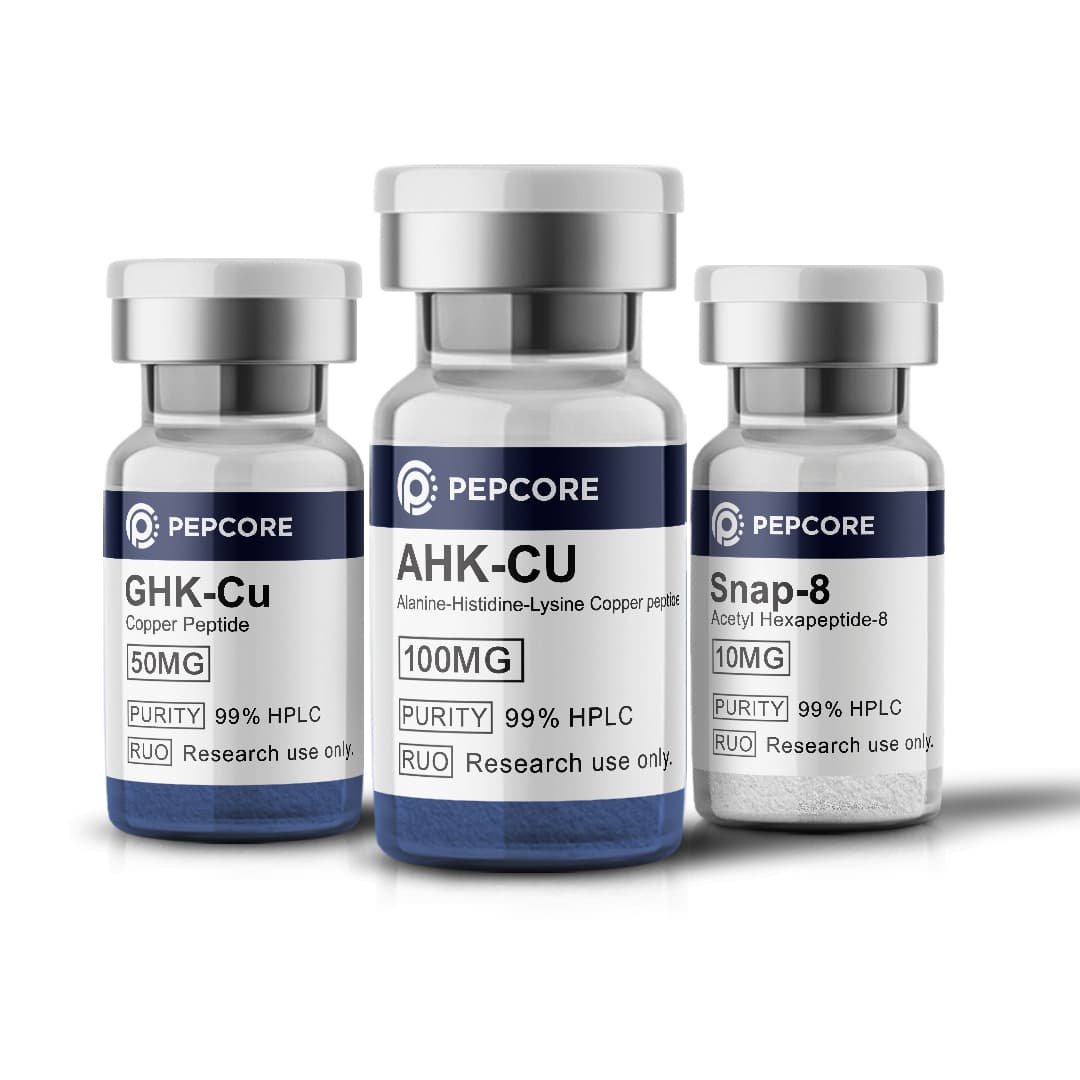
GHK-Cu + AHK-Cu + Snap-8 Bundle
For in-vitro laboratory research use only. Not intended for human consumption, veterinary, diagnostic, or clinical use.




Description
This bundle brings together 1× GHK-Cu 50 mg + 1× AHK-Cu 100 mg + 1× Snap-8 10 mg in a single research bundle, priced around 18% below buying each vial separately. Each peptide is supplied in its own individual vial, so reconstitution and handling stay fully independent per compound.
Every vial is lyophilized research-grade powder at ≥ 99% HPLC purity, with a Certificate of Analysis available on request.
For laboratory research use only. Not for human or veterinary use.
GHK-Cu 50 mg
GHK-Cu is a naturally occurring copper-binding tripeptide composed of glycine, histidine, and lysine. It is classified as a bioactive tripeptide-copper complex widely studied for its role in tissue remodeling and cellular signaling research.
In biological systems, GHK binds copper ions to form the bioactive GHK-Cu complex, which functions as a signaling molecule involved in maintaining tissue integrity. The peptide influences extracellular matrix remodeling by stimulating collagen synthesis and modulating matrix metalloproteinase activity. It also engages TGF-beta signaling pathways and supports endothelial-related cellular responses. At the genomic level, GHK-Cu has been shown to influence gene expression patterns associated with aging and cellular renewal.
Research interest in GHK-Cu focuses on its ability to influence extracellular matrix remodeling, stimulate collagen synthesis, modulate inflammatory signaling, and support [cellular renewal processes](/product/pinealon-20-mg). Investigations have documented its capacity to reset gene expression patterns associated with aging, activating protective and cellular-pathway genes ([Pickart & Margolina, 2018, International Journal of Molecular Sciences](https://pubmed.ncbi.nlm.nih.gov/29986520/)). Due to its broad biological activity, GHK-Cu is frequently investigated in cellular-pathway biology, skin physiology, and age-related tissue degeneration models. It remains a foundational compound in connective tissue and aging research. See also: Epitalon, Snap-8, MOTS-c 10 mg
AHK-Cu 100 mg
AHK-Cu is a synthetic copper-binding tripeptide composed of alanine, histidine, and lysine. It is classified as a tripeptide-copper complex structurally related to GHK-Cu, differing in the substitution of alanine for glycine at the N-terminus. AHK-Cu is investigated in cosmetic peptide research and hair follicle research models.
In biological systems, AHK binds copper ions to form the bioactive AHK-Cu complex, which functions as a signaling molecule in cellular research models. The peptide engages copper-dependent enzymatic processes, supports endothelial-related cellular responses, and has been studied for its influence on dermal papilla cell signaling pathways. The compact tripeptide-copper structure positions AHK-Cu as a useful comparative research compound alongside other copper-binding peptides.
Research interest in AHK-Cu focuses on hair follicle research, dermal papilla cell models, VEGF and angiogenic-pathway signaling research, and copper-dependent cellular signaling. Comparative research with [GHK-Cu](/product/ghk-cu) explores how the N-terminal residue substitution influences copper-peptide signaling profiles in cellular-pathway research and cosmetic peptide research contexts. See also: GHK-Cu, Snap-8, Pinealon 20 mg
Snap-8 10 mg
Snap-8 (Acetyl Octapeptide-3) is a synthetic eight-amino-acid peptide modeled on the N-terminal sequence of the SNAP-25 protein. It is classified as a cosmetic-research peptide and is structurally extended from the earlier hexapeptide Argireline, with two additional residues that influence binding interactions in laboratory models. Snap-8 is studied as a topical-research compound in the context of skin-surface science, often alongside GHK-Cu epidermal research peptides.
At the molecular level, Snap-8 is investigated for its ability to compete with native SNAP-25 within the SNARE complex, the protein assembly responsible for vesicle docking and acetylcholine release at neuromuscular junctions. In research skin models, this competitive interaction is examined as a way to attenuate the formation of fully functional SNARE complexes, thereby influencing contraction-related signaling in cultured cell systems. The peptide is non-toxic in standard cosmetic-research assays and is positioned as an alternative-pathway compound to botulinum-toxin (BoNT/A) research models.
Snap-8 is actively studied in cosmetic-research and topical-delivery contexts, particularly in formulations designed for expression-line research, surface-texture investigation, and skin-barrier modeling. Studies on the parent hexapeptide demonstrated significant influence on expression-line measurements in controlled laboratory protocols, supporting interest in the extended Snap-8 sequence as a related research tool ([Blanes-Mira et al., 2002, International Journal of Cosmetic Science](https://pubmed.ncbi.nlm.nih.gov/18498498/)). Research groups continue to evaluate Snap-8 in stability, penetration, and formulation-compatibility studies relevant to topical research models, and it is often referenced alongside the [Glow blend epidermal research formulation](/product/glow-blend) and [KPV cosmetic-adjacent inflammation research](/product/kpv-10-mg). See also: GHK-Cu, Epitalon, Cartalax 20 mg
Scientific Background
GHK-Cu + AHK-Cu + Snap-8 Bundle combines 3 research compounds: GHK-Cu 50 mg, AHK-Cu 100 mg, Snap-8 10 mg. Scientific background for each component is documented below.
GHK-Cu 50 mg
GHK was first identified in human plasma and later recognized for its strong affinity for copper ions. The GHK-Cu complex naturally occurs in tissues and fluids, where it participates in signaling pathways related to cellular-response research. Levels of GHK decline with age, which has led to scientific interest in its role in age-related loss of tissue cellular-pathway capacity.
Experimental studies have demonstrated that GHK-Cu can influence the expression of a wide range of genes involved in cell growth, antioxidant defense, inflammatory signaling control, and extracellular matrix organization. These properties have positioned GHK-Cu as an important research compound in studies of cellular-process signaling, skin aging, and connective tissue biology.
AHK-Cu 100 mg
AHK is a tripeptide composed of alanine, histidine, and lysine. The AHK-Cu complex forms when AHK binds a copper ion, creating a bioactive copper-peptide signaling molecule that has been studied alongside the more extensively characterized GHK-Cu tripeptide. The two compounds share the histidine-lysine C-terminal motif required for copper coordination, but differ at the N-terminus, where AHK substitutes alanine for the glycine residue found in GHK.
Experimental studies have investigated AHK-Cu in dermal papilla cell research models, where it has been examined for its influence on growth-related signaling and VEGF-pathway expression. AHK-Cu is also investigated for copper transport, antioxidant defense pathway research, and cellular-pathway signaling within cosmetic and dermatological research contexts.
The structural similarity to GHK-Cu and the substitution of alanine for glycine at the N-terminus has positioned AHK-Cu as a useful comparative research compound for laboratory studies of copper-peptide pharmacology, hair follicle research, and follicle-pathway research.
Snap-8 10 mg
The development of Snap-8 emerged from a broader research direction in the early 2000s that sought peptide-based alternatives to neurotoxin-based research models for studying expression-line biology. Researchers at the Universidad Miguel Hernández identified a short hexapeptide segment (Argireline) derived from the N-terminus of SNAP-25 that was capable of mimicking the binding interface of this protein within the SNARE complex. Snap-8 was developed as an extended octapeptide built on the same conceptual framework.
Further work in cosmetic-science laboratories characterized the binding affinity, stability, and topical-formulation behavior of Snap-8. By extending the sequence to eight residues, formulators sought to improve interaction with the SNARE complex while retaining the favorable safety profile observed for the shorter parent peptide. Comparative studies have explored differences in binding kinetics, hydrolytic stability, and surface-penetration behavior between Argireline and Snap-8 in cell-free and skin-model systems.
Today, Snap-8 occupies a defined position within the cosmetic-research peptide category. It is referenced in topical-delivery research, formulation-compatibility studies, and SNARE-pathway investigations, and continues to be evaluated as a research tool for laboratories investigating peptide-based alternatives to neurotoxin research models.
Structure
GHK-Cu + AHK-Cu + Snap-8 Bundle is supplied as a homogeneous lyophilized mixture. Structural details for each compound:
GHK-Cu 50 mg
AHK-Cu 100 mg
Snap-8 10 mg
Mechanism of Action
Each compound in GHK-Cu + AHK-Cu + Snap-8 Bundle engages distinct biochemical targets. Mechanism of action per compound:
GHK-Cu 50 mg
1. Copper Transport and Delivery
GHK binds copper ions and facilitates their safe transport and delivery to cells, supporting copper-dependent enzymatic processes essential for cellular-process research and antioxidant defense.
2. Extracellular Matrix Regulation
GHK-Cu has been shown to stimulate collagen, elastin, and proteoglycan synthesis while simultaneously regulating matrix metalloproteinases, contributing to balanced tissue remodeling.
3. Modulation of Inflammatory Signaling
Research indicates that GHK-Cu may help regulate inflammatory pathways by reducing pro-inflammatory cytokine activity and supporting inflammatory-pathway gene expression profiles.
4. Gene Expression and Cellular Renewal
GHK-Cu influences the expression of genes associated with cell survival, differentiation, and cellular signaling research, supporting cellular turnover and tissue maintenance.
Research Applications
Conclusion
GHK-Cu is a copper-binding tripeptide investigated for its role in cellular-process research, extracellular matrix regulation, and gene expression associated with cellular-response signaling. By supporting copper-dependent biological processes, modulating inflammatory signaling, and promoting structural protein synthesis, GHK-Cu represents a foundational research compound in cellular-pathway biology and aging-related tissue studies.
AHK-Cu 100 mg
1. Copper Transport and Delivery
AHK binds copper ions and facilitates their safe transport and delivery to cellular research models, supporting copper-dependent enzymatic processes essential for cellular-process research and antioxidant defense research.
2. Dermal Papilla Cell Signaling Research
AHK-Cu has been investigated in hair follicle research models, particularly dermal papilla cell cultures, where it is studied for its role in growth-related signaling and cellular activity in follicle-pathway research.
3. VEGF and Vascular Pathway Research
Research has examined AHK-Cu for its association with VEGF (vascular endothelial growth factor) expression and angiogenic-pathway signaling in cellular models, which is relevant to follicle research and dermal cellular-pathway research contexts.
4. Comparative Copper-Peptide Research
AHK-Cu is frequently studied alongside GHK-Cu as a comparative copper-peptide research compound, allowing investigation of how N-terminal residue substitution (alanine versus glycine) influences copper-peptide signaling profiles in cellular research models.
Research Applications
Conclusion
AHK-Cu is a copper-binding tripeptide investigated for its role in hair follicle research, copper transport, and comparative copper-peptide pharmacology research. Its structural similarity to GHK-Cu and substitution of alanine for glycine at the N-terminus makes AHK-Cu a useful research compound for laboratory studies of copper-peptide signaling and follicle-related research models.
Snap-8 10 mg
1. SNARE-Complex Competitive Interaction
Snap-8 is studied for its capacity to compete with endogenous SNAP-25 in the assembly of the SNARE complex. In research models, this competitive interaction is examined as a mechanism that attenuates the efficiency of vesicle-fusion machinery, which in turn modulates signaling outputs associated with muscle contraction at the cellular level.
2. Acetylcholine-Release Signaling in Cellular Models
By influencing SNARE-complex formation, Snap-8 is investigated for its downstream effects on acetylcholine release in laboratory neuromuscular-junction models. Reduced vesicle-fusion efficiency in these in vitro systems is associated with diminished contraction-related signaling, providing a research framework distinct from neurotoxin-based experimental approaches.
3. Topical-Penetration and Surface-Layer Behavior
Snap-8 is characterized in formulation-research contexts for its behavior in topical carrier systems. Investigations examine its stability in cosmetic emulsions, compatibility with common excipients, and surface-layer penetration in skin-model assays such as Franz-cell diffusion studies. These properties make it a useful reference compound in topical-peptide research.
4. Expression-Line and Skin-Surface Research
In cosmetic-research models, Snap-8 is studied for its potential influence on visible expression-line metrics in controlled laboratory protocols. Research instruments measure micro-relief, surface texture, and contraction-related skin parameters in standardized cohorts, providing a quantitative readout of peptide activity in surface-research contexts.
Research Applications
Conclusion
Snap-8 is a synthetic octapeptide of considerable interest in cosmetic and topical-peptide research. Its position as a SNAP-25-derived sequence allows researchers to study SNARE-complex biology and contraction-related signaling in controlled laboratory settings. Continued investigation supports its role as a reference tool in topical-peptide and surface-research model studies.
References
Published references for each compound in GHK-Cu + AHK-Cu + Snap-8 Bundle, listed by component:
GHK-Cu 50 mg
AHK-Cu 100 mg
Snap-8 10 mg
Related products
Articles you might find useful

Peptide Longevity Research: Cellular Aging Overview
Senescence, telomere shortening, mitochondrial decline: how research peptides give scientists n…
GHK-Cu vs Snap-8: Cosmetic Research Comparison
Two cosmetic research peptides with different mechanisms: GHK-Cu modulates extracellular matrix…
Semaglutide vs Tirzepatide: Research Comparison
Comparing semaglutide's selective GLP-1 action with tirzepatide's dual GIP/GLP-1 agonism, and w…