Bioregulators
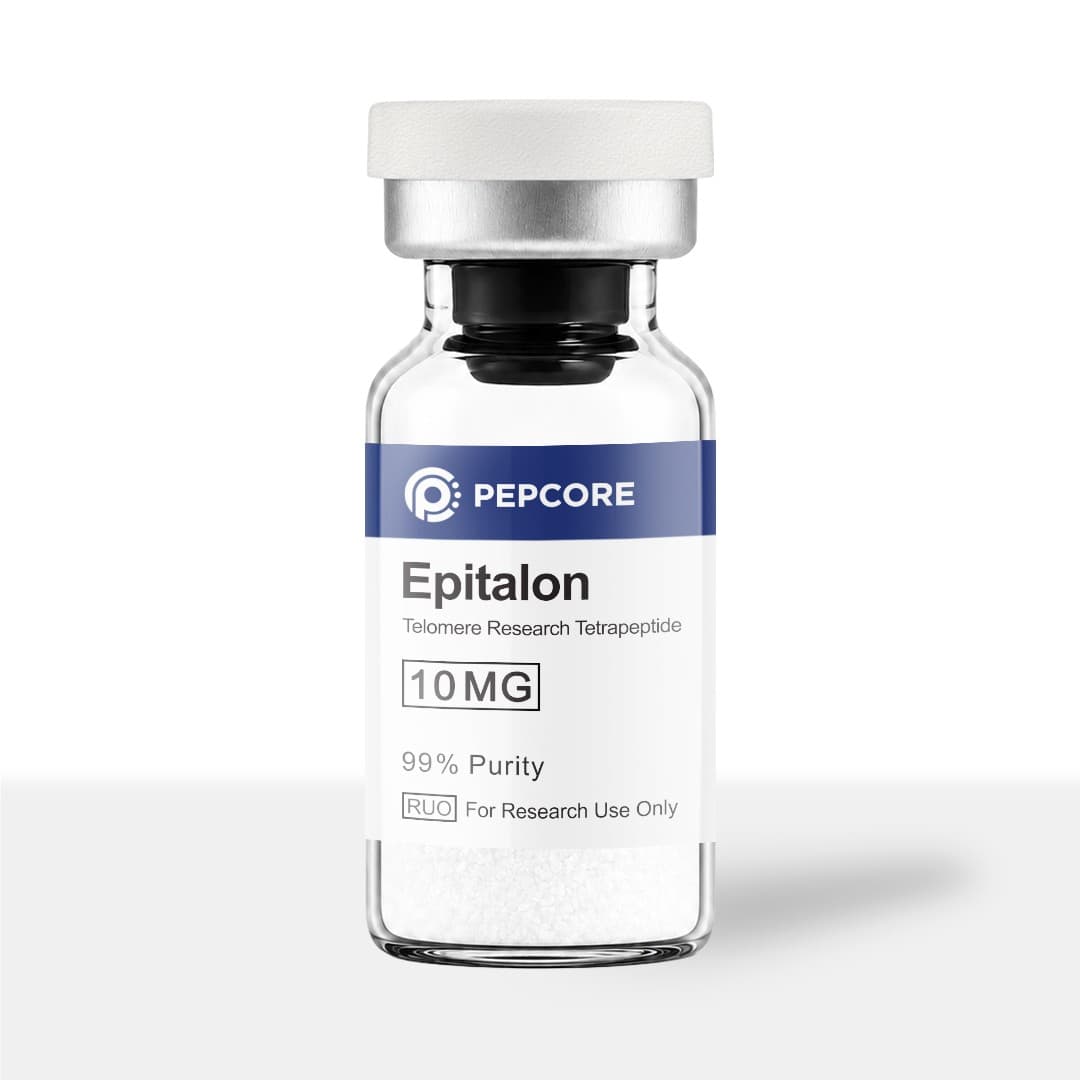
Epitalon
In Stock
Amount (mg)
Bacteriostatic Water
Insulin Syringes
Alcohol Swabs
Quantity
1
Price€54.00
Fast delivery, dispatched same day before 14:00
Tracked delivery, door to door
Shipped discreetly
Secure payments



Order before 14:00 for same-day shipping
Order now, ships today
OrderedToday
ShippedToday
Delivered24-25 November
Epitalon is a synthetic bioregulator peptide built from just four amino acids in the sequence Ala-Glu-Asp-Gly (you may also see it written as Epithalon or the Khavinson tetrapeptide AEDG). It's best known in research circles for its links to pineal-gland signaling and telomere biology, which is the trait that makes it stand out from most other short peptides.
It also carries a real research footprint, with foundational lab work tracing back decades (Khavinson et al., 2003, Bull Exp Biol Med). That history is why it keeps appearing in studies on aging-related cellular models.
Research Applications
•Pineal-gland signaling research
•Telomere-biology studies
•Gene-expression research models
•Age-related cellular research
Supplied as a lyophilized powder for stability.
Scientific Background
The concept of peptide bioregulators emerged from research at the Saint Petersburg Institute of Bioregulation and Gerontology, where short peptides were proposed as tissue-specific signaling molecules capable of modulating gene expression and cellular homeostasis. Epitalon was designed as a synthetic analog of the pineal preparation epithalamin, with the goal of reproducing pineal-tropic regulatory activity using a defined tetrapeptide.
Subsequent studies demonstrated that the AEDG sequence can interact with chromatin-associated structures and influence the transcription of telomerase and other genes linked to cellular renewal. These observations placed Epitalon at the intersection of telomere biology, pineal endocrinology, and circadian regulation.
Its sustained presence in biogerontology research reflects continued interest in compact peptide bioregulators that modulate age-related transcriptional programs through pineal-tropic and chromatin-level mechanisms.
Structure
Peptide ClassSynthetic pineal-tropic tetrapeptide bioregulator
Amino Acid SequenceAla-Glu-Asp-Gly (AEDG)
Molecular FormulaC₁₄H₂₂N₄O₉
Molecular Weight~390.4 g/mol
CAS Number307297-39-8
Common IdentifiersEpitalon, Epithalon, Khavinson tetrapeptide AEDG
Mechanism of Action
Telomerase Regulation and Telomere Maintenance
Epitalon is studied for its ability to influence the expression of the human telomerase catalytic subunit (hTERT) in somatic cell research models. By engaging chromatin regions associated with the telomerase locus, the AEDG sequence has been reported to support telomere elongation and to extend replicative capacity in cultured fibroblasts, providing a research tool for examining the molecular boundaries of cellular lifespan.
Pineal-Tropic Gene Expression
As a designed analog of pineal-derived epithalamin, Epitalon is investigated for tissue-tropic effects on the pineal gland and downstream neuroendocrine targets. Research models examine how the peptide modulates transcription of genes linked to melatonin biosynthesis, circadian oscillators, and pineal-pituitary signaling cascades.
Melatonin-Pathway and Circadian Signaling
Experimental studies have explored Epitalon as a modulator of melatonin-pathway activity, including its influence on rhythmic patterns of melatonin secretion and on the expression of clock genes in pineal and peripheral tissues. These investigations support its use as a research probe for circadian biology and age-related disruption of rhythmic output.
Oxidative Balance and Cellular-Adaptation Signaling
Beyond telomere and pineal effects, Epitalon has been examined in models of oxidative stress and cellular adaptation. Reported observations include modulation of antioxidant enzyme activity, mitochondrial-stability markers, and stress-response gene expression in aging cellular research models, contributing to its profile as a multi-pathway bioregulator.
Conclusion
Epitalon is a synthetic AEDG tetrapeptide that occupies a central position in pineal-tropic bioregulator research. Through its reported influence on telomerase activity, pineal-tropic gene expression, melatonin-pathway signaling, and cellular-adaptation pathways, it serves as a compact research tool for investigating the molecular mechanisms of cellular longevity and age-related neuroendocrine regulation.
References
•Khavinson VKh et al. (2003). Epithalon peptide induces telomerase activity and telomere elongation in human somatic cells. Bulletin of Experimental Biology and Medicine. PubMed
•Anisimov VN, Khavinson VKh (2010). Peptide bioregulation of aging: results and prospects. Biogerontology. PubMed
•Khavinson V et al. (2020). AEDG Peptide (Epitalon) Stimulates Gene Expression and Protein Synthesis during Neurogenesis: Possible Epigenetic Mechanism. Molecules. PubMed
•Khavinson VKh et al. (2014). [Peptides and CCL11 and HMGB1 as molecular markers of aging: literature review and own data]. Advances in Gerontology. PubMed
•Goncharova ND et al. (2005). Pineal peptides restore the age-related disturbances in hormonal functions of the pineal gland and the pancreas. Experimental Gerontology. PubMed
•Yue X et al. (2022). Epitalon protects against post-ovulatory aging-related damage of mouse oocytes in vitro. Aging (Albany NY). PubMed
Research Use Disclaimer
This product is intended for research and laboratory use only. It is designed exclusively for in vitro research purposes. All information provided is for educational and research reference only. This product is not intended for human or animal use. It is not a drug, food, or cosmetic and must not be marketed, labeled, or used as such. Use and handling are restricted to trained and qualified professionals.
What is Epitalon?
Epitalon is a synthetic bioregulator peptide built from just four amino acids in the sequence Ala-Glu-Asp-Gly (you may also see it written as Epithalon or the Khavinson tetrapeptide AEDG). It is supplied as a lyophilized powder for laboratory research use only.
What is Epitalon used for in research?
In research, Epitalon is studied in areas such as: Pineal-gland signaling research, Telomere-biology studies and Gene-expression research models. Related compounds in our Bioregulators range include Thymogen and Testagen.
Where can I buy Epitalon?
Epitalon is available from Pepcore, shipped from the Netherlands to every European country with tracking. A certificate of analysis is available on request.
How is Epitalon reconstituted?
With bacteriostatic water, added slowly down the inside of the glass rather than onto the powder, then swirled gently, never shaken. Bacteriostatic water is optional when you order: you can add a 3 ml vial (+€4.99) or a 10 ml vial (+€12.99), or leave it out. Use our peptide calculator to work out the concentration for your vial size.
How is Epitalon stored, and how long does shipping take?
Lyophilized Epitalon is kept cool, dry and away from light. Once reconstituted, the solution is refrigerated at 2 to 8 °C, see our peptide stability guide. Orders leave the Netherlands the same or next business day: 1 to 2 business days to the Netherlands and Belgium, 2 to 7 to Germany, France, Spain, Italy and Luxembourg, 3 to 8 to the rest of the EU, free from €250, see shipping.
Amount (mg)10 mg, 50 mg
Bacteriostatic Water3 ml or 10 ml, optional
Insulin Syringes10× 1 ml insulin syringes, 10× 0.5 ml insulin syringes, None
Alcohol SwabsYes, No
TestingThird-party HPLC/MS
CAS307297-39-8
Netherlands & Belgium: 1-2 business days, €8.49-€12.99
Germany: 2-7 business days, €12.99
France, Spain, Italy & Luxembourg: 2-7 business days, €14.90
Rest of the EU: 3-8 business days, €14.90
Poland: 3-8 business days, €15.99
Sweden: 3-8 business days, €15.99
Switzerland, Norway, United Kingdom & other European countries outside the EU: 5-10 business days, €15.99
Canary Islands: 7-12 business days, €24.99
Free shipping on orders from €250
For laboratory and research use only.
Not for human or veterinary use, diagnosis, or treatment.
To be handled only by qualified personnel in a controlled lab setting.
By placing an order, you confirm you have read and agree to these research-use terms.


€54.00