
Recovery & Repair
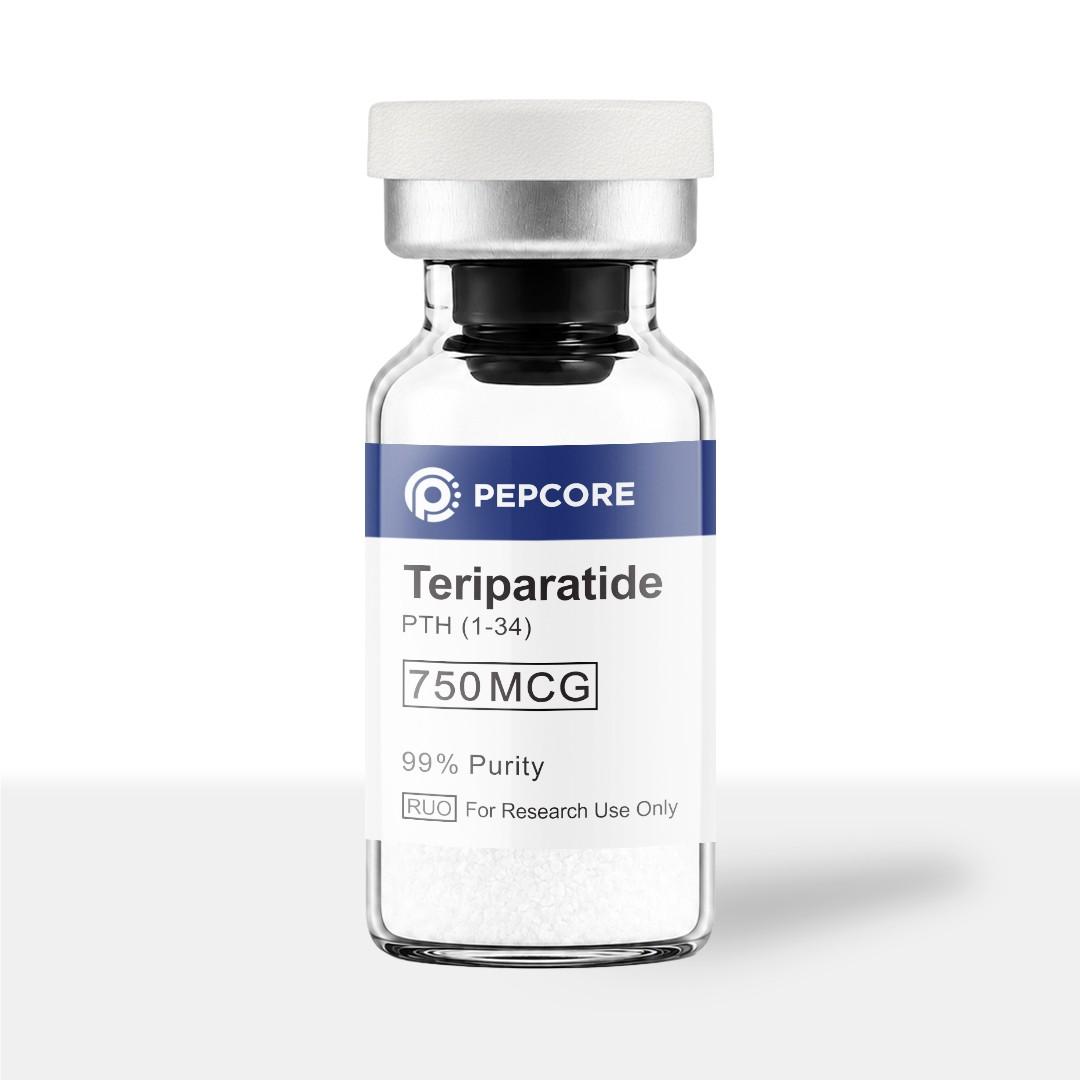
Teriparatide 750 mcg
In Stock
Size
Bacteriostatic Water
Insulin Syringes
Alcohol Swabs
Quantity
1
Price€59.00
Fast delivery, dispatched same day before 14:00
Tracked delivery, door to door
Shipped discreetly
Secure payments



Order before 14:00 for same-day shipping
Order now, ships today
OrderedToday
ShippedToday
Delivered24-25 November
Teriparatide is the active 1-34 fragment of human parathyroid hormone (PTH), a 34-amino-acid peptide that binds PTH1R, the parathyroid hormone receptor on bone and kidney cells. In research it is known as the classic bone-anabolic peptide: short, intermittent exposure switches on osteoblasts and new bone formation, which is why it is used in bone remodelling, bone formation and calcium-balance models.
Teriparatide is studied for how PTH1R signalling builds bone rather than breaking it down, with published work showing that intermittent exposure raises bone formation by keeping osteoblasts alive longer in laboratory models (Jilka et al., 1999, J Clin Invest).
Research Applications
•Studied in bone formation and osteoblast models
•Relevant in research on intermittent versus continuous PTH1R exposure
•Examined in bone remodelling and calcium-phosphate homeostasis studies
•Applied in PTH1R signalling and receptor-conformation work alongside abaloparatide
Supplied as a lyophilized powder for stability.
Scientific Background
Parathyroid hormone (PTH) is the body's main regulator of blood calcium. Released by the parathyroid glands, the 84-amino-acid hormone acts on bone and kidney through a single receptor, PTH1R, to release calcium from the skeleton, retain it in the kidney and raise active vitamin D. Early work showed that almost all of this activity sits in the first 34 amino acids of the chain.
Teriparatide is that 1-34 fragment. Its research value comes from a paradox seen in laboratory models: continuous exposure to PTH drives bone resorption, while brief, intermittent exposure produces the opposite, a net gain in bone formation. The deciding factor is time. Short, repeated peaks switch on osteoblast genes, whereas sustained levels shift the balance toward osteoclast-driven breakdown.
This anabolic window made teriparatide the reference compound for studying how bone is built. Work with it has mapped PTH1R signalling from the receptor to the osteoblast, and side-by-side studies with abaloparatide, a PTHrP-based analogue, have shown how two ligands of the same receptor can favour different receptor conformations and different signalling durations.
Structure
Peptide ClassParathyroid hormone fragment (PTH1R agonist)
Amino Acid SequenceSVSEIQLMHNLGKHLNSMERVEWLRKKLQDVHNF
Molecular FormulaC₁₈₁H₂₉₁N₅₅O₅₁S₂
Molecular Weight4117.7 g/mol
CAS Number52232-67-4
PubChem CID16133850
Mechanism of Action
PTH1R Binding and Gs/cAMP Signalling
Teriparatide binds the PTH type 1 receptor (PTH1R), a class B G protein-coupled receptor on osteoblasts, osteocytes and renal tubule cells. The C-terminal part of the peptide docks onto the receptor's extracellular domain while the N-terminal residues engage the transmembrane core, activating Gs, raising cAMP and switching on protein kinase A (PKA). PTH1R also couples to Gq/phospholipase C and recruits β-arrestins, which regulate receptor internalization and ERK signalling in research models.
Receptor Conformations and Signal Duration
PTH1R can adopt two high-affinity states: RG, the G protein-coupled form, and R0, a form that stays bound to the ligand after the G protein is released. Teriparatide binds R0 with relatively high affinity, so the ligand-receptor complex is carried into endosomes where it keeps producing cAMP. Abaloparatide favours RG and gives a shorter cAMP response in cell studies, a contrast that makes the pair a standard model for ligand-dependent signal timing.
Intermittent Versus Continuous Exposure
In rodent models, brief, intermittent exposure to hPTH(1-34) builds bone, while continuous exposure increases osteoclast-driven resorption. Short signalling pulses favour osteoblast programmes, including suppression of the Wnt inhibitor sclerostin and pro-survival signals that reduce osteoblast apoptosis, whereas sustained signalling raises RANKL relative to osteoprotegerin and tips remodelling toward breakdown.
Bone Formation and Mineral Homeostasis
Intermittent PTH1R activation recruits bone-lining cells, lengthens osteoblast lifespan and increases bone formation markers such as osteocalcin and P1NP in laboratory studies. In the kidney, the same receptor increases calcium reabsorption, lowers phosphate reabsorption and stimulates 1α-hydroxylase, the enzyme that produces active vitamin D, which is why teriparatide is also used in calcium and phosphate homeostasis models.
Conclusion
Teriparatide is a well-characterized peptide that gives researchers direct control over PTH1R, the receptor at the centre of bone remodelling and mineral balance. Because its effect depends on the timing of exposure and on the receptor conformation it engages, it provides a versatile tool for bone formation, remodelling and receptor-signalling research, and a natural reference point for comparison with abaloparatide.
References
•Jilka RL et al. (1999). Increased bone formation by prevention of osteoblast apoptosis with parathyroid hormone. Journal of Clinical Investigation. PubMed
•Frolik CA et al. (2003). Anabolic and catabolic bone effects of human parathyroid hormone (1-34) are predicted by duration of hormone exposure. Bone. PubMed
•Ferrandon S et al. (2009). Sustained cyclic AMP production by parathyroid hormone receptor endocytosis. Nature Chemical Biology. PubMed
•Hattersley G et al. (2016). Binding Selectivity of Abaloparatide for PTH-Type-1-Receptor Conformations and Effects on Downstream Signaling. Endocrinology. PubMed
Research Use Disclaimer
This product is intended for research and laboratory use only. It is designed exclusively for in vitro research purposes. All information provided is for educational and research reference only. This product is not intended for human or animal use. It is not a drug, food, or cosmetic and must not be marketed, labeled, or used as such. Use and handling are restricted to trained and qualified professionals.
What is Teriparatide 750 mcg?
Teriparatide is the active 1-34 fragment of human parathyroid hormone (PTH), a 34-amino-acid peptide that binds PTH1R, the parathyroid hormone receptor on bone and kidney cells. It is supplied as a lyophilized powder for laboratory research use only.
What is Teriparatide 750 mcg used for in research?
In research, Teriparatide 750 mcg is studied in bone formation and osteoblast models, in research on intermittent versus continuous PTH1R exposure as well as in bone remodelling and calcium-phosphate homeostasis studies. Related compounds in our Recovery & Repair range include TB-500 and Glutathione.
Where can I buy Teriparatide 750 mcg?
Teriparatide 750 mcg is available from Pepcore, shipped from the Netherlands to every European country with tracking. A certificate of analysis is available on request.
How is Teriparatide 750 mcg reconstituted?
With bacteriostatic water, added slowly down the inside of the glass rather than onto the powder, then swirled gently, never shaken. Bacteriostatic water is optional when you order: you can add a 3 ml vial (+€4.99) or a 10 ml vial (+€12.99), or leave it out. Use our peptide calculator to work out the concentration for your vial size.
How is Teriparatide 750 mcg stored, and how long does shipping take?
Lyophilized Teriparatide 750 mcg is kept cool, dry and away from light. Once reconstituted, the solution is refrigerated at 2 to 8 °C, see our peptide stability guide. Orders leave the Netherlands the same or next business day: 1 to 2 business days to the Netherlands and Belgium, 2 to 7 to Germany, France, Spain, Italy and Luxembourg, 3 to 8 to the rest of the EU, free from €250, see shipping.
Size750 mcg
Bacteriostatic Water3 ml or 10 ml, optional
Insulin Syringes10× 1 ml insulin syringes, 10× 0.5 ml insulin syringes, None
Alcohol SwabsYes, No
TestingThird-party HPLC/MS
CAS52232-67-4
Netherlands & Belgium: 1-2 business days, €8.49-€12.99
Germany: 2-7 business days, €12.99
France, Spain, Italy & Luxembourg: 2-7 business days, €14.90
Rest of the EU: 3-8 business days, €14.90
Poland: 3-8 business days, €15.99
Sweden: 3-8 business days, €15.99
Switzerland, Norway, United Kingdom & other European countries outside the EU: 5-10 business days, €15.99
Canary Islands: 7-12 business days, €24.99
Free shipping on orders from €250
For laboratory and research use only.
Not for human or veterinary use, diagnosis, or treatment.
To be handled only by qualified personnel in a controlled lab setting.
By placing an order, you confirm you have read and agree to these research-use terms.


€59.00