
Muscle Growth
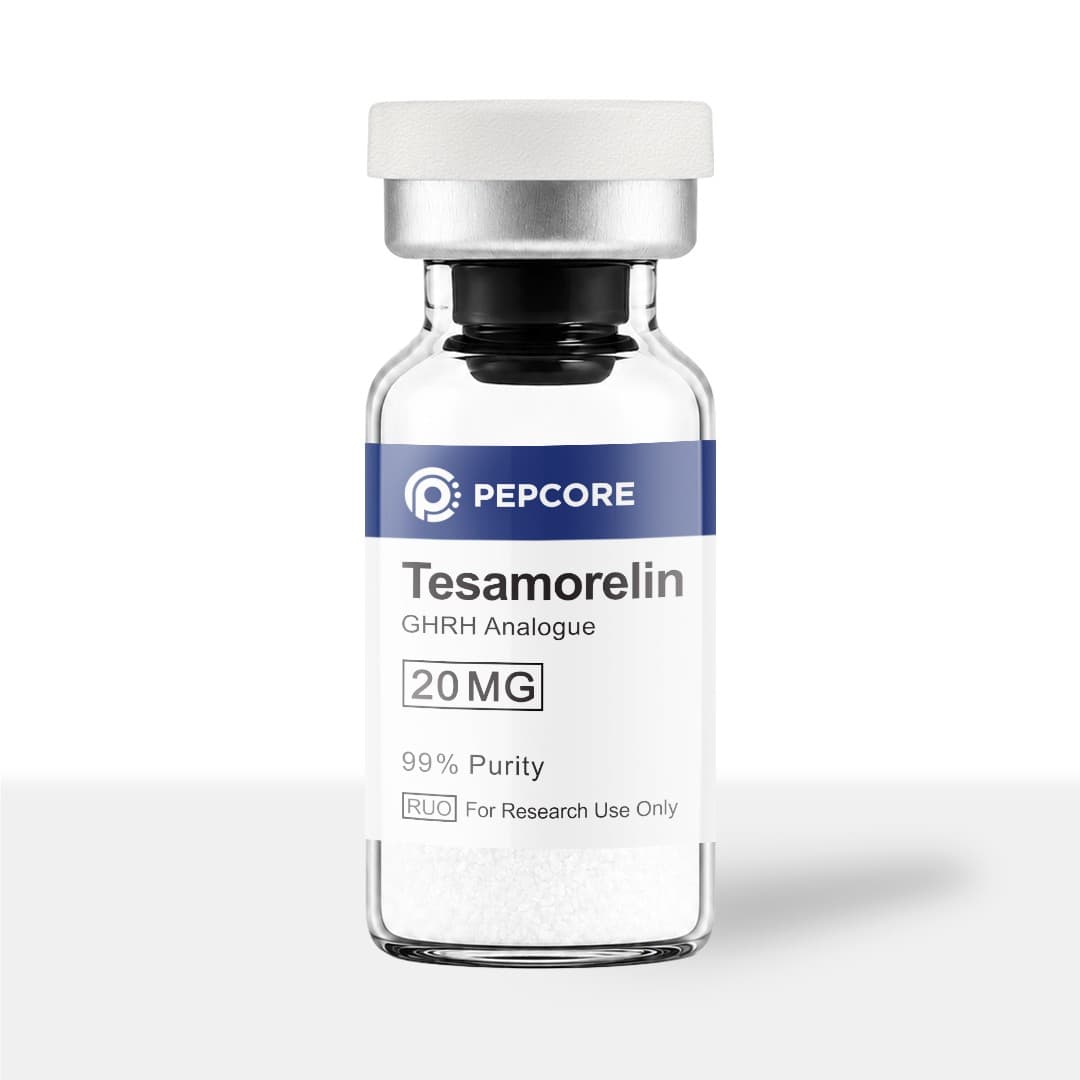
Tesamorelin
In Stock
Amount (mg)
Bacteriostatic Water
Insulin Syringes
Alcohol Swabs
Quantity
1
Price€109.00
Fast delivery, dispatched same day before 14:00
Tracked delivery, door to door
Shipped discreetly
Secure payments



Order before 14:00 for same-day shipping
Order now, ships today
OrderedToday
ShippedToday
Delivered24-25 November
Tesamorelin is a synthetic peptide built as a stabilized version of growth hormone-releasing hormone (GHRH), made of 44 amino acids with a special chemical group added to one end. It is best known for its role in growth hormone signaling research, and that added group is what helps it resist quick breakdown in lab studies.
It also has a solid research base, with work looking at how this kind of stabilized GHRH analogue behaves and how it interacts with its receptor (Ferdinandi et al., 2007, Basic & Clinical Pharmacology). That makes it a common reference peptide in studies on the growth hormone axis.
Research Applications
•GHRH-receptor signaling research
•Growth hormone axis studies
•Peptide stability research
•Structure and activity studies
Supplied as a lyophilized powder for stability.
Scientific Background
Growth hormone-releasing hormone (GHRH) is a 44-residue hypothalamic peptide that engages the GHRH receptor on pituitary somatotroph cells and participates in somatotropic-axis research. Native GHRH(1-44) is rapidly inactivated in plasma by dipeptidyl peptidase-IV, which cleaves the N-terminal Tyr-Ala dipeptide and limits its utility as a research reference compound. The development of stabilized GHRH analogs was driven by interest in molecules that preserve receptor engagement while resisting enzymatic deactivation.
Tesamorelin was developed as a synthetic GHRH(1-44) analog with a trans-3-hexenoyl moiety attached to the N-terminal tyrosine. This minimal modification confers resistance to dipeptidyl peptidase-IV cleavage while preserving the native amino acid sequence and receptor-binding pharmacophore, enabling extended plasma residency in laboratory research studies.
This structural design has made tesamorelin a widely studied reference compound for laboratory investigations of GHRH-receptor signaling, somatotropic-axis pulsatility, and downstream IGF-1 pathway dynamics. Research interest spans pituitary research models, hepatic lipid-metabolism research, adipose-tissue research models, and comparative pharmacology with other GHRH analogs and growth-hormone-releasing secretagogues.
Structure
Peptide ClassStabilized synthetic GHRH(1-44) analogue
Residue Count44 amino acids
Key Modificationtrans-3-hexenoyl moiety on N-terminal Tyr1
Molecular FormulaC₂₂₁H₃₆₆N₇₂O₆₇S
Molecular Weight~5136 g/mol (free base)
CAS Number218949-48-5
PubChem CID16137828
Mechanism of Action
GHRH-Receptor Engagement
Tesamorelin interacts with the GHRH receptor, a class B G-protein-coupled receptor expressed on pituitary somatotroph cells. Research models indicate that this engagement modulates Gαs-coupled signaling at the GHRH receptor, producing intracellular responses that are comparable to native GHRH(1-44) in laboratory side-by-side studies.
Modulation of Cyclic AMP and Pulsatile Growth Hormone Release
Upon receptor binding, tesamorelin engages adenylyl cyclase activity and modulates intracellular cyclic AMP accumulation in somatotroph research models. Downstream, this is associated with protein kinase A activation and pulsatile release of growth hormone from pituitary storage granules, both of which are extensively studied in somatotropic-axis research.
Resistance to Dipeptidyl Peptidase-IV
Laboratory research studies have characterized tesamorelin's trans-3-hexenoyl modification as conferring resistance to dipeptidyl peptidase-IV cleavage at the N-terminal Tyr-Ala dipeptide. This enzymatic stability is an active area of structure–activity research and is investigated as a contributor to extended plasma residency in research models relative to native GHRH(1-44).
Downstream IGF-1 Pathway Dynamics
Pulsatile growth hormone release in research models engages hepatic growth hormone receptors and modulates insulin-like growth factor-1 (IGF-1) gene expression and secretion. This downstream signaling cascade is investigated in lipid-metabolism research, hepatic-pathway research, and comparative pharmacology research with other somatotropic-axis modulators.
Conclusion
Tesamorelin represents a structurally engineered stabilized GHRH(1-44) analog that has become a central reference compound in GHRH-receptor signaling research. Its combination of preserved native sequence, N-terminal trans-3-hexenoyl modification, and resistance to dipeptidyl peptidase-IV cleavage makes it a valuable investigational laboratory peptide for studying class B G-protein-coupled receptor pharmacology and somatotropic-axis research models.
References
•Ferdinandi ES et al. (2007). Non-clinical pharmacology and safety evaluation of TH9507, a human growth hormone-releasing factor analogue. Basic & Clinical Pharmacology & Toxicology. PubMed
•Stanley TL et al. (2011). Effects of a growth hormone-releasing hormone analog on endogenous GH pulsatility and insulin sensitivity in healthy men. The Journal of Clinical Endocrinology and Metabolism. PubMed
•Stanley TL et al. (2019). Effects of tesamorelin on non-alcoholic fatty liver disease in HIV: a randomised, double-blind, multicentre trial. The Lancet HIV. PubMed
•Fourman LT et al. (2020). Effects of tesamorelin on hepatic transcriptomic signatures in HIV-associated NAFLD. JCI Insight. PubMed
•Fourman LT et al. (2021). Delineating tesamorelin response pathways in HIV-associated NAFLD using a targeted proteomic and transcriptomic approach. Scientific Reports. PubMed
•Ding J et al. (2013). Mouse models of growth hormone action and aging: a proteomic perspective. Proteomics. PubMed
Research Use Disclaimer
This product is intended for research and laboratory use only. It is designed exclusively for in vitro research purposes. All information provided is for educational and research reference only. This product is not intended for human or animal use. It is not a drug, food, or cosmetic and must not be marketed, labeled, or used as such. Use and handling are restricted to trained and qualified professionals.
What is Tesamorelin?
Tesamorelin is a synthetic peptide built as a stabilized version of growth hormone-releasing hormone (GHRH), made of 44 amino acids with a special chemical group added to one end. It is supplied as a lyophilized powder for laboratory research use only.
What is Tesamorelin used for in research?
In research, Tesamorelin is studied in areas such as: GHRH-receptor signaling research, Growth hormone axis studies and Peptide stability research. Related compounds in our Muscle Growth range include Sermorelin and Ipamorelin. Further reading: Tesamorelin: what it is and what it does.
Where can I buy Tesamorelin?
Tesamorelin is available from Pepcore, shipped from the Netherlands to every European country with tracking. A certificate of analysis is available on request.
How is Tesamorelin reconstituted?
With bacteriostatic water, added slowly down the inside of the glass rather than onto the powder, then swirled gently, never shaken. Bacteriostatic water is optional when you order: you can add a 3 ml vial (+€4.99) or a 10 ml vial (+€12.99), or leave it out. Use our peptide calculator to work out the concentration for your vial size.
How is Tesamorelin stored, and how long does shipping take?
Lyophilized Tesamorelin is kept cool, dry and away from light. Once reconstituted, the solution is refrigerated at 2 to 8 °C, see our peptide stability guide. Orders leave the Netherlands the same or next business day: 1 to 2 business days to the Netherlands and Belgium, 2 to 7 to Germany, France, Spain, Italy and Luxembourg, 3 to 8 to the rest of the EU, free from €250, see shipping.
Amount (mg)10 mg, 20 mg
Bacteriostatic Water3 ml or 10 ml, optional
Insulin Syringes10× 1 ml insulin syringes, 10× 0.5 ml insulin syringes, None
Alcohol SwabsYes, No
TestingThird-party HPLC/MS
CAS218949-48-5
Netherlands & Belgium: 1-2 business days, €8.49-€12.99
Germany: 2-7 business days, €12.99
France, Spain, Italy & Luxembourg: 2-7 business days, €14.90
Rest of the EU: 3-8 business days, €14.90
Poland: 3-8 business days, €15.99
Sweden: 3-8 business days, €15.99
Switzerland, Norway, United Kingdom & other European countries outside the EU: 5-10 business days, €15.99
Canary Islands: 7-12 business days, €24.99
Free shipping on orders from €250
For laboratory and research use only.
Not for human or veterinary use, diagnosis, or treatment.
To be handled only by qualified personnel in a controlled lab setting.
By placing an order, you confirm you have read and agree to these research-use terms.


€109.00