
Weight Management
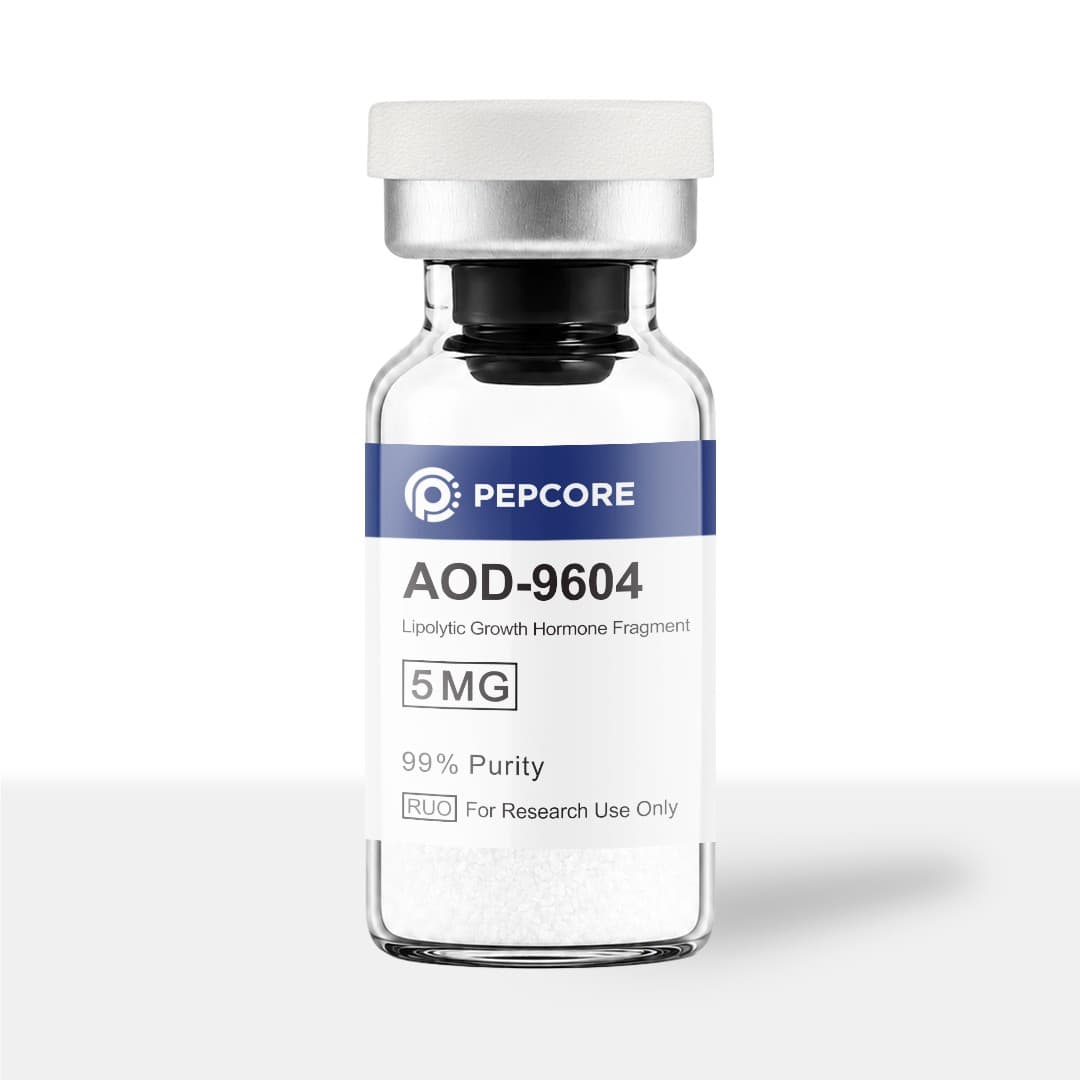
AOD-9604
In Stock
Amount (mg)
Bacteriostatic Water
Insulin Syringes
Alcohol Swabs
Quantity
1
Price€54.00
Fast delivery, dispatched same day before 14:00
Tracked delivery, door to door
Shipped discreetly
Secure payments



Order before 14:00 for same-day shipping
Order now, ships today
OrderedToday
ShippedToday
Delivered24-25 November
AOD-9604 is a synthetic 16-amino-acid peptide based on the tail end of human growth hormone, with an extra tyrosine added to one end. In research it is best known as a reference fragment for lipid-metabolism work, and that small structural tweak is what sets it apart from the natural sequence.
It also has a solid research footing, with early lab work characterizing this growth-hormone fragment and how it behaves (Ng et al., 2000, Hormone Research). That history is why it turns up often in studies on engineered HGH-derived peptides.
Research Applications
•Lipid-metabolism research models
•HGH C-terminal fragment studies
•Structure and activity research
•Engineered peptide reference work
Supplied as a lyophilized powder for stability.
Scientific Background
Human growth hormone (HGH) is a 191-residue polypeptide that engages the growth-hormone receptor and the prolactin receptor and participates in somatotropic-axis research. Early structure–activity research on HGH demonstrated that distinct functional domains within the full-length molecule could be isolated and synthesized as shorter peptides, including the C-terminal region spanning residues 177-191, which became a focal point in lipid-metabolism research.
AOD-9604 was developed as a synthetic 16-residue analog of HGH(177-191) with an additional tyrosine residue at the N-terminus. This N-terminal extension was engineered to confer altered physicochemical properties and to support comparative research on the lipid-metabolism-associated activity of the HGH C-terminal domain independent of the full-length molecule's growth-hormone-receptor engagement.
This structural design has made AOD-9604 a widely studied reference compound for laboratory investigations of HGH C-terminal fragment pharmacology, β3-adrenergic receptor expression dynamics, and downstream lipid-metabolism signaling. Research interest spans adipose-tissue research models, chondrocyte and cartilage-matrix research, and comparative pharmacology with full-length HGH and the unmodified HGH(176-191) fragment.
Structure
Peptide ClassEngineered HGH C-terminal fragment with N-terminal tyrosine extension
Residue Count16 amino acids
Amino Acid SequenceTyr-Leu-Arg-Ile-Val-Gln-Cys-Arg-Ser-Val-Glu-Gly-Ser-Cys-Gly-Phe (YLRIVQCRSVEGSCGF)
Key ModificationN-terminal tyrosine extension on HGH(177-191)
Molecular FormulaC₇₈H₁₂₃N₂₃O₂₃S₂
Molecular Weight~1815.1 g/mol
CAS Number221231-10-3
PubChem CID71300630
Mechanism of Action
Receptor-Independent Engagement of Lipid-Metabolism Pathways
AOD-9604 is investigated in research models for its engagement of lipid-metabolism pathways independent of the growth-hormone receptor and the downstream IGF-1 axis. Research models indicate that this receptor-independent engagement modulates adipose-tissue research model signaling and provides a structurally focused tool for examining the C-terminal HGH lipid-metabolism domain.
Modulation of β3-Adrenergic Receptor Expression
Laboratory research studies have characterized AOD-9604 as modulating β3-adrenergic receptor expression in adipose-tissue research models. This dynamic is investigated as a contributor to altered downstream lipid-metabolism signaling and is an active area of structure–activity research on the engineered N-terminally extended HGH C-terminal fragment.
3. Lipid-Metabolism Signaling Without Growth-Hormone-Receptor Engagement
Laboratory research studies have characterized AOD-9604 as modulating adipose-tissue research model lipid-metabolism signaling without engaging the growth-hormone receptor or modulating downstream IGF-1 production. This receptor-selectivity profile is an active area of structure–activity research and is investigated as a distinguishing feature relative to full-length HGH in laboratory comparative studies.
Chondrocyte and Cartilage-Matrix Research
Research models have investigated AOD-9604 in chondrocyte research and cartilage-matrix research, examining its engagement of collagen and proteoglycan biosynthesis pathways in cartilage-tissue research models. This research direction is a frequent subject of HGH-fragment comparative pharmacology and structure–activity research.
Conclusion
AOD-9604 represents a structurally engineered HGH C-terminal fragment with an N-terminal tyrosine extension that has become a reference compound in HGH C-terminal fragment research. Its combination of receptor-independent engagement of lipid-metabolism pathways, modulation of β3-adrenergic receptor expression, and absence of growth-hormone-receptor engagement makes it a valuable investigational laboratory peptide for studying HGH-fragment pharmacology and structure–activity research models.
References
•Ng FM et al. (2000). Metabolic studies of a synthetic lipolytic domain (AOD9604) of human growth hormone. Hormone Research. PubMed
•Heffernan M et al. (2001). The effects of human GH and its lipolytic fragment (AOD9604) on lipid metabolism following chronic treatment in obese mice and beta(3)-AR knock-out mice. Endocrinology. PubMed
•Stier H. et al. (2013). Safety and metabolism research of AOD9604. Journal of Endocrinology and Metabolism.
•Cox HD et al. (2015). Detection and in vitro metabolism of AOD9604. Drug Testing and Analysis. PubMed
Research Use Disclaimer
This product is intended for research and laboratory use only. It is designed exclusively for in vitro research purposes. All information provided is for educational and research reference only. This product is not intended for human or animal use. It is not a drug, food, or cosmetic and must not be marketed, labeled, or used as such. Use and handling are restricted to trained and qualified professionals.
What is AOD-9604?
AOD-9604 is a synthetic 16-amino-acid peptide based on the tail end of human growth hormone, with an extra tyrosine added to one end. It is supplied as a lyophilized powder for laboratory research use only.
What is AOD-9604 used for in research?
In research, AOD-9604 is studied in areas such as: Lipid-metabolism research models, HGH C-terminal fragment studies and Structure and activity research. Related compounds in our Weight Management range include Tirzepatide and SLU-PP-332.
Where can I buy AOD-9604?
AOD-9604 is available from Pepcore, shipped from the Netherlands to every European country with tracking. A certificate of analysis is available on request.
How is AOD-9604 reconstituted?
With bacteriostatic water, added slowly down the inside of the glass rather than onto the powder, then swirled gently, never shaken. Bacteriostatic water is optional when you order: you can add a 3 ml vial (+€4.99) or a 10 ml vial (+€12.99), or leave it out. Use our peptide calculator to work out the concentration for your vial size.
How is AOD-9604 stored, and how long does shipping take?
Lyophilized AOD-9604 is kept cool, dry and away from light. Once reconstituted, the solution is refrigerated at 2 to 8 °C, see our peptide stability guide. Orders leave the Netherlands the same or next business day: 1 to 2 business days to the Netherlands and Belgium, 2 to 7 to Germany, France, Spain, Italy and Luxembourg, 3 to 8 to the rest of the EU, free from €250, see shipping.
Amount (mg)5 mg, 10 mg
Bacteriostatic Water3 ml or 10 ml, optional
Insulin Syringes10× 1 ml insulin syringes, 10× 0.5 ml insulin syringes, None
Alcohol SwabsYes, No
TestingThird-party HPLC/MS
CAS221231-10-3
Netherlands & Belgium: 1-2 business days, €8.49-€12.99
Germany: 2-7 business days, €12.99
France, Spain, Italy & Luxembourg: 2-7 business days, €14.90
Rest of the EU: 3-8 business days, €14.90
Poland: 3-8 business days, €15.99
Sweden: 3-8 business days, €15.99
Switzerland, Norway, United Kingdom & other European countries outside the EU: 5-10 business days, €15.99
Canary Islands: 7-12 business days, €24.99
Free shipping on orders from €250
For laboratory and research use only.
Not for human or veterinary use, diagnosis, or treatment.
To be handled only by qualified personnel in a controlled lab setting.
By placing an order, you confirm you have read and agree to these research-use terms.
AI recommendations
Often bought together


€54.00