
Recovery & Repair
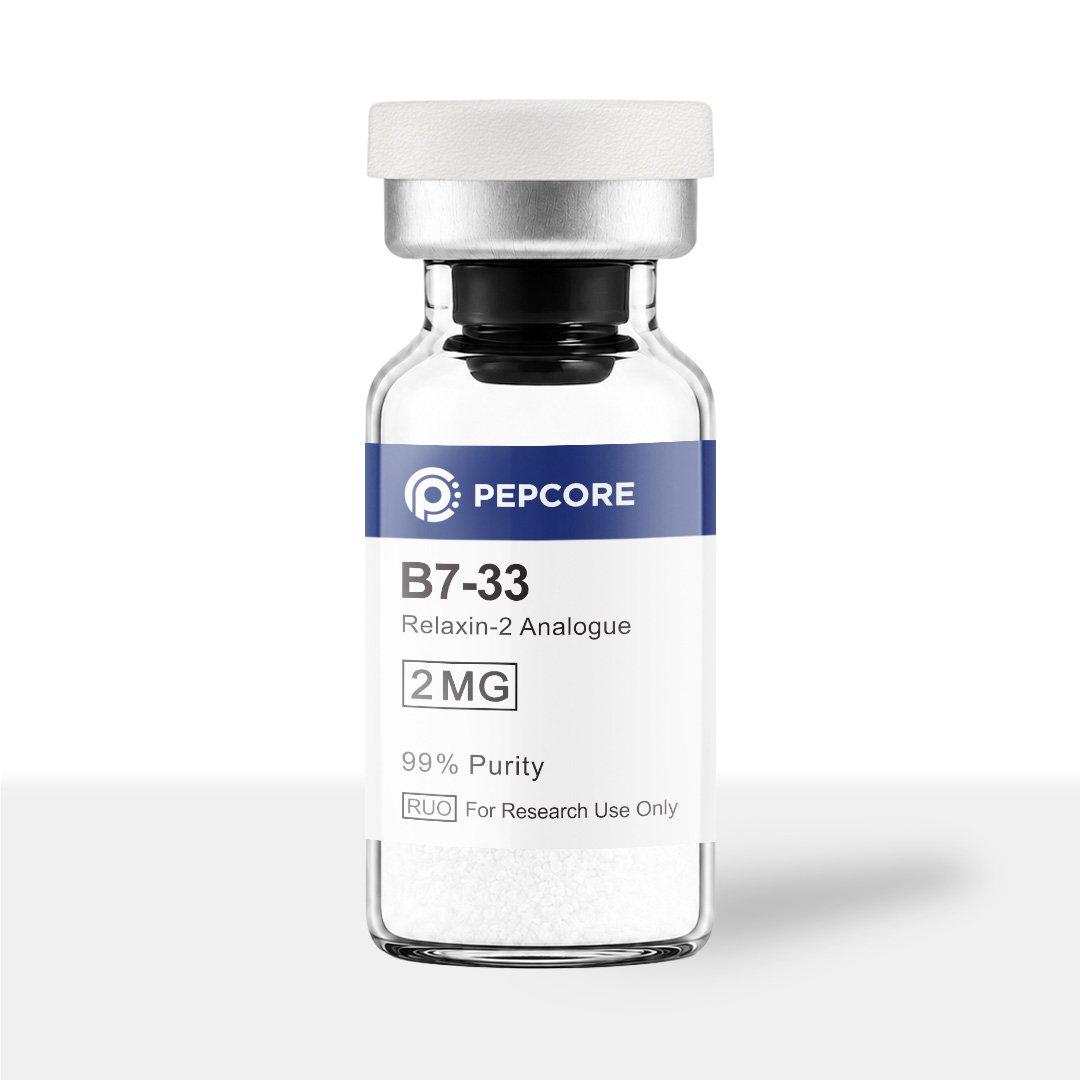
B7-33 2 mg
In Stock
Amount (mg)
Bacteriostatic Water
Insulin Syringes
Alcohol Swabs
Quantity
1
Price€34.00
Fast delivery, dispatched same day before 14:00
Tracked delivery, door to door
Shipped discreetly
Secure payments



Order before 14:00 for same-day shipping
Order now, ships today
OrderedToday
ShippedToday
Delivered24-25 November
B7-33 is a synthetic peptide derived from the B-chain of human relaxin-2. It can activate RXFP1 receptor signaling, a system studied in how cells respond to their surroundings. In published fibroblast experiments, it increased MMP-2, an enzyme involved in breaking down components of the extracellular matrix, the supporting material around cells.
B7-33 also produced a distinctive balance between ERK1/2 and cAMP signals in the tested fibroblast models compared with relaxin-2. These are different ways cells pass a receptor message inward. The balance depends on the cellular system and the measurement used. Researchers use this compact, single-chain peptide to examine receptor recognition, signal selection and matrix turnover under defined laboratory conditions. Hossain et al., 2016, Handley et al., 2023.
Research Applications
•Studied in connective-tissue matrix turnover in cell models
•Relevant in relaxin receptor signaling research
•Examined in collagen turnover and matrix enzymes studies
•Applied in fibroblast responses research
Supplied as a lyophilized powder for stability.
Scientific Background
Human relaxin-2 has two peptide chains connected by disulfide bonds. B7-33 was designed by focusing on the B-chain region responsible for recognition of RXFP1. The reference sequence replaces two cysteines with serines, truncates the N-terminus and extends the C-terminus with a basic segment. These changes produce a linear peptide without the disulfide-linked A-chain.
The sequence retains the RXXXRXXI recognition cassette found in relaxin. Its arrangement of arginine and isoleucine residues provides a starting point for examining which side chains contribute to receptor interaction. Substitution studies in the original work linked this cassette to B7-33 binding and signaling.
This scaffold also illustrates how the experimental system changes the apparent profile of a ligand. Cells engineered to express RXFP1 and fibroblasts that naturally carry the receptor gave different relative responses. Later work compared truncated and conformationally modified derivatives using binding, cAMP and circular-dichroism measurements. Together these studies place B7-33 within research on peptide minimization and on the relationship between sequence, conformation and receptor pharmacology (Handley et al., 2023, International Journal of Molecular Sciences).
Structure
Peptide classSynthetic single-chain relaxin-2 analogue
Reference sequenceVIKLSGRELVRAQIAISGMSTWSKRSL-NH₂
Residues27
Molecular formulaC₁₃₁H₂₂₉N₄₁O₃₆S
Molecular weight2986.6 g/mol
CAS numberN/A
Mechanism of Action
RXFP1 recognition
B7-33 engages RXFP1 through a sequence derived from the relaxin B-chain. Experiments replacing key residues in the recognition cassette changed receptor binding and functional responses, supporting a role for those side chains in the interaction. The receptor has an extracellular leucine-rich-repeat region involved in ligand recognition. Binding measurements describe this interaction, while downstream assays examine what follows receptor engagement. Comparing both helps separate a change in receptor affinity from a change in the signaling response.
Context-dependent signaling
In fibroblast models studied by Hossain and colleagues, B7-33 favored ERK1/2 phosphorylation relative to cAMP accumulation when compared with H2 relaxin. This is a model-dependent pattern of functional selectivity. It depends on the receptor's cellular environment and the measured pathway. ERK phosphorylation is a chemical change in signaling proteins, while cAMP is a small messenger made inside cells. Comparing them shows how the same receptor can pass on different messages. The same ligand can therefore be characterized across multiple readouts without assigning one universal activity value.
Matrix-related experimental readouts
The original fibroblast experiments also measured matrix metalloproteinase-2 (MMP-2), an enzyme relevant to extracellular-matrix turnover. Receptor-directed interventions were used to examine the contribution of RXFP1 and angiotensin II type 2 receptor signaling to these responses. Enzyme measurements address one part of matrix biology, while cell or tissue studies examine a broader setting. Subsequent peptide-analogue research compares sequence modifications with receptor activity and conformation, allowing the molecular scaffold and each biological endpoint to be assessed separately.
References
•Hossain MA et al. (2016). B7-33 design, RXFP1 binding and cellular ERK/cAMP/MMP-2 measurements. Chemical Science. DOI
•Handley TNG et al. (2023). Relaxin-derived peptide sequence, receptor-binding and cell-signaling comparisons. International Journal of Molecular Sciences. DOI
Research Use Disclaimer
This product is intended for in vitro laboratory research only. All information is provided for education and research reference. Not for personal use, diagnosis or treatment. Handling is restricted to trained and qualified professionals.
What is B7-33?
B7-33 is a synthetic peptide derived from the B-chain of human relaxin-2. It is supplied as a lyophilized powder for laboratory research use only.
What is B7-33 used for in research?
In research, B7-33 is studied in connective-tissue matrix turnover in cell models, in relaxin receptor signaling research as well as in collagen turnover and matrix enzymes studies. Related compounds in our Recovery & Repair range include TB-500 and Glutathione.
Where can I buy B7-33?
B7-33 is available from Pepcore, shipped from the Netherlands to every European country with tracking. A certificate of analysis is available on request.
How is B7-33 reconstituted?
With bacteriostatic water, added slowly down the inside of the glass rather than onto the powder, then swirled gently, never shaken. Bacteriostatic water is optional when you order: you can add a 3 ml vial (+€4.99) or a 10 ml vial (+€12.99), or leave it out. Use our peptide calculator to work out the concentration for your vial size.
How is B7-33 stored, and how long does shipping take?
Lyophilized B7-33 is kept cool, dry and away from light. Once reconstituted, the solution is refrigerated at 2 to 8 °C, see our peptide stability guide. Orders leave the Netherlands the same or next business day: 1 to 2 business days to the Netherlands and Belgium, 2 to 7 to Germany, France, Spain, Italy and Luxembourg, 3 to 8 to the rest of the EU, free from €250, see shipping.
Amount (mg)2 mg
Bacteriostatic Water3 ml or 10 ml, optional
Insulin Syringes10× 1 ml insulin syringes, 10× 0.5 ml insulin syringes, None
Alcohol SwabsYes, No
TestingThird-party HPLC/MS
CASN/A
Netherlands & Belgium: 1-2 business days, €8.49-€12.99
Germany: 2-7 business days, €12.99
France, Spain, Italy & Luxembourg: 2-7 business days, €14.90
Rest of the EU: 3-8 business days, €14.90
Poland: 3-8 business days, €15.99
Sweden: 3-8 business days, €15.99
Switzerland, Norway, United Kingdom & other European countries outside the EU: 5-10 business days, €15.99
Canary Islands: 7-12 business days, €24.99
Free shipping on orders from €250
For laboratory and research use only.
Not for human or veterinary use, diagnosis, or treatment.
To be handled only by qualified personnel in a controlled lab setting.
By placing an order, you confirm you have read and agree to these research-use terms.


€34.00