Recovery & Repair
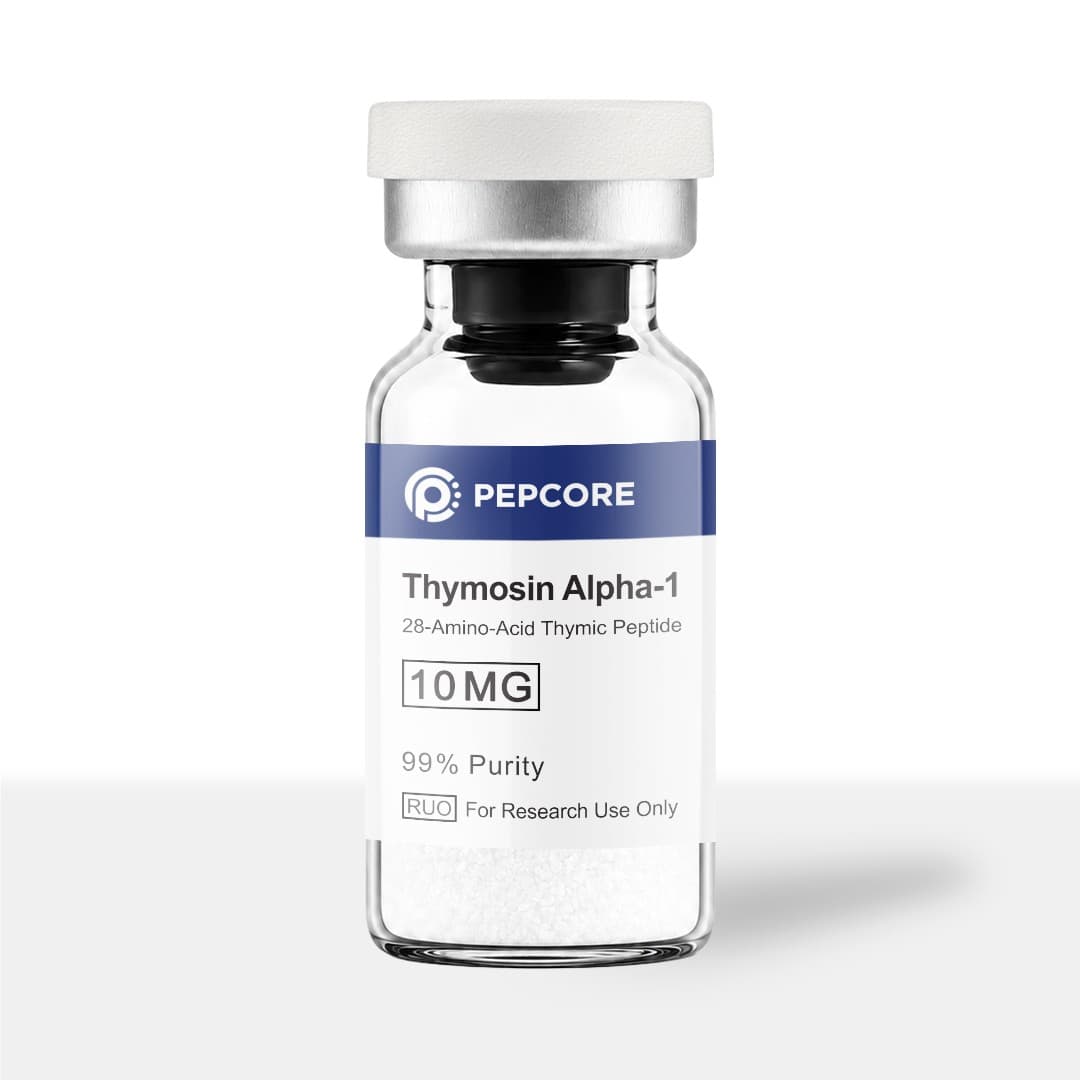
Thymosin Alpha-1
Out of Stock
Amount (mg)
Bacteriostatic Water
Insulin Syringes
Alcohol Swabs
Quantity
1
Price€69.00
Fast delivery, dispatched same day before 14:00
Tracked delivery, door to door
Shipped discreetly
Secure payments



Order before 14:00 for same-day shipping
Order now, ships today
OrderedToday
ShippedToday
Delivered24-25 November
Thymosin Alpha-1 is a synthetic peptide built from 28 amino acids with an acetyl cap on its front end. It is best known in research for immune-signalling studies, and what makes it stand out is that it was never designed from scratch. It is the front section of a larger natural protein called prothymosin alpha, cut free by an enzyme and rebuilt synthetically.
It carries one of the longest research records of any short peptide, beginning with its isolation and sequencing from calf thymus tissue (Goldstein et al., 1977, PNAS). That history is why it turns up often as a reference compound in this field.
Research Applications
•Dendritic-cell maturation research
•Toll-like receptor signalling studies
•T-cell differentiation research models
•Immune-tolerance and regulatory pathways
Supplied as a lyophilized powder for stability.
Scientific Background
Thymosin Alpha-1 emerged from the fractionation of thymus tissue in the 1960s and 1970s, when laboratories were separating crude thymic extracts to find which component carried the activity they could measure. Within one such preparation, thymosin fraction 5, the active species was identified as a 28-residue acetylated peptide and its full sequence was published in 1977.
Its origin was settled later. The peptide is the N-terminal fragment of prothymosin alpha, a protein found in the cell nucleus, released by a lysosomal asparaginyl endopeptidase. Finding the free fragment in mammalian tissue resolved a long-running question about whether it was simply an artefact of the extraction process rather than a molecule the body actually makes.
Interest persisted because the peptide appeared to act at the junction between the innate and adaptive immune systems rather than on a single cell type. Later research placed it upstream of dendritic-cell maturation and described it as a bidirectional regulator, reported to promote responsiveness in some laboratory models and restraint in others, which is why it remains an active subject of mechanistic investigation rather than a settled one.
Structure
Peptide ClassSynthetic thymic peptide, N-terminal fragment of prothymosin alpha
Amino Acid SequenceAc-SDAAVDTSSEITTKDLKEKKEVVEEAEN
Residues28 (N-terminally acetylated)
Molecular FormulaC₁₂₉H₂₁₅N₃₃O₅₅
Molecular Weight~3108.3 g/mol
CAS Number62304-98-7
SynonymsTα1, TA1, thymalfasin
Mechanism of Action
Toll-Like Receptor Signalling
Thymosin Alpha-1 is studied as a modulator of pattern-recognition receptor pathways, the sensors immune cells use to detect broad classes of threat. Reported work describes engagement of TLR2 and TLR9 on dendritic cells, with the downstream response depending on the adaptor protein MyD88 and, for the tolerogenic branch, on the type I interferon receptor. Knockout cells are used to map which route a given readout travels.
Dendritic-Cell Maturation and Antigen Presentation
Dendritic cells collect material and display fragments of it for T cells to inspect. In human cells grown from blood monocytes, exposure to the peptide raised surface CD40, CD80 and both classes of MHC molecule, while several other surface markers stayed unchanged. Antigen uptake fell at the same time, the pattern researchers read as a cell switching from collecting to presenting.
T-Cell Differentiation and Cytokine Research
Because dendritic-cell output shapes what lymphocytes do next, the peptide is examined for effects on T-cell differentiation. In mitogen-stimulated human lymphocytes, interleukin-2 production, interleukin-2 receptor expression and interferon-gamma production all increased, with no effect measurable in unstimulated cells. Related work reports shifts towards Th1-type profiles in culture models.
Regulatory and Tolerance Signalling
An immune response needs a brake as well as an accelerator. In mouse dendritic cells the peptide switched on indoleamine 2,3-dioxygenase, an enzyme that degrades tryptophan, and the resulting tolerogenic programme is described as depending on that enzyme. Interleukin-10 output and regulatory T-cell generation rose alongside it, in the same systems where activating readouts also rose.
Conclusion
Thymosin Alpha-1 is a 28-residue acetylated peptide derived from prothymosin alpha, studied at the junction between innate and adaptive immune signalling rather than against a single target. Its reported bidirectional behaviour, promoting a response in some models and restraint in others, is what keeps it in use as a laboratory tool for examining how immune decisions are made and unmade.
References
•Goldstein AL et al. (1977). Thymosin alpha1: isolation and sequence analysis of an immunologically active thymic polypeptide. Proceedings of the National Academy of Sciences of the United States of America. PubMed
•Serrate SA et al. (1987). Modulation of human natural killer cell cytotoxic activity, lymphokine production, and interleukin 2 receptor expression by thymic hormones. The Journal of Immunology. PubMed
•Sarandeses CS et al. (2003). Prothymosin alpha is processed to thymosin alpha 1 and thymosin alpha 11 by a lysosomal asparaginyl endopeptidase. The Journal of Biological Chemistry. PubMed
•Romani L et al. (2004). Thymosin alpha 1 activates dendritic cells for antifungal Th1 resistance through toll-like receptor signaling. Blood. PubMed
•Romani L et al. (2006). Thymosin alpha1 activates dendritic cell tryptophan catabolism and establishes a regulatory environment for balance of inflammation and tolerance. Blood. PubMed
•Yao Q et al. (2007). Thymosin-alpha1 modulates dendritic cell differentiation and functional maturation from human peripheral blood CD14+ monocytes. Immunology Letters. PubMed
Research Use Disclaimer
This product is intended for research and laboratory use only. It is designed exclusively for in vitro research purposes. All information provided is for educational and research reference only. This product is not intended for human or animal use. It is not a drug, food, or cosmetic and must not be marketed, labeled, or used as such. Use and handling are restricted to trained and qualified professionals.
What is Thymosin Alpha-1?
Thymosin Alpha-1 is a synthetic peptide built from 28 amino acids with an acetyl cap on its front end. It is supplied as a lyophilized powder for laboratory research use only.
What is Thymosin Alpha-1 used for in research?
In research, Thymosin Alpha-1 is studied in areas such as: Dendritic-cell maturation research, Toll-like receptor signalling studies and T-cell differentiation research models. Related compounds in our Recovery & Repair range include TB-500 and Glutathione.
Where can I buy Thymosin Alpha-1?
Thymosin Alpha-1 is available from Pepcore, shipped from the Netherlands to every European country with tracking. A certificate of analysis is available on request.
How is Thymosin Alpha-1 reconstituted?
With bacteriostatic water, added slowly down the inside of the glass rather than onto the powder, then swirled gently, never shaken. Bacteriostatic water is optional when you order: you can add a 3 ml vial (+€4.99) or a 10 ml vial (+€12.99), or leave it out. Use our peptide calculator to work out the concentration for your vial size.
How is Thymosin Alpha-1 stored, and how long does shipping take?
Lyophilized Thymosin Alpha-1 is kept cool, dry and away from light. Once reconstituted, the solution is refrigerated at 2 to 8 °C, see our peptide stability guide. Orders leave the Netherlands the same or next business day: 1 to 2 business days to the Netherlands and Belgium, 2 to 7 to Germany, France, Spain, Italy and Luxembourg, 3 to 8 to the rest of the EU, free from €250, see shipping.
Amount (mg)10 mg
Bacteriostatic Water3 ml or 10 ml, optional
Insulin Syringes10× 1 ml insulin syringes, 10× 0.5 ml insulin syringes, None
Alcohol SwabsYes, No
TestingThird-party HPLC/MS
CAS62304-98-7
Netherlands & Belgium: 1-2 business days, €8.49-€12.99
Germany: 2-7 business days, €12.99
France, Spain, Italy & Luxembourg: 2-7 business days, €14.90
Rest of the EU: 3-8 business days, €14.90
Poland: 3-8 business days, €15.99
Sweden: 3-8 business days, €15.99
Switzerland, Norway, United Kingdom & other European countries outside the EU: 5-10 business days, €15.99
Canary Islands: 7-12 business days, €24.99
Free shipping on orders from €250
For laboratory and research use only.
Not for human or veterinary use, diagnosis, or treatment.
To be handled only by qualified personnel in a controlled lab setting.
By placing an order, you confirm you have read and agree to these research-use terms.


€69.00