Bioregulators
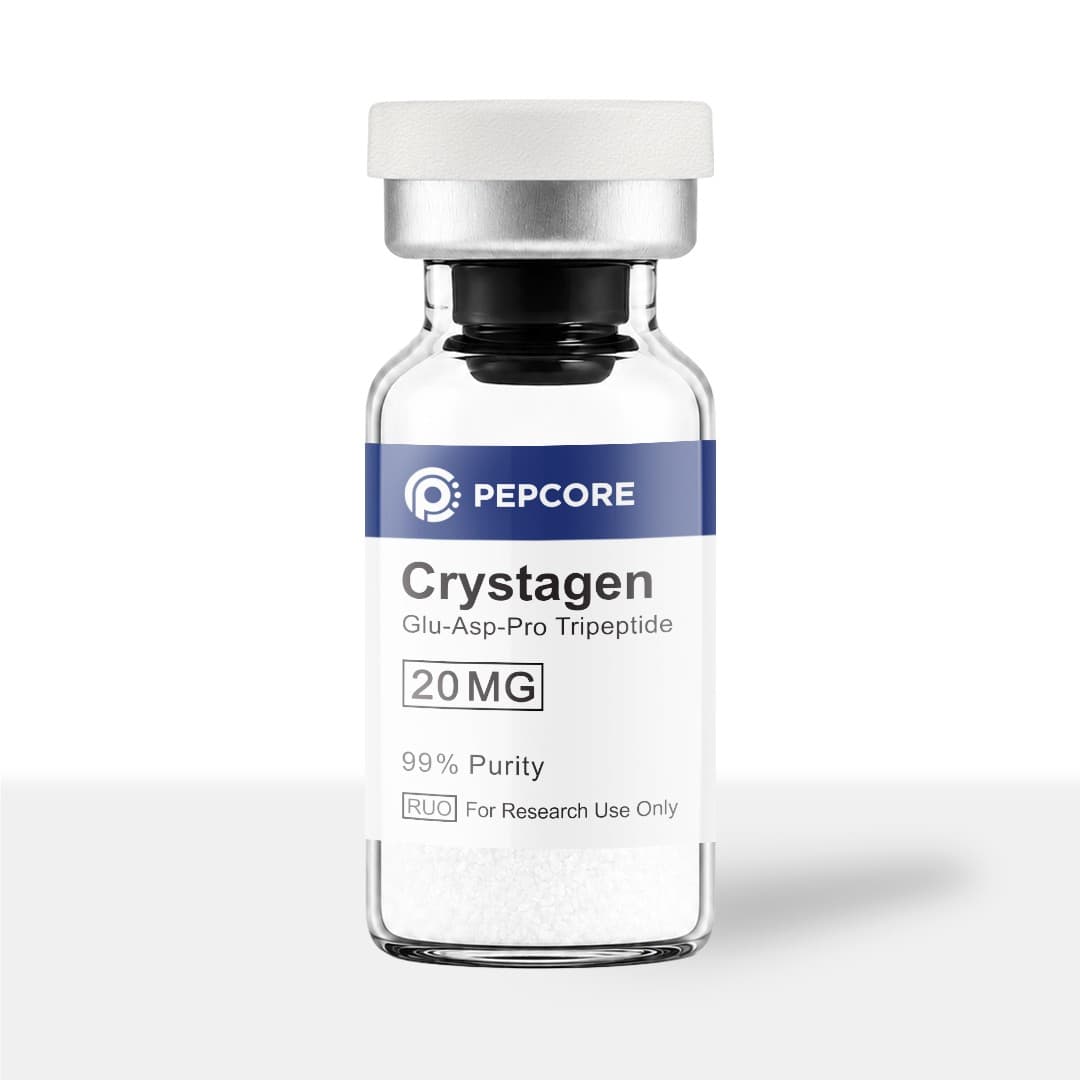
Crystagen 20 mg
Out of Stock
Amount (mg)
Bacteriostatic Water
Insulin Syringes
Alcohol Swabs
Quantity
1
Price€79.00
Fast delivery, dispatched same day before 14:00
Tracked delivery, door to door
Shipped discreetly
Secure payments



Order before 14:00 for same-day shipping
Order now, ships today
OrderedToday
ShippedToday
Delivered24-25 November
Crystagen is a short synthetic peptide bioregulator built from three amino acids in the sequence Glu-Asp-Pro. It is best known in research for studying how very small peptides interact with thymus tissue and immune-cell models, and its tiny size is what makes it a handy tool for this kind of work.
It comes out of the well-documented Khavinson peptide-bioregulator field, which has explored how short peptides behave in tissue and aging research (Khavinson & Anisimov, 2009). That background is why it often appears as a reference compound in laboratory studies.
Research Applications
•Peptide bioregulator research
•Thymus tissue study models
•Immune-cell laboratory research
•Short-peptide signaling studies
Supplied as a lyophilized powder for stability.
Scientific Background
The development of short peptide bioregulators began in the 1970s at the Military Medical Academy in Saint Petersburg, where Professor Vladimir Khavinson and colleagues isolated peptide fractions from animal tissues that appeared to restore organ-specific function in experimental models. This work led to the founding of the Saint Petersburg Institute of Bioregulation and Gerontology and the systematic study of tissue-derived peptide complexes, including the thymic peptide complex from which Crystagen was later derived.
Crystagen was identified within this research program as a synthetic tripeptide bioregulator with the sequence Glu-Asp-Pro (EDP), associated with thymic tissue and immune-cell research models. Subsequent biochemical and molecular investigations explored how this peptide interacts with chromatin and influences gene-expression patterns in thymic and lymphocyte cell systems, supporting the hypothesis that minimal peptide sequences can act as tissue-specific gene-expression modulators within thymic and immune cell models.
Today, Crystagen is positioned within the wider family of Khavinson-school oligopeptides studied for thymus-tissue gene expression, immune-cell maturation research, and lymphocyte signaling research in laboratory contexts.
Structure
Peptide ClassShort peptide bioregulator (Khavinson-school)
Amino Acid SequenceGlu-Asp-Pro (EDP)
Molecular FormulaC₁₄H₂₁N₃O₈
Molecular Weight~359.34 g/mol
CAS NumberN/A
Mechanism of Action
Chromatin Interaction and Gene-Expression Modulation
Within the Khavinson framework, Crystagen is proposed to interact with specific regions of double-stranded DNA and associated chromatin proteins, where it has been reported to influence gene-expression activation in thymic and lymphocyte research models. This proposed mode of action positions Crystagen as a tool for investigating peptide-mediated chromatin remodeling and transcriptional regulation in immune tissues.
Thymic-Cell Signaling and Immune-Cell Pathways
Research observations suggest that Crystagen engages with intracellular signaling pathways relevant to thymic-cell function, including pathways associated with thymic hormone expression research and immune-cell maturation research models. These observations make Crystagen a useful compound for exploring tissue-specific peptide signaling in thymic cell-culture systems.
Lymphocyte and Immune-Cell Chromatin Research
Comparative work on short peptide bioregulators indicates that the EDP sequence is associated with chromatin-organization changes in lymphocyte cell models, including studies of aged immune cell populations. In lymphocyte research models, Crystagen is investigated for its role in chromatin remodeling studies, transcriptional reactivation research, and age-related immune chromatin organization investigations.
Adaptive and Homeostatic Signaling
Khavinson-school bioregulators are described as adaptive peptide regulators that operate under physiological stress conditions. Crystagen is studied for its proposed contribution to thymic-tissue homeostasis research, including models of age-related decline in immune-cell signaling and oxidative stress adaptation.
Conclusion
Crystagen is a Khavinson-school short peptide bioregulator with the sequence Glu-Asp-Pro, studied for its proposed role in thymus-tissue gene expression, immune-cell maturation research, and lymphocyte chromatin research. Its compact tripeptide structure and dual thymic-lymphocyte positioning make Crystagen a valuable laboratory compound for exploring peptidergic regulation of gene expression in research models.
References
•Khavinson VKh, Anisimov VN (2009). [35-year experience in research of peptide regulation of aging]. Advances in Gerontology. PubMed
•Khavinson V.K. et al. (2003). Peptidergic Regulation of Homeostasis. Nauka, St. Petersburg (monograph).
•Khavinson V.K., Malinin V.V. (2005). Gerontological Aspects of Genome Peptide Regulation. Karger.
•Chervyakova NA et al. (2014). [Molecular aspects of immunoprotective activity of peptides in spleen during the ageing process]. Advances in Gerontology. PubMed
•Anisimov VN, Khavinson VKh (2010). Peptide bioregulation of aging: results and prospects. Biogerontology. PubMed
•Khavinson VKh et al. (2011). Effect of tripeptides on lymphoid and stem cells. Bulletin of Experimental Biology and Medicine. PubMed
Research Use Disclaimer
This product is intended for research and laboratory use only. It is designed exclusively for in vitro research purposes. All information provided is for educational and research reference only. This product is not intended for human or animal use. It is not a drug, food, or cosmetic and must not be marketed, labeled, or used as such. Use and handling are restricted to trained and qualified professionals.
What is Crystagen?
Crystagen is a short synthetic peptide bioregulator built from three amino acids in the sequence Glu-Asp-Pro. It is supplied as a lyophilized powder for laboratory research use only.
What is Crystagen used for in research?
In research, Crystagen is studied in areas such as: Peptide bioregulator research, Thymus tissue study models and Immune-cell laboratory research. Related compounds in our Bioregulators range include Thymogen and Testagen.
Where can I buy Crystagen?
Crystagen is available from Pepcore, shipped from the Netherlands to every European country with tracking. A certificate of analysis is available on request.
How is Crystagen reconstituted?
With bacteriostatic water, added slowly down the inside of the glass rather than onto the powder, then swirled gently, never shaken. Bacteriostatic water is optional when you order: you can add a 3 ml vial (+€4.99) or a 10 ml vial (+€12.99), or leave it out. Use our peptide calculator to work out the concentration for your vial size.
How is Crystagen stored, and how long does shipping take?
Lyophilized Crystagen is kept cool, dry and away from light. Once reconstituted, the solution is refrigerated at 2 to 8 °C, see our peptide stability guide. Orders leave the Netherlands the same or next business day: 1 to 2 business days to the Netherlands and Belgium, 2 to 7 to Germany, France, Spain, Italy and Luxembourg, 3 to 8 to the rest of the EU, free from €250, see shipping.
Amount (mg)20 mg
Bacteriostatic Water3 ml or 10 ml, optional
Insulin Syringes10× 1 ml insulin syringes, 10× 0.5 ml insulin syringes, None
Alcohol SwabsYes, No
TestingThird-party HPLC/MS
CASN/A
Netherlands & Belgium: 1-2 business days, €8.49-€12.99
Germany: 2-7 business days, €12.99
France, Spain, Italy & Luxembourg: 2-7 business days, €14.90
Rest of the EU: 3-8 business days, €14.90
Poland: 3-8 business days, €15.99
Sweden: 3-8 business days, €15.99
Switzerland, Norway, United Kingdom & other European countries outside the EU: 5-10 business days, €15.99
Canary Islands: 7-12 business days, €24.99
Free shipping on orders from €250
For laboratory and research use only.
Not for human or veterinary use, diagnosis, or treatment.
To be handled only by qualified personnel in a controlled lab setting.
By placing an order, you confirm you have read and agree to these research-use terms.


€79.00