Bioregulators
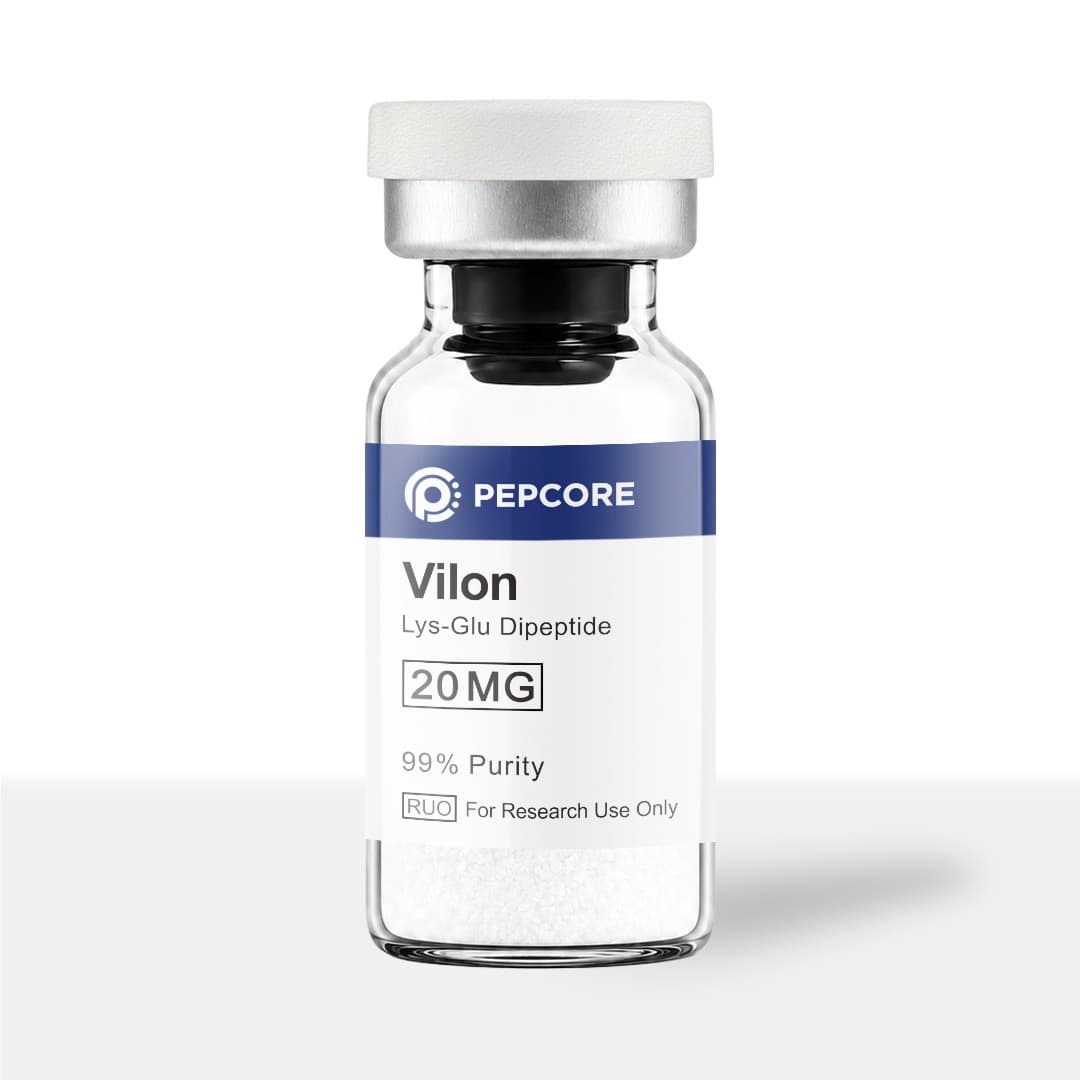
Vilon 20 mg
In Stock
Amount (mg)
Bacteriostatic Water
Insulin Syringes
Alcohol Swabs
Quantity
1
Price€79.00
Fast delivery, dispatched same day before 14:00
Tracked delivery, door to door
Shipped discreetly
Secure payments



Order before 14:00 for same-day shipping
Order now, ships today
OrderedToday
ShippedToday
Delivered24-25 November
Vilon is a short synthetic peptide bioregulator built from just two amino acids, lysine and glutamic acid (often written as Lys-Glu or KE). It is best known for its role in immune and lymphoid research, and its very simple two-piece structure is what makes it stand out.
It comes out of the Khavinson line of peptide work and has a real research base, with studies looking at how tiny peptides like this one interact with the body's regulatory systems (Khavinson & Anisimov, 2009). That history is part of why it shows up so often as a model compound in this field.
Research Applications
•Immune and lymphoid research
•Short-peptide bioregulator studies
•Cell-signaling and regulation models
•Organ-specific peptide research
Supplied as a lyophilized powder for stability.
Scientific Background
The study of short peptide bioregulators originated within the Khavinson school of gerontology, where researchers identified that defined amino acid sequences extracted from animal tissues could regulate cellular function in an organ-specific manner. Among these early findings, Lys-Glu was characterized as a dipeptide associated with immune and lymphoid tissue regulation, later synthesized for controlled experimental use as Vilon.
Vilon was developed as a minimal yet biologically active dipeptide that retains regulatory activity while offering enhanced stability and reproducibility for research. Its compact structure allows for investigations into how very short peptides may cross cellular membranes, reach nuclear chromatin, and influence gene transcription patterns in lymphocyte and thymus-related research models.
Ongoing research has positioned Vilon alongside other Khavinson-school bioregulators such as Thymogen and Epitalon, contributing to a broader investigation into peptide-mediated epigenetic regulation, age-associated immune balance, and the molecular foundations of lymphoid cellular communication.
Structure
Peptide ClassShort peptide bioregulator (Khavinson-school)
Amino Acid SequenceLys-Glu (KE)
Molecular FormulaC₁₁H₂₁N₃O₅
Molecular Weight~275.30 g/mol
CAS NumberN/A
Mechanism of Action
Chromatin Decondensation
Vilon is studied for its ability to interact with chromatin organization at the nuclear level. Experimental observations suggest that the KE dipeptide can promote local chromatin decondensation, exposing regulatory DNA regions to transcriptional machinery and supporting gene expression changes associated with lymphocyte activity.
Gene Expression Regulation
Research models indicate that Vilon may modulate the expression of genes involved in immune signaling, lymphocyte differentiation, and adaptive immune responses. These effects reflect a regulatory mode of action rather than direct receptor-mediated stimulation, supporting its classification as a peptide bioregulator.
Immune Signaling Modulation
Vilon has been examined for its influence on immune-cell communication pathways, including cytokine-related signaling and lymphocyte proliferation balance. Experimental data suggest a normalizing effect on immune activity in research models involving stress, aging, or impaired immune responsiveness.
Interaction with Thymus-Derived Peptides
Vilon is frequently studied alongside thymic peptides such as Thymogen and Thymalin. Comparative investigations explore how short bioregulators may complement one another in influencing thymic function, lymphoid tissue regulation, and adaptive immune balance.
Conclusion
Vilon is a Khavinson-school dipeptide bioregulator studied for its capacity to influence chromatin organization, gene expression, and immune signaling in lymphocyte research models. Its regulatory nature distinguishes it from direct-acting agents and supports its continued investigation as a research compound for immunomodulation, epigenetic studies, and age-associated immune balance.
References
•Khavinson VKh, Anisimov VN (2009). [35-year experience in research of peptide regulation of aging]. Advances in Gerontology. PubMed
•Khavinson VKh, Anisimov VN (2009). Peptide regulation of aging: 35-year research experience. Bulletin of Experimental Biology and Medicine. PubMed
•Anisimov VN, Khavinson VKh (2010). Peptide bioregulation of aging: results and prospects. Biogerontology. PubMed
•Sevostianova NN et al. (2013). Immunomodulating effects of Vilon and its analogue in the culture of human and animal thymus cells. Bulletin of Experimental Biology and Medicine. PubMed
•Khavinson VKh et al. (2002). [Tissue-specific action of peptides in tissue culture of rats of various ages]. Advances in Gerontology. PubMed
•Khavinson VK et al. (2021). Peptide Regulation of Gene Expression: A Systematic Review. Molecules. PubMed
Research Use Disclaimer
This product is intended for research and laboratory use only. It is designed exclusively for in vitro research purposes. All information provided is for educational and research reference only. This product is not intended for human or animal use. It is not a drug, food, or cosmetic and must not be marketed, labeled, or used as such. Use and handling are restricted to trained and qualified professionals.
What is Vilon?
Vilon is a short synthetic peptide bioregulator built from just two amino acids, lysine and glutamic acid (often written as Lys-Glu or KE). It is supplied as a lyophilized powder for laboratory research use only.
What is Vilon used for in research?
In research, Vilon is studied in areas such as: Immune and lymphoid research, Short-peptide bioregulator studies and Cell-signaling and regulation models. Related compounds in our Bioregulators range include Thymogen and Testagen.
Where can I buy Vilon?
Vilon is available from Pepcore, shipped from the Netherlands to every European country with tracking. A certificate of analysis is available on request.
How is Vilon reconstituted?
With bacteriostatic water, added slowly down the inside of the glass rather than onto the powder, then swirled gently, never shaken. Bacteriostatic water is optional when you order: you can add a 3 ml vial (+€4.99) or a 10 ml vial (+€12.99), or leave it out. Use our peptide calculator to work out the concentration for your vial size.
How is Vilon stored, and how long does shipping take?
Lyophilized Vilon is kept cool, dry and away from light. Once reconstituted, the solution is refrigerated at 2 to 8 °C, see our peptide stability guide. Orders leave the Netherlands the same or next business day: 1 to 2 business days to the Netherlands and Belgium, 2 to 7 to Germany, France, Spain, Italy and Luxembourg, 3 to 8 to the rest of the EU, free from €250, see shipping.
Amount (mg)20 mg
Bacteriostatic Water3 ml or 10 ml, optional
Insulin Syringes10× 1 ml insulin syringes, 10× 0.5 ml insulin syringes, None
Alcohol SwabsYes, No
TestingThird-party HPLC/MS
CASN/A
Netherlands & Belgium: 1-2 business days, €8.49-€12.99
Germany: 2-7 business days, €12.99
France, Spain, Italy & Luxembourg: 2-7 business days, €14.90
Rest of the EU: 3-8 business days, €14.90
Poland: 3-8 business days, €15.99
Sweden: 3-8 business days, €15.99
Switzerland, Norway, United Kingdom & other European countries outside the EU: 5-10 business days, €15.99
Canary Islands: 7-12 business days, €24.99
Free shipping on orders from €250
For laboratory and research use only.
Not for human or veterinary use, diagnosis, or treatment.
To be handled only by qualified personnel in a controlled lab setting.
By placing an order, you confirm you have read and agree to these research-use terms.


€79.00