Bioregulators
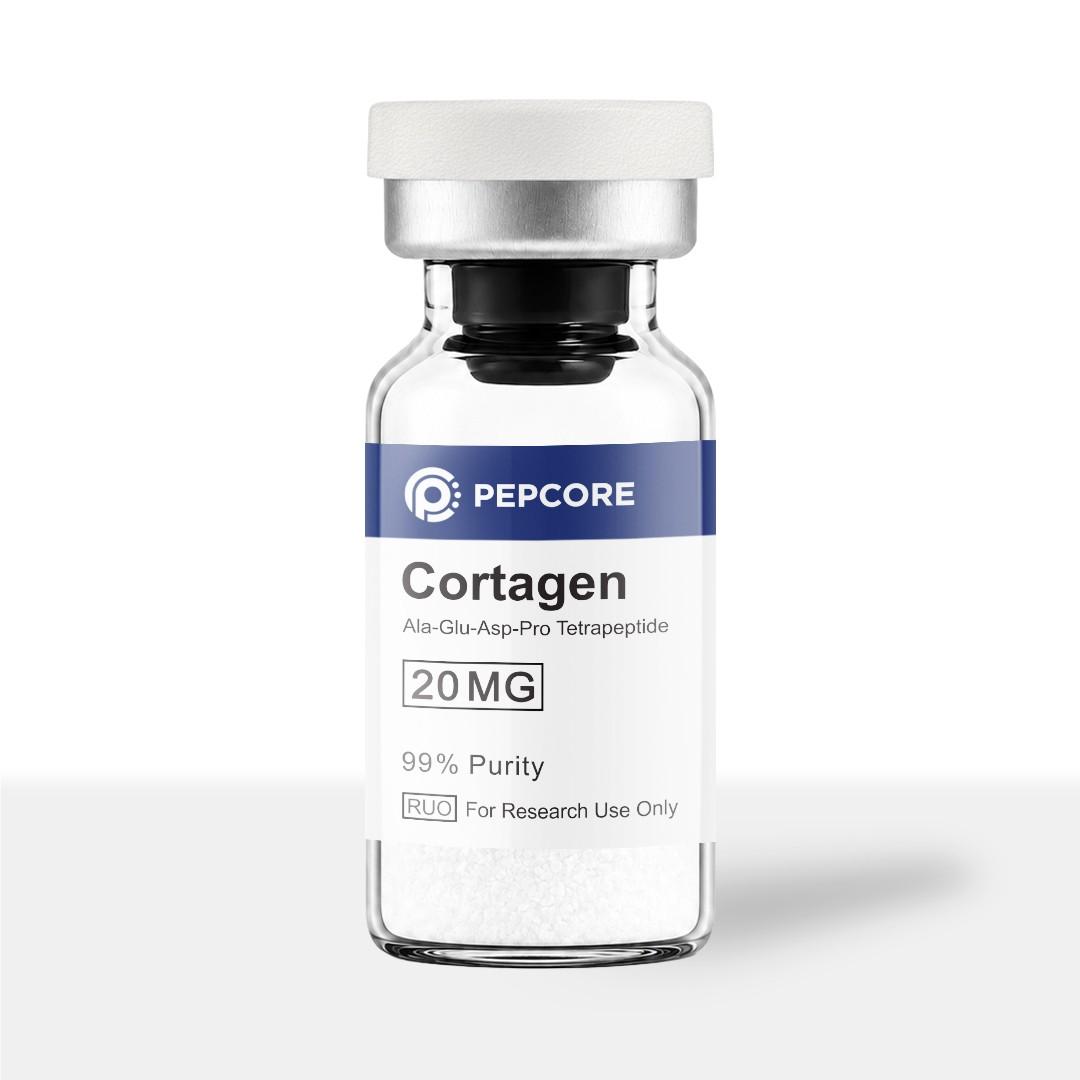
Cortagen 20 mg
In Stock
Amount (mg)
Bacteriostatic Water
Insulin Syringes
Alcohol Swabs
Quantity
1
Price€69.00
Fast delivery, dispatched same day before 14:00
Tracked delivery, door to door
Shipped discreetly
Secure payments



Order before 14:00 for same-day shipping
Order now, ships today
OrderedToday
ShippedToday
Delivered24-25 November
Cortagen is a synthetic short-chain peptide bioregulator built from four amino acids in the sequence Ala-Glu-Asp-Pro. It is best known in research for how it is studied alongside cerebral cortex tissue, and its very compact structure is what makes it a handy tool for peptide-signaling work.
It comes from the well-documented Khavinson peptide-bioregulator line, which has a long track record in the research literature (Khavinson & Anisimov, 2009). That history is why it keeps turning up as a reference compound in this field.
Research Applications
•Cerebral cortex tissue research
•Neuronal-pathway study models
•Short peptide bioregulator studies
•Tissue-specific signaling research
Supplied as a lyophilized powder for stability.
Scientific Background
The development of short peptide bioregulators began in the 1970s at the Military Medical Academy in Saint Petersburg, where Professor Vladimir Khavinson and colleagues isolated peptide fractions from animal tissues that appeared to restore organ-specific function in experimental models. This work led to the founding of the Saint Petersburg Institute of Bioregulation and Gerontology and the systematic study of tissue-derived peptide complexes, including the cerebral cortex peptide complex from which Cortagen was later derived.
Cortagen was identified within this research program as a synthetic tetrapeptide bioregulator with the sequence Ala-Glu-Asp-Pro (AEDP), associated with cerebral cortex tissue and neuronal-pathway research models. Subsequent biochemical and molecular investigations explored how this peptide interacts with chromatin and influences neuronal gene expression, supporting the hypothesis that minimal peptide sequences can act as tissue-specific gene-expression modulators within neural and cortical cell systems.
Today, Cortagen is positioned within the wider family of Khavinson-school oligopeptides studied for nervous-system tissue gene expression, neuronal-pathway research, and chromatin-organization research in laboratory contexts.
Structure
Peptide ClassShort peptide bioregulator (Khavinson-school)
Amino Acid SequenceAla-Glu-Asp-Pro (AEDP)
Molecular FormulaC₁₇H₂₆N₄O₉
Molecular Weight~430.4 g/mol
CAS NumberN/A
PubChem CID18439621
SynonymsSCHEMBL5491754
Mechanism of Action
Chromatin Interaction and Cortical Gene Expression
Within the Khavinson framework, Cortagen is proposed to interact with specific regions of double-stranded DNA and associated chromatin proteins, where it has been reported to influence gene-expression patterns in cortical neuron research models. This proposed mode of action positions Cortagen as a tool for investigating peptide-mediated chromatin engagement and transcriptional regulation in neural-derived cell systems.
Neuronal Signaling and Nervous-System Pathways
Research observations suggest that Cortagen engages with intracellular signaling pathways relevant to neuronal function, including pathways associated with neural membrane signaling research and neuronal-pathway adaptation research models. These observations make Cortagen a useful compound for exploring tissue-specific peptide signaling in cortical cell-culture systems.
Neuroimmune and Chromatin-Organization Research
Comparative work on short peptide bioregulators indicates that the AEDP sequence is associated with chromatin-organization changes in neural and immune cell models, including studies of cytokine-related signaling in neuroendocrine research. In nervous-system research models, Cortagen is investigated for its role in neural chromatin studies, neuroimmune signaling research, and age-related neural-gene-expression investigations.
Adaptive and Homeostatic Signaling
Khavinson-school bioregulators are described as adaptive peptide regulators that operate under physiological stress conditions. Cortagen is studied for its proposed contribution to neural-tissue homeostasis research, including models of age-related decline in neuronal-cell signaling and metabolic or ischemic-stress adaptation in cortical cell systems.
Conclusion
Cortagen is a Khavinson-school short peptide bioregulator with the sequence Ala-Glu-Asp-Pro, studied for its proposed role in nervous-system tissue gene expression, neuronal-pathway research, and chromatin-organization research. Its compact tetrapeptide structure and cortical-tissue positioning make Cortagen a valuable laboratory compound for exploring peptidergic regulation of gene expression in neurobiology research models.
References
•Khavinson VKh, Anisimov VN (2009). [35-year experience in research of peptide regulation of aging]. Advances in Gerontology. PubMed
•Khavinson V.K. et al. (2003). Peptidergic Regulation of Homeostasis. Nauka, St. Petersburg (monograph).
•Khavinson V.K., Malinin V.V. (2005). Gerontological Aspects of Genome Peptide Regulation. Karger.
•Anisimov SV et al. (2004). Elucidation of the effect of brain cortex tetrapeptide Cortagen on gene expression in mouse heart by microarray. Neuroendocrinology Letters. PubMed
•Anisimov VN, Khavinson VKh (2010). Peptide bioregulation of aging: results and prospects. Biogerontology. PubMed
•Lezhava T et al. (2020). EPIGENETIC MODIFICATION UNDER THE INFLUENCE OF PEPTIDE BIOREGULATORS ON "AGED" HETEROCHROMATIN. Georgian Medical News. PubMed
Research Use Disclaimer
This product is intended for research and laboratory use only. It is designed exclusively for in vitro research purposes. All information provided is for educational and research reference only. This product is not intended for human or animal use. It is not a drug, food, or cosmetic and must not be marketed, labeled, or used as such. Use and handling are restricted to trained and qualified professionals.
What is Cortagen?
Cortagen is a synthetic short-chain peptide bioregulator built from four amino acids in the sequence Ala-Glu-Asp-Pro. It is supplied as a lyophilized powder for laboratory research use only.
What is Cortagen used for in research?
In research, Cortagen is studied in areas such as: Cerebral cortex tissue research, Neuronal-pathway study models and Short peptide bioregulator studies. Related compounds in our Bioregulators range include Thymogen and Testagen.
Where can I buy Cortagen?
Cortagen is available from Pepcore, shipped from the Netherlands to every European country with tracking. A certificate of analysis is available on request.
How is Cortagen reconstituted?
With bacteriostatic water, added slowly down the inside of the glass rather than onto the powder, then swirled gently, never shaken. Bacteriostatic water is optional when you order: you can add a 3 ml vial (+€4.99) or a 10 ml vial (+€12.99), or leave it out. Use our peptide calculator to work out the concentration for your vial size.
How is Cortagen stored, and how long does shipping take?
Lyophilized Cortagen is kept cool, dry and away from light. Once reconstituted, the solution is refrigerated at 2 to 8 °C, see our peptide stability guide. Orders leave the Netherlands the same or next business day: 1 to 2 business days to the Netherlands and Belgium, 2 to 7 to Germany, France, Spain, Italy and Luxembourg, 3 to 8 to the rest of the EU, free from €250, see shipping.
Amount (mg)20 mg
Bacteriostatic Water3 ml or 10 ml, optional
Insulin Syringes10× 1 ml insulin syringes, 10× 0.5 ml insulin syringes, None
Alcohol SwabsYes, No
TestingThird-party HPLC/MS
CASN/A
Netherlands & Belgium: 1-2 business days, €8.49-€12.99
Germany: 2-7 business days, €12.99
France, Spain, Italy & Luxembourg: 2-7 business days, €14.90
Rest of the EU: 3-8 business days, €14.90
Poland: 3-8 business days, €15.99
Sweden: 3-8 business days, €15.99
Switzerland, Norway, United Kingdom & other European countries outside the EU: 5-10 business days, €15.99
Canary Islands: 7-12 business days, €24.99
Free shipping on orders from €250
For laboratory and research use only.
Not for human or veterinary use, diagnosis, or treatment.
To be handled only by qualified personnel in a controlled lab setting.
By placing an order, you confirm you have read and agree to these research-use terms.


€69.00