
Weight Management
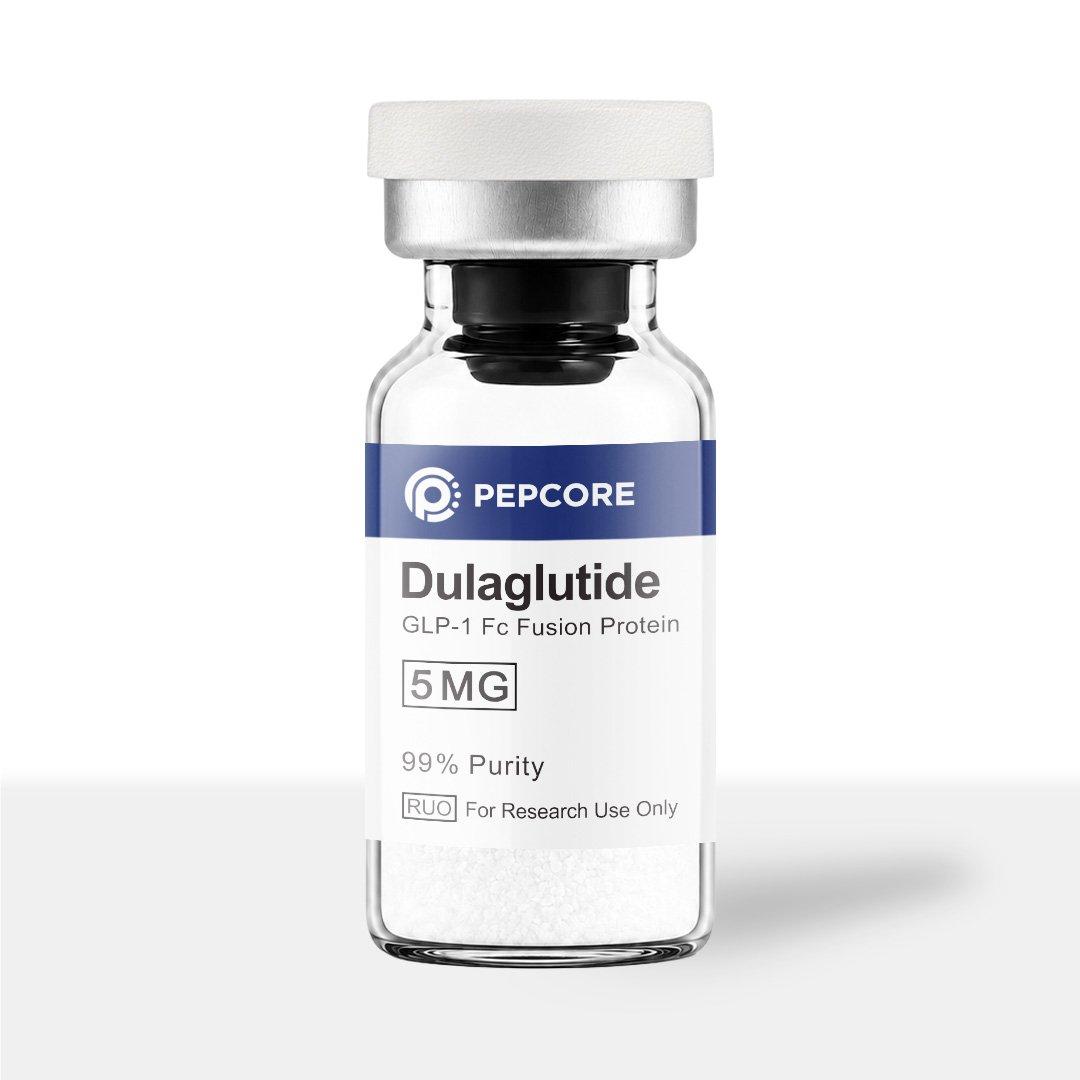
Dulaglutide 5 mg
In Stock
Amount (mg)
Bacteriostatic Water
Insulin Syringes
Alcohol Swabs
Quantity
1
Price€89.00
Fast delivery, dispatched same day before 14:00
Tracked delivery, door to door
Shipped discreetly
Secure payments



Order before 14:00 for same-day shipping
Order now, ships today
OrderedToday
ShippedToday
Delivered24-25 November
Dulaglutide is a GLP-1 receptor agonist built as a peptide–Fc fusion protein. It is studied for glucose-dependent insulin release and the coordination of pancreatic hormone responses. Human glucose-challenge research has measured both early and later insulin responses, helping connect receptor activation with the secretory behaviour of beta cells.
Two GLP-1-like domains are joined to an engineered human IgG4 Fc scaffold. The resulting dimer is much larger than a free peptide. This format makes it relevant to comparisons between receptor-active peptides and Fc-fusion proteins without implying that the Fc region adds a second metabolic receptor target. GLP-1 receptor activation helps pancreatic beta cells release insulin when glucose is elevated. It also influences glucagon secretion and digestive signalling. These are coordinated biological responses: a rise in cAMP in a receptor-expressing cell is an early signal, while insulin release, meal-related hormone changes and appetite ratings are separate downstream measurements.
Research Applications
•Studied in glucose-dependent insulin release and beta-cell function.
•Relevant in glucose regulation and meal-related metabolic responses.
•Examined in pancreatic hormone regulation involving insulin and glucagon.
•Applied in incretin biology linking GLP-1 signals with pancreatic responses.
Supplied as a lyophilized powder for stability.
Scientific Background
The GLP-1 receptor is a cell-surface G-protein-coupled receptor. Its activation raises cAMP and recruits signalling systems that amplify glucose-triggered insulin secretion. This glucose dependence matters: an insulin response measured at elevated glucose does not imply the same response under every culture condition. Receptor abundance, glucose concentration and the secretory capacity of the cells all influence the result.
Published physiological studies add context beyond receptor assays. Measurements of insulin and C-peptide indicate secretory responses, whereas glucagon, meal responses and gastric-emptying measurements describe other parts of the metabolic system. These endpoints should be read individually rather than treated as interchangeable evidence of receptor potency. Molecular format also matters when comparing analogues: lipid attachment and Fc fusion change protein interactions and molecular size without creating an additional incretin receptor target.
Structure
Peptide ClassRecombinant GLP-1 receptor agonist Fc fusion protein
StructureDisulfide-linked homodimer of two identical 275-amino-acid chains
GLP-1 DomainHGEGTFTSDVSSYLEEQAAKEFIAWLVKGGG (GLP-1(7-37) analog with A8G, G22E, R36G)
LinkerGGGGSGGGGSGGGGSA (16 residues)
Fc DomainHuman IgG4 Fc with S228P, F234A and L235A substitutions, C-terminal Lys removed
Molecular FormulaC₂₆₄₆H₄₀₄₄N₇₀₄O₈₃₆S₁₈ (dimer)
Molecular Weight~59670 g/mol (dimer, protein backbone without glycans)
CAS Number923950-08-7
Research CodeLY2189265
SynonymsGLP-1 IgG4 Fc fusion protein
Mechanism of Action
Receptor activation
The GLP-1-like region binds GLP-1R and favours an active receptor state. Coupling to Gs stimulates adenylyl cyclase, raising intracellular cAMP. A cAMP assay can therefore measure early receptor signalling, but its magnitude also depends on receptor expression and the assay system. Binding affinity and signalling potency answer different questions.
Glucose-dependent secretion
In responsive beta cells, cAMP-dependent pathways involving PKA and Epac support the calcium and secretory machinery triggered by glucose. The effect is an amplification of insulin release, not an unconditional instruction to secrete insulin. Studies that measure insulin alongside C-peptide can help distinguish secretion from changes in hormone clearance. Glucagon responses add information about the wider islet system.
Molecular format and broader responses
The Fc scaffold increases molecular size and changes the handling of the GLP-1-like domains. It does not make dulaglutide a dual incretin agonist. Human glucose-challenge studies show changes in insulin and C-peptide responses; those physiological findings complement receptor assays but cannot be reproduced or predicted simply from a cAMP value.
References
•Glaesner W et al. (2010). Engineering and characterization of the GLP-1 analogue LY2189265, an Fc fusion protein. PubMed
•Barrington P et al. (2011). Dulaglutide pharmacology and glucose-dependent insulin responses. PubMed
Research Use Disclaimer
This product is intended for in vitro laboratory research only. All information is provided for education and research reference. Not for personal use, diagnosis or treatment. Handling is restricted to trained and qualified professionals.
What is Dulaglutide?
Dulaglutide is a GLP-1 receptor agonist built as a peptide–Fc fusion protein. It is supplied as a lyophilized powder for laboratory research use only.
What is Dulaglutide used for in research?
In research, Dulaglutide is studied in glucose-dependent insulin release and beta-cell function., in glucose regulation and meal-related metabolic responses. as well as in pancreatic hormone regulation involving insulin and glucagon.. Related compounds in our Weight Management range include Tirzepatide and SLU-PP-332.
Where can I buy Dulaglutide?
Dulaglutide is available from Pepcore, shipped from the Netherlands to every European country with tracking. A certificate of analysis is available on request.
How is Dulaglutide reconstituted?
With bacteriostatic water, added slowly down the inside of the glass rather than onto the powder, then swirled gently, never shaken. Bacteriostatic water is optional when you order: you can add a 3 ml vial (+€4.99) or a 10 ml vial (+€12.99), or leave it out. Use our peptide calculator to work out the concentration for your vial size.
How is Dulaglutide stored, and how long does shipping take?
Lyophilized Dulaglutide is kept cool, dry and away from light. Once reconstituted, the solution is refrigerated at 2 to 8 °C, see our peptide stability guide. Orders leave the Netherlands the same or next business day: 1 to 2 business days to the Netherlands and Belgium, 2 to 7 to Germany, France, Spain, Italy and Luxembourg, 3 to 8 to the rest of the EU, free from €250, see shipping.
Amount (mg)5 mg
Bacteriostatic Water3 ml or 10 ml, optional
Insulin Syringes10× 1 ml insulin syringes, 10× 0.5 ml insulin syringes, None
Alcohol SwabsYes, No
TestingThird-party HPLC/MS
CAS923950-08-7
Netherlands & Belgium: 1-2 business days, €8.49-€12.99
Germany: 2-7 business days, €12.99
France, Spain, Italy & Luxembourg: 2-7 business days, €14.90
Rest of the EU: 3-8 business days, €14.90
Poland: 3-8 business days, €15.99
Sweden: 3-8 business days, €15.99
Switzerland, Norway, United Kingdom & other European countries outside the EU: 5-10 business days, €15.99
Canary Islands: 7-12 business days, €24.99
Free shipping on orders from €250
For laboratory and research use only.
Not for human or veterinary use, diagnosis, or treatment.
To be handled only by qualified personnel in a controlled lab setting.
By placing an order, you confirm you have read and agree to these research-use terms.
Related products


€89.00