
Weight Management
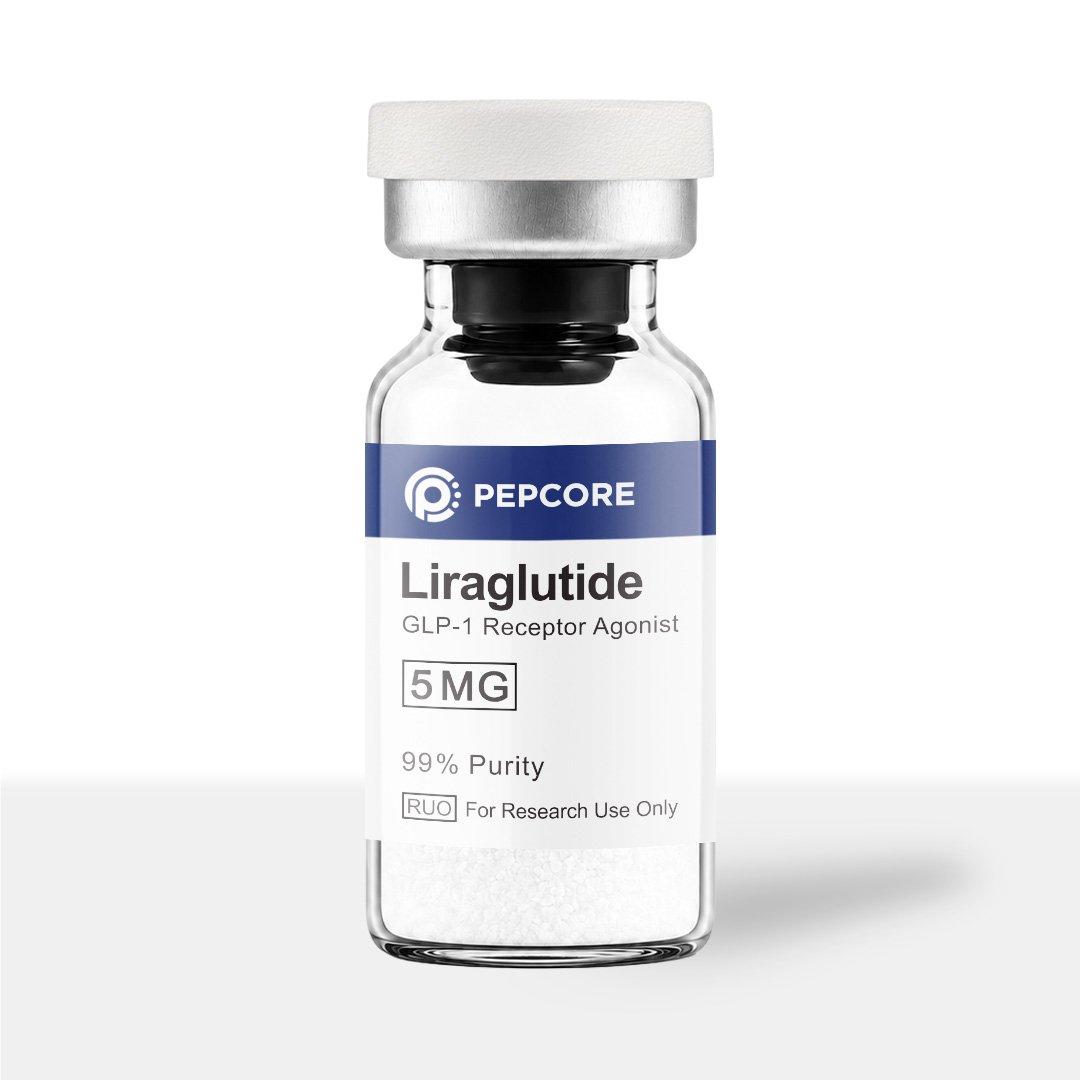
Liraglutide 5 mg
In Stock
Amount (mg)
Bacteriostatic Water
Insulin Syringes
Alcohol Swabs
Quantity
1
Price€49.00
Fast delivery, dispatched same day before 14:00
Tracked delivery, door to door
Shipped discreetly
Secure payments



Order before 14:00 for same-day shipping
Order now, ships today
OrderedToday
ShippedToday
Delivered24-25 November
Liraglutide is an acylated GLP-1 analogue studied for glucose-dependent insulin release, glucagon regulation and appetite-related signalling. Published human research also examines satiety, food intake and the early phase of gastric emptying. These effects make it relevant to research on how pancreatic and digestive signals respond to a meal.
Its 31-residue peptide carries a C16 fatty-acid group that supports reversible albumin association. This distinguishes its molecular design from native GLP-1 and from larger Fc-fusion analogues. GLP-1 receptor activation helps pancreatic beta cells release insulin when glucose is elevated. It also influences glucagon secretion and digestive signalling. These are coordinated biological responses: a rise in cAMP in a receptor-expressing cell is an early signal, while insulin release, meal-related hormone changes and appetite ratings are separate downstream measurements.
Research Applications
•Studied in appetite and satiety research on meal-related responses.
•Relevant in energy balance research involving food intake.
•Examined in glucose-dependent insulin release and pancreatic hormone regulation.
•Applied in gastric emptying research focused on early meal responses.
Supplied as a lyophilized powder for stability.
Scientific Background
The GLP-1 receptor is a cell-surface G-protein-coupled receptor. Its activation raises cAMP and recruits signalling systems that amplify glucose-triggered insulin secretion. This glucose dependence matters: an insulin response measured at elevated glucose does not imply the same response under every culture condition. Receptor abundance, glucose concentration and the secretory capacity of the cells all influence the result.
Published physiological studies add context beyond receptor assays. Measurements of insulin and C-peptide indicate secretory responses, whereas glucagon, meal responses and gastric-emptying measurements describe other parts of the metabolic system. These endpoints should be read individually rather than treated as interchangeable evidence of receptor potency. Molecular format also matters when comparing analogues: lipid attachment and Fc fusion change protein interactions and molecular size without creating an additional incretin receptor target.
Structure
Peptide ClassSynthetic acylated GLP-1 receptor agonist
Residue Count31 amino acids (GLP-1(7-37) backbone)
Amino Acid SequenceHis-Ala-Glu-Gly-Thr-Phe-Thr-Ser-Asp-Val-Ser-Ser-Tyr-Leu-Glu-Gly-Gln-Ala-Ala-Lys(γGlu-palmitoyl)-Glu-Phe-Ile-Ala-Trp-Leu-Val-Arg-Gly-Arg-Gly
Key ModificationsArg substitution at position 34, C16 palmitic acid attached via γGlu spacer at Lys26
Molecular FormulaC₁₇₂H₂₆₅N₄₃O₅₁
Molecular Weight3751.2 g/mol
CAS Number204656-20-2
PubChem CID16134956
SynonymsNN2211, NNC 90-1170, Arg34Lys26-(Nε-(γ-Glu(Nα-hexadecanoyl)))-GLP-1(7-37)
Mechanism of Action
Receptor activation
The GLP-1-like region binds GLP-1R and favours an active receptor state. Coupling to Gs stimulates adenylyl cyclase, raising intracellular cAMP. A cAMP assay can therefore measure early receptor signalling, but its magnitude also depends on receptor expression and the assay system. Binding affinity and signalling potency answer different questions.
Glucose-dependent secretion
In responsive beta cells, cAMP-dependent pathways involving PKA and Epac support the calcium and secretory machinery triggered by glucose. The effect is an amplification of insulin release, not an unconditional instruction to secrete insulin. Studies that measure insulin alongside C-peptide can help distinguish secretion from changes in hormone clearance. Glucagon responses add information about the wider islet system.
Molecular format and broader responses
The C16 side chain supports albumin association, while the peptide region supplies GLP-1R agonism. Human meal studies report appetite and early gastric-emptying effects, but do not show an identical delay across the full observation period. These integrated responses are distinct from cAMP in isolated cells and should not be inferred from a receptor assay alone.
References
•van Can J et al. (2014). Liraglutide effects on gastric emptying, appetite and metabolic measurements in adults. PubMed
Research Use Disclaimer
This product is intended for in vitro laboratory research only. All information is provided for education and research reference. Not for personal use, diagnosis or treatment. Handling is restricted to trained and qualified professionals.
What is Liraglutide?
Liraglutide is an acylated GLP-1 analogue studied for glucose-dependent insulin release, glucagon regulation and appetite-related signalling. It is supplied as a lyophilized powder for laboratory research use only.
What is Liraglutide used for in research?
In research, Liraglutide is studied in appetite and satiety research on meal-related responses., in energy balance research involving food intake. as well as in glucose-dependent insulin release and pancreatic hormone regulation.. Related compounds in our Weight Management range include Tirzepatide and SLU-PP-332.
Where can I buy Liraglutide?
Liraglutide is available from Pepcore, shipped from the Netherlands to every European country with tracking. A certificate of analysis is available on request.
How is Liraglutide reconstituted?
With bacteriostatic water, added slowly down the inside of the glass rather than onto the powder, then swirled gently, never shaken. Bacteriostatic water is optional when you order: you can add a 3 ml vial (+€4.99) or a 10 ml vial (+€12.99), or leave it out. Use our peptide calculator to work out the concentration for your vial size.
How is Liraglutide stored, and how long does shipping take?
Lyophilized Liraglutide is kept cool, dry and away from light. Once reconstituted, the solution is refrigerated at 2 to 8 °C, see our peptide stability guide. Orders leave the Netherlands the same or next business day: 1 to 2 business days to the Netherlands and Belgium, 2 to 7 to Germany, France, Spain, Italy and Luxembourg, 3 to 8 to the rest of the EU, free from €250, see shipping.
Amount (mg)5 mg
Bacteriostatic Water3 ml or 10 ml, optional
Insulin Syringes10× 1 ml insulin syringes, 10× 0.5 ml insulin syringes, None
Alcohol SwabsYes, No
TestingThird-party HPLC/MS
CAS204656-20-2
Netherlands & Belgium: 1-2 business days, €8.49-€12.99
Germany: 2-7 business days, €12.99
France, Spain, Italy & Luxembourg: 2-7 business days, €14.90
Rest of the EU: 3-8 business days, €14.90
Poland: 3-8 business days, €15.99
Sweden: 3-8 business days, €15.99
Switzerland, Norway, United Kingdom & other European countries outside the EU: 5-10 business days, €15.99
Canary Islands: 7-12 business days, €24.99
Free shipping on orders from €250
For laboratory and research use only.
Not for human or veterinary use, diagnosis, or treatment.
To be handled only by qualified personnel in a controlled lab setting.
By placing an order, you confirm you have read and agree to these research-use terms.
Related products


€49.00