Bioregulators
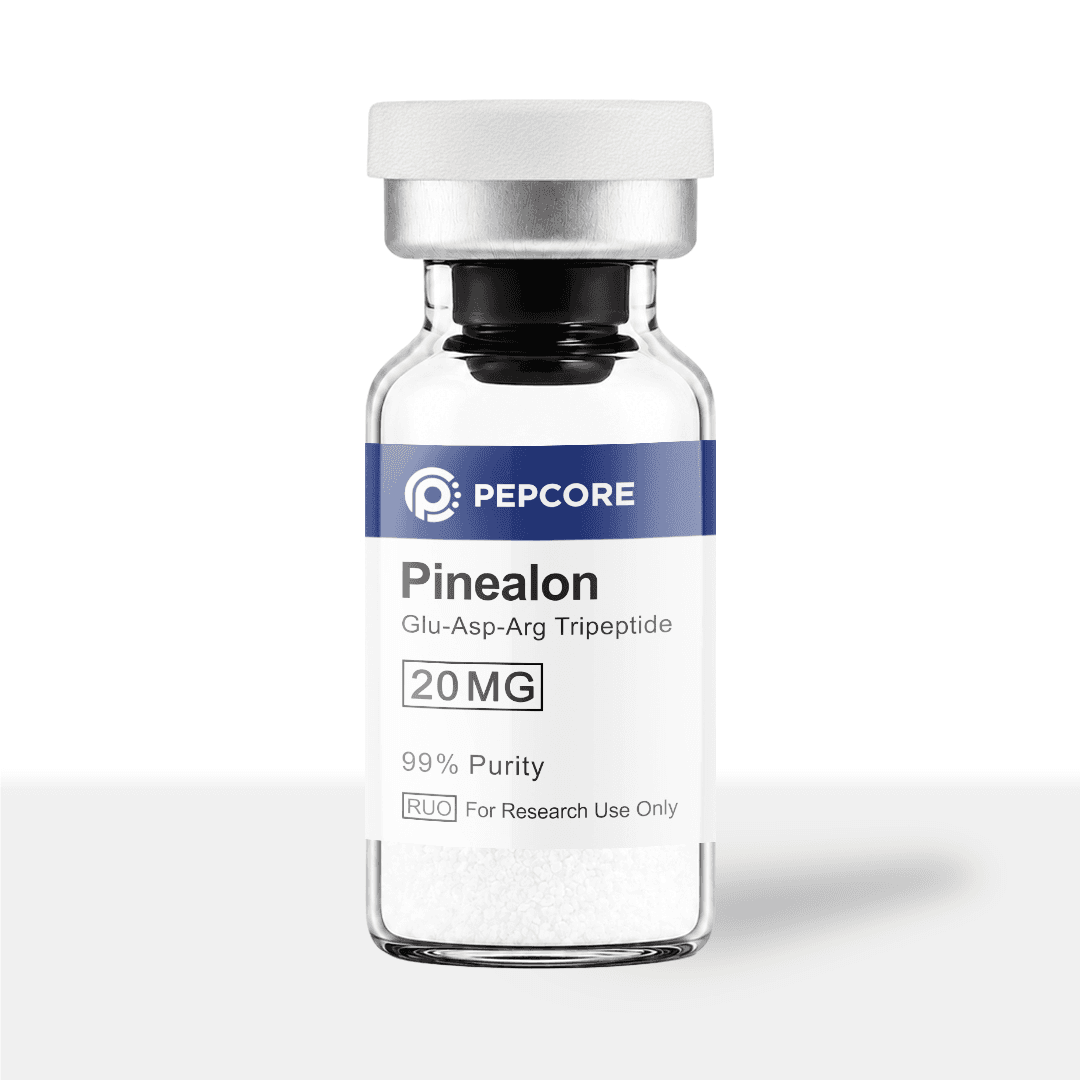
Pinealon
In Stock
Amount (mg)
Bacteriostatic Water
Insulin Syringes
Alcohol Swabs
Quantity
1
Price€109.00
Fast delivery, dispatched same day before 14:00
Tracked delivery, door to door
Shipped discreetly
Secure payments



Order before 14:00 for same-day shipping
Order now, ships today
OrderedToday
ShippedToday
Delivered24-25 November
Pinealon is a synthetic short peptide bioregulator built from three amino acids (the Glu-Asp-Arg, or EDR, sequence). It is best known in research for how it interacts with brain cells and pineal-gland biology, and it sits in the same peptide family that scientists pair with Epitalon in aging studies.
It also rests on a real body of work, including foundational gerontology research from the Khavinson group (Khavinson & Anisimov, 2009). That background is why it turns up so often as a reference peptide in this field.
Research Applications
•Short-peptide and neural-cell research
•Pineal-gland and aging studies
•Cognitive-pathway signaling research
•Peptide bioregulator reference models
Supplied as a lyophilized powder for stability.
Scientific Background
The concept of peptide bioregulation originated in research conducted at the Saint Petersburg Institute of Bioregulation and Gerontology, where Professor Vladimir Khavinson and colleagues identified a family of short tissue-specific peptides capable of modulating gene expression in the tissues from which they were derived. Within this framework, the pineal gland emerged as a particularly active site for short-peptide research, given its role in circadian rhythm regulation and age-related neuroendocrine balance.
Pinealon was characterized as a pineal-tropic tripeptide with the sequence Glu-Asp-Arg (EDR). Laboratory observations have suggested that bioregulators of this class can interact with specific DNA sequences and influence the transcription of genes linked to neurotrophic signaling, antioxidant defense, and synaptic-pathway proteins. Pinealon is frequently studied alongside Epitalon, the tetrapeptide bioregulator that emerged from the same research program.
This positioning at the intersection of peptide chemistry, neural-cell biology, and gerontology has made Pinealon a peptide of continued interest in studies of cognitive-pathway research, pineal-gland aging, and short-peptide gene-expression research.
Structure
Peptide ClassShort peptide bioregulator (Khavinson-school)
Amino Acid SequenceGlu-Asp-Arg (EDR)
Molecular FormulaC₁₅H₂₆N₆O₈
Molecular Weight~418.4 g/mol
CAS NumberN/A
Mechanism of Action
Neural Cell Engagement
Pinealon is investigated for its tissue-selective interaction with neural cells, including neurons and glial populations. Laboratory models indicate that short peptides of this class may enter target cells, where they engage with intracellular structures associated with transcriptional control and neurotrophic signaling.
Modulation of Neurotrophic Gene Expression
Khavinson-school research suggests that Pinealon can influence the expression of genes involved in neurotrophic factor synthesis, antioxidant defense, and synaptic-pathway proteins. Through these effects, the peptide is studied as a model compound for transcriptional regulation in neural and pineal-gland biology.
Cellular-Stress Adaptation
In research models of oxidative load and cellular stress, Pinealon has been examined for its association with balanced redox markers, reduced apoptosis indicators, and improved neural-cell resilience. These observations support its use in laboratory studies of cellular-stress adaptation and age-related neural decline.
Cognitive-Pathway Signaling
Pinealon has been studied within cognitive-pathway research models, where it is examined for its association with markers of learning, memory-related signaling, and behavioral adaptation. Research by Khavinson and Linkova has linked the peptide to cognitive-pathway research and neural-cell function in aged experimental models.
Conclusion
Pinealon is a short tripeptide bioregulator with selective activity in neural-cell and pineal-gland research. Through engagement of neural cells, modulation of neurotrophic gene expression, and contributions to cellular-stress adaptation, it serves as a valuable research compound in studies of cognitive-pathway signaling, age-related neural decline, and Khavinson-school peptide bioregulation.
References
•Khavinson VKh, Anisimov VN (2009). [35-year experience in research of peptide regulation of aging]. Advances in Gerontology. PubMed
•Khavinson VKh et al. (2003). Epithalon peptide induces telomerase activity and telomere elongation in human somatic cells. Bulletin of Experimental Biology and Medicine. PubMed
•Anisimov VN, Khavinson VKh (2010). Peptide bioregulation of aging: results and prospects. Biogerontology. PubMed
•Arutjunyan A et al. (2012). Pinealon protects the rat offspring from prenatal hyperhomocysteinemia. International Journal of Clinical and Experimental Medicine. PubMed
•Khavinson VK et al. (2021). Peptide Regulation of Gene Expression: A Systematic Review. Molecules. PubMed
Research Use Disclaimer
This product is intended for research and laboratory use only. It is designed exclusively for in vitro research purposes. All information provided is for educational and research reference only. This product is not intended for human or animal use. It is not a drug, food, or cosmetic and must not be marketed, labeled, or used as such. Use and handling are restricted to trained and qualified professionals.
What is Pinealon?
Pinealon is a synthetic short peptide bioregulator built from three amino acids (the Glu-Asp-Arg, or EDR, sequence). It is supplied as a lyophilized powder for laboratory research use only.
What is Pinealon used for in research?
In research, Pinealon is studied in areas such as: Short-peptide and neural-cell research, Pineal-gland and aging studies and Cognitive-pathway signaling research. Related compounds in our Bioregulators range include Thymogen and Testagen.
Where can I buy Pinealon?
Pinealon is available from Pepcore, shipped from the Netherlands to every European country with tracking. A certificate of analysis is available on request.
How is Pinealon reconstituted?
With bacteriostatic water, added slowly down the inside of the glass rather than onto the powder, then swirled gently, never shaken. Bacteriostatic water is optional when you order: you can add a 3 ml vial (+€4.99) or a 10 ml vial (+€12.99), or leave it out. Use our peptide calculator to work out the concentration for your vial size.
How is Pinealon stored, and how long does shipping take?
Lyophilized Pinealon is kept cool, dry and away from light. Once reconstituted, the solution is refrigerated at 2 to 8 °C, see our peptide stability guide. Orders leave the Netherlands the same or next business day: 1 to 2 business days to the Netherlands and Belgium, 2 to 7 to Germany, France, Spain, Italy and Luxembourg, 3 to 8 to the rest of the EU, free from €250, see shipping.
Amount (mg)10 mg, 20 mg
Bacteriostatic Water3 ml or 10 ml, optional
Insulin Syringes10× 1 ml insulin syringes, 10× 0.5 ml insulin syringes, None
Alcohol SwabsYes, No
TestingThird-party HPLC/MS
CASN/A
Netherlands & Belgium: 1-2 business days, €8.49-€12.99
Germany: 2-7 business days, €12.99
France, Spain, Italy & Luxembourg: 2-7 business days, €14.90
Rest of the EU: 3-8 business days, €14.90
Poland: 3-8 business days, €15.99
Sweden: 3-8 business days, €15.99
Switzerland, Norway, United Kingdom & other European countries outside the EU: 5-10 business days, €15.99
Canary Islands: 7-12 business days, €24.99
Free shipping on orders from €250
For laboratory and research use only.
Not for human or veterinary use, diagnosis, or treatment.
To be handled only by qualified personnel in a controlled lab setting.
By placing an order, you confirm you have read and agree to these research-use terms.


€109.00