Hair & Skin
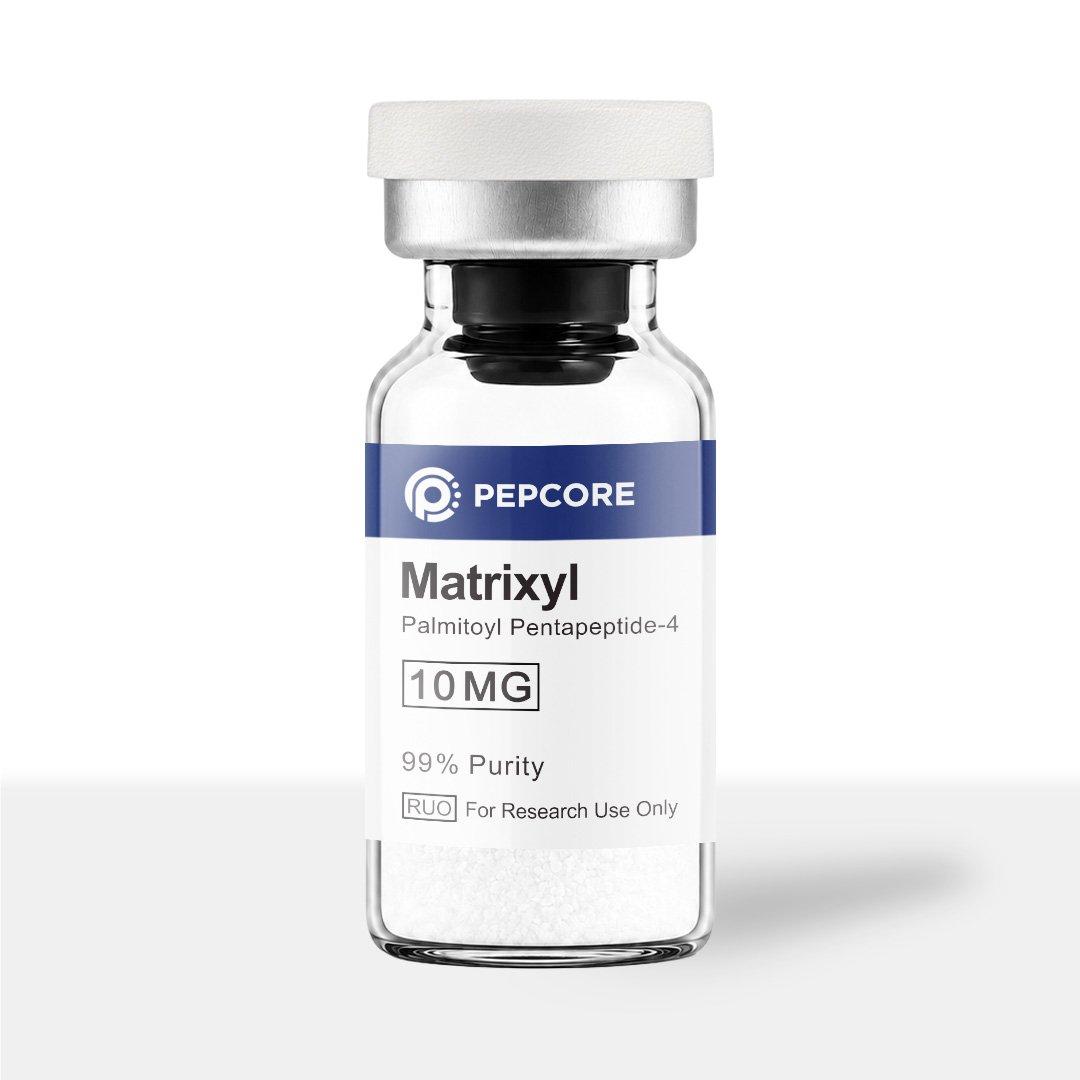
Matrixyl 10 mg
In Stock
Amount (mg)
Bacteriostatic Water
Insulin Syringes
Alcohol Swabs
Quantity
1
Price€39.00
Fast delivery, dispatched same day before 14:00
Tracked delivery, door to door
Shipped discreetly
Secure payments



Order before 14:00 for same-day shipping
Order now, ships today
OrderedToday
ShippedToday
Delivered24-25 November
Matrixyl is palmitoyl pentapeptide-4 (Pal-KTTKS), a short peptide linked to a fatty-acid chain. Its KTTKS core can increase collagen and fibronectin production in cultured cells. These proteins form part of the extracellular matrix, the network surrounding cells that gives tissues structure. Pal-KTTKS is studied for how it changes matrix-related signals and fibroblast behavior.
The peptide also influences fibroblast contractility and maturation markers in cell-based models. Its palmitoyl group changes how it interacts with water, lipids and carrier systems, so the free peptide and formulated versions can behave differently. Researchers separate these physical effects from changes in collagen output and cell responses rather than assuming every preparation gives the same result (Katayama et al., 1993; Park et al., 2017).
Research Applications
•Studied in collagen and fibronectin production models
•Relevant in skin matrix biology research
•Examined in fibroblast contraction studies
•Applied in connective-tissue remodeling research
Supplied as a lyophilized powder for stability.
Scientific Background
The sequence Lys-Thr-Thr-Lys-Ser comes from a region of type I procollagen, the precursor of collagen. Early cell work identified KTTKS as the smallest active segment of a larger fragment that stimulated matrix production. This led to the idea that fragments released during matrix remodeling can act as feedback signals. Katayama et al., 1993.
Matrixyl adds a palmitoyl chain to the N-terminus of KTTKS. This makes the molecule more lipid-associated and changes its surface activity. It is a defined lipopeptide, with a five-amino-acid sequence and a lipid group; it is distinct from longer collagen proteins and from other products sold under related trade names.
The original KTTKS findings and later Pal-KTTKS experiments answer related but different questions. Sequence effects, lipidation and the carrier system should be considered separately. Published fibroblast work includes collagen measurements and changes in α-smooth-muscle actin, a marker associated with a more contractile cell state.
Structure
ClassPalmitoylated signal pentapeptide
SequencePal-Lys-Thr-Thr-Lys-Ser-OH (Pal-KTTKS)
ModificationN-terminal palmitoylation; free C-terminal carboxyl group
FormulaC₃₉H₇₅N₇O₁₀
Molar mass802.07 g/mol
CAS214047-00-4
DatabasePubChem CID 9897237
SynonymsPalmitoyl pentapeptide-4, Palmitoyl pentapeptide-3, Pal-KTTKS, Lipopentapeptide 3
Mechanism of Action
A signal linked to the matrix
Cells respond to fragments of their surrounding matrix as well as to intact structural proteins. The KTTKS sequence is studied as one such signal. Its proposed feedback role connects procollagen processing with new matrix production. This does not identify a single confirmed receptor for every effect of Pal-KTTKS, but provides a biological framework for cell-culture comparisons.
Changes in fibroblast behavior
Fibroblasts produce matrix proteins and can acquire a more contractile state. Pal-KTTKS altered α-smooth-muscle-actin expression and contraction-related measurements in published cultures. These endpoints concern how cells behave within an experimental matrix. They are distinct from proving visible changes in skin or a wound outcome from this research material. Park et al., 2017.
The lipid group and carrier matter
The palmitoyl chain changes solubility and surface activity relative to KTTKS. In NIH-3T3 fibroblast experiments, liposome-associated Pal-KTTKS produced a different collagen response from free peptide. Comparisons therefore account for both the peptide and its delivery environment, with carrier controls helping separate their contributions. Mortazavi et al., 2019; Vitali et al., 2024.
References
•Park H et al. (2017). Pal-KTTKS, fibroblast contractility and α-smooth-muscle-actin expression. PubMed
•Vitali A et al. (2024). Pal-KTTKS liposomes and collagen measurements in fibroblast cultures. PubMed
Research Use Disclaimer
This product is intended for in vitro laboratory research only. All information is provided for education and research reference. Not for personal use, diagnosis or treatment. Handling is restricted to trained and qualified professionals.
What is Matrixyl?
Matrixyl is palmitoyl pentapeptide-4 (Pal-KTTKS), a short peptide linked to a fatty-acid chain. It is supplied as a lyophilized powder for laboratory research use only.
What is Matrixyl used for in research?
In research, Matrixyl is studied in collagen and fibronectin production models, in skin matrix biology research as well as in fibroblast contraction studies. Related compounds in our Hair & Skin range include PT-141 and Melanotan 2.
Where can I buy Matrixyl?
Matrixyl is available from Pepcore, shipped from the Netherlands to every European country with tracking. A certificate of analysis is available on request.
How is Matrixyl reconstituted?
With bacteriostatic water, added slowly down the inside of the glass rather than onto the powder, then swirled gently, never shaken. Bacteriostatic water is optional when you order: you can add a 3 ml vial (+€4.99) or a 10 ml vial (+€12.99), or leave it out. Use our peptide calculator to work out the concentration for your vial size.
How is Matrixyl stored, and how long does shipping take?
Lyophilized Matrixyl is kept cool, dry and away from light. Once reconstituted, the solution is refrigerated at 2 to 8 °C, see our peptide stability guide. Orders leave the Netherlands the same or next business day: 1 to 2 business days to the Netherlands and Belgium, 2 to 7 to Germany, France, Spain, Italy and Luxembourg, 3 to 8 to the rest of the EU, free from €250, see shipping.
Amount (mg)10 mg
Bacteriostatic Water3 ml or 10 ml, optional
Insulin Syringes10× 1 ml insulin syringes, 10× 0.5 ml insulin syringes, None
Alcohol SwabsYes, No
TestingThird-party HPLC/MS
CAS214047-00-4
Netherlands & Belgium: 1-2 business days, €8.49-€12.99
Germany: 2-7 business days, €12.99
France, Spain, Italy & Luxembourg: 2-7 business days, €14.90
Rest of the EU: 3-8 business days, €14.90
Poland: 3-8 business days, €15.99
Sweden: 3-8 business days, €15.99
Switzerland, Norway, United Kingdom & other European countries outside the EU: 5-10 business days, €15.99
Canary Islands: 7-12 business days, €24.99
Free shipping on orders from €250
For laboratory and research use only.
Not for human or veterinary use, diagnosis, or treatment.
To be handled only by qualified personnel in a controlled lab setting.
By placing an order, you confirm you have read and agree to these research-use terms.
Related products


€39.00