Hair & Skin
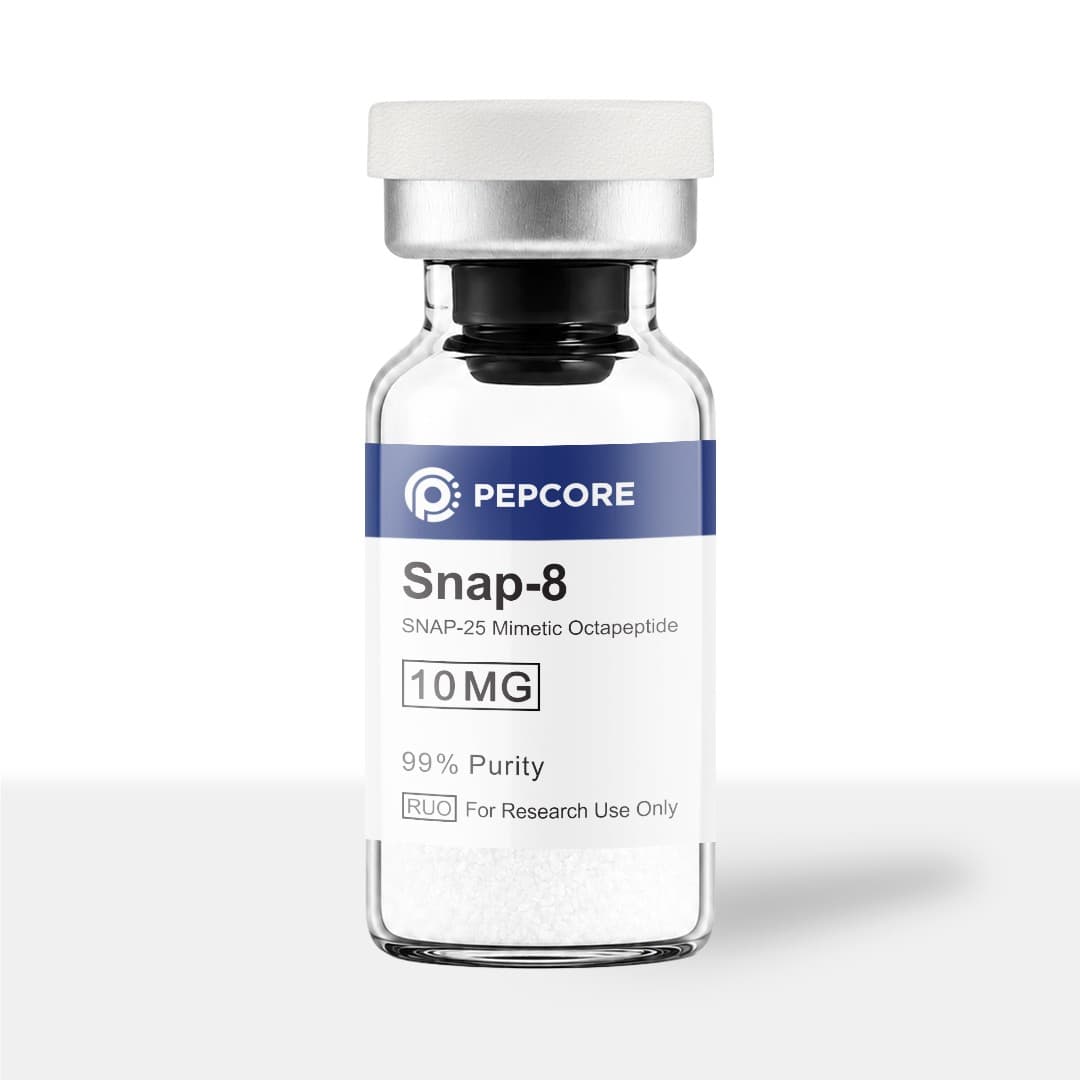
Snap-8 10 mg
In Stock
Amount (mg)
Bacteriostatic Water
Insulin Syringes
Alcohol Swabs
Quantity
1
Price€59.00
Fast delivery, dispatched same day before 14:00
Tracked delivery, door to door
Shipped discreetly
Secure payments



Order before 14:00 for same-day shipping
Order now, ships today
OrderedToday
ShippedToday
Delivered24-25 November
Snap-8 (Acetyl Octapeptide-3) is a synthetic cosmetic-research peptide made of eight amino acids, modeled on a short piece of the SNAP-25 protein. It is best known as a longer version of Argireline, with two extra building blocks that change how it behaves in lab models.
It also has a research base behind it, with work looking at how this kind of peptide interacts with the signaling pathways studied in skin-surface science (Blanes-Mira et al., 2002, International Journal of Cosmetic Science). That is why it shows up often as a reference compound in topical-peptide studies.
Research Applications
•Skin-surface science research
•Topical-peptide laboratory models
•Peptide binding and interaction studies
•Cosmetic-research and reference work
Supplied as a lyophilized powder for stability.
Scientific Background
The development of Snap-8 emerged from a broader research direction in the early 2000s that sought peptide-based alternatives to neurotoxin-based research models for studying expression-line biology. Researchers at the Universidad Miguel Hernández identified a short hexapeptide segment (Argireline) derived from the N-terminus of SNAP-25 that was capable of mimicking the binding interface of this protein within the SNARE complex. Snap-8 was developed as an extended octapeptide built on the same conceptual framework.
Further work in cosmetic-science laboratories characterized the binding affinity, stability, and topical-formulation behavior of Snap-8. By extending the sequence to eight residues, formulators sought to improve interaction with the SNARE complex while retaining the favorable safety profile observed for the shorter parent peptide. Comparative studies have explored differences in binding kinetics, hydrolytic stability, and surface-penetration behavior between Argireline and Snap-8 in cell-free and skin-model systems.
Today, Snap-8 occupies a defined position within the cosmetic-research peptide category. It is referenced in topical-delivery research, formulation-compatibility studies, and SNARE-pathway investigations, and continues to be evaluated as a research tool for laboratories investigating peptide-based alternatives to neurotoxin research models.
Structure
Peptide ClassSynthetic cosmetic-research peptide (SNAP-25 N-terminal mimetic)
Amino Acid SequenceAc-Glu-Glu-Met-Gln-Arg-Arg-Ala-Asp-NH₂
Molecular FormulaC₄₁H₇₀N₁₆O₁₆S
Molecular Weight~1075.2 g/mol
CAS NumberN/A
Mechanism of Action
SNARE-Complex Competitive Interaction
Snap-8 is studied for its capacity to compete with endogenous SNAP-25 in the assembly of the SNARE complex. In research models, this competitive interaction is examined as a mechanism that attenuates the efficiency of vesicle-fusion machinery, which in turn modulates signaling outputs associated with muscle contraction at the cellular level.
Acetylcholine-Release Signaling in Cellular Models
By influencing SNARE-complex formation, Snap-8 is investigated for its downstream effects on acetylcholine release in laboratory neuromuscular-junction models. Reduced vesicle-fusion efficiency in these in vitro systems is associated with diminished contraction-related signaling, providing a research framework distinct from neurotoxin-based experimental approaches.
Topical-Penetration and Surface-Layer Behavior
Snap-8 is characterized in formulation-research contexts for its behavior in topical carrier systems. Investigations examine its stability in cosmetic emulsions, compatibility with common excipients, and surface-layer penetration in skin-model assays such as Franz-cell diffusion studies. These properties make it a useful reference compound in topical-peptide research.
Expression-Line and Skin-Surface Research
In cosmetic-research models, Snap-8 is studied for its potential influence on visible expression-line metrics in controlled laboratory protocols. Research instruments measure micro-relief, surface texture, and contraction-related skin parameters in standardized cohorts, providing a quantitative readout of peptide activity in surface-research contexts.
Conclusion
Snap-8 is a synthetic octapeptide of considerable interest in cosmetic and topical-peptide research. Its position as a SNAP-25-derived sequence allows researchers to study SNARE-complex biology and contraction-related signaling in controlled laboratory settings. Continued investigation supports its role as a reference tool in topical-peptide and surface-research model studies.
References
•Blanes-Mira C et al. (2002). A synthetic hexapeptide (Argireline) with antiwrinkle activity. International Journal of Cosmetic Science. PubMed
•Wang Y et al. (2013). The anti-wrinkle efficacy of argireline, a synthetic hexapeptide, in Chinese subjects: a randomized, placebo-controlled study. American Journal of Clinical Dermatology. PubMed
•Ruiz MA et al. (2007). Preparation and stability of cosmetic formulations with an anti-aging peptide. Journal of Cosmetic Science. PubMed
•Gorouhi F, Maibach HI (2009). Role of topical peptides in preventing or treating aged skin. International Journal of Cosmetic Science. PubMed
•Reddy BY et al. (2012). Bioactive oligopeptides in dermatology: Part II. Experimental Dermatology. PubMed
•Pickart L, Margolina A (2018). Regenerative and Protective Actions of the GHK-Cu Peptide in the Light of the New Gene Data. International Journal of Molecular Sciences. PubMed
Research Use Disclaimer
This product is intended for research and laboratory use only. It is designed exclusively for in vitro research purposes. All information provided is for educational and research reference only. This product is not intended for human or animal use. It is not a drug, food, or cosmetic and must not be marketed, labeled, or used as such. Use and handling are restricted to trained and qualified professionals.
What is Snap-8?
Snap-8 (Acetyl Octapeptide-3) is a synthetic cosmetic-research peptide made of eight amino acids, modeled on a short piece of the SNAP-25 protein. It is supplied as a lyophilized powder for laboratory research use only.
What is Snap-8 used for in research?
In research, Snap-8 is studied in areas such as: Skin-surface science research, Topical-peptide laboratory models and Peptide binding and interaction studies. Related compounds in our Hair & Skin range include PT-141 and Melanotan 2.
Where can I buy Snap-8?
Snap-8 is available from Pepcore, shipped from the Netherlands to every European country with tracking. A certificate of analysis is available on request.
How is Snap-8 reconstituted?
With bacteriostatic water, added slowly down the inside of the glass rather than onto the powder, then swirled gently, never shaken. Bacteriostatic water is optional when you order: you can add a 3 ml vial (+€4.99) or a 10 ml vial (+€12.99), or leave it out. Use our peptide calculator to work out the concentration for your vial size.
How is Snap-8 stored, and how long does shipping take?
Lyophilized Snap-8 is kept cool, dry and away from light. Once reconstituted, the solution is refrigerated at 2 to 8 °C, see our peptide stability guide. Orders leave the Netherlands the same or next business day: 1 to 2 business days to the Netherlands and Belgium, 2 to 7 to Germany, France, Spain, Italy and Luxembourg, 3 to 8 to the rest of the EU, free from €250, see shipping.
Amount (mg)10mg
Bacteriostatic Water3 ml or 10 ml, optional
Insulin Syringes10× 1 ml insulin syringes, 10× 0.5 ml insulin syringes, None
Alcohol SwabsYes, No
TestingThird-party HPLC/MS
CASN/A
Netherlands & Belgium: 1-2 business days, €8.49-€12.99
Germany: 2-7 business days, €12.99
France, Spain, Italy & Luxembourg: 2-7 business days, €14.90
Rest of the EU: 3-8 business days, €14.90
Poland: 3-8 business days, €15.99
Sweden: 3-8 business days, €15.99
Switzerland, Norway, United Kingdom & other European countries outside the EU: 5-10 business days, €15.99
Canary Islands: 7-12 business days, €24.99
Free shipping on orders from €250
For laboratory and research use only.
Not for human or veterinary use, diagnosis, or treatment.
To be handled only by qualified personnel in a controlled lab setting.
By placing an order, you confirm you have read and agree to these research-use terms.


€59.00