Cognitive
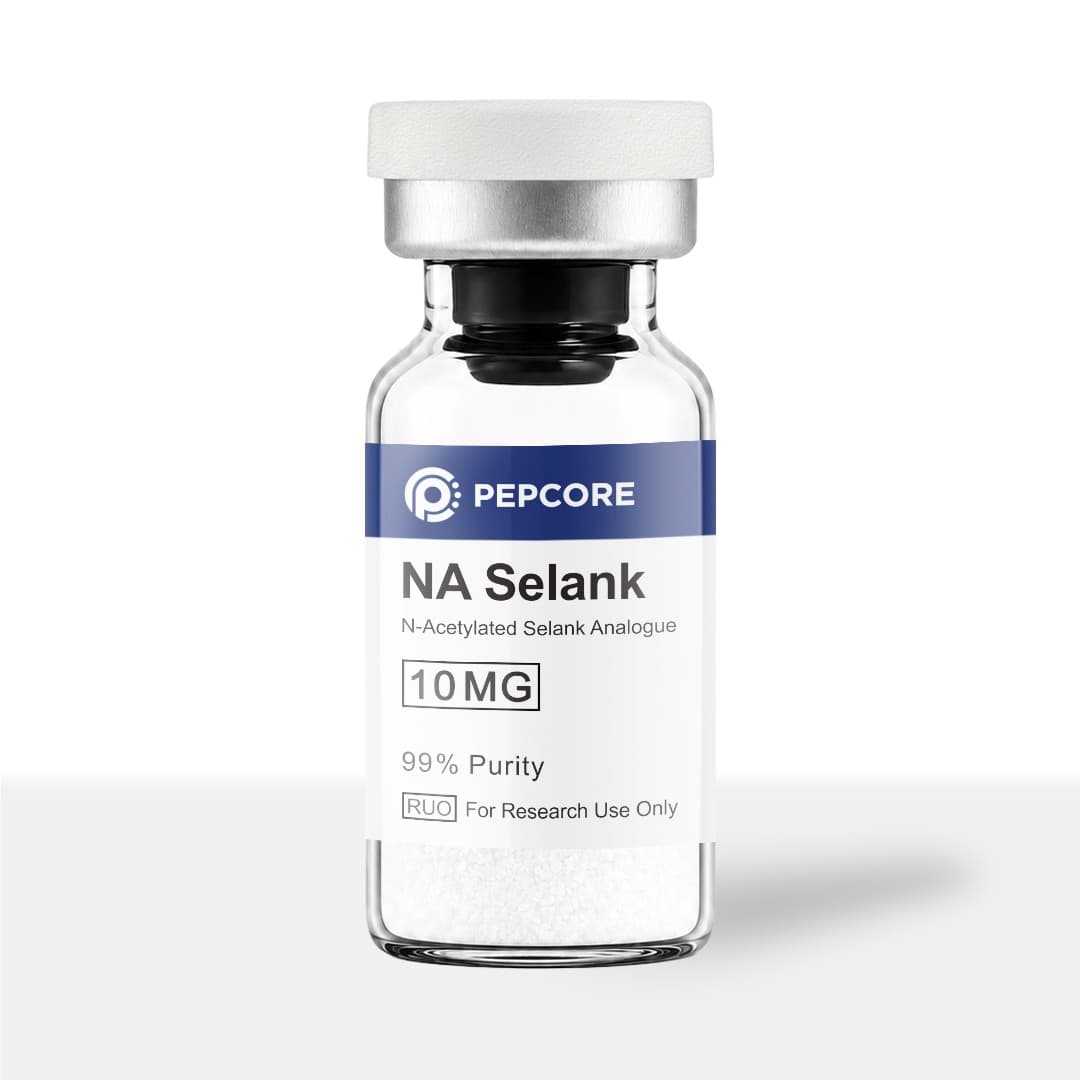
NA Selank
In Stock
Amount (mg)
Bacteriostatic Water
Insulin Syringes
Alcohol Swabs
Quantity
1
Price€59.00
Fast delivery, dispatched same day before 14:00
Tracked delivery, door to door
Shipped discreetly
Secure payments



Order before 14:00 for same-day shipping
Order now, ships today
OrderedToday
ShippedToday
Delivered24-25 November
NA Selank is an acetylated version of Selank, a short synthetic peptide chain of seven amino acids derived from a small piece of the natural protein tuftsin. It is best known in cognitive and behavioral research, and what makes it different is the acetyl cap added to its end, which is meant to make the molecule more stable.
It builds on a solid research base, with the original Selank explored for how it interacts with brain signaling and stability in lab settings (Volkova et al., 2016, Frontiers in Pharmacology). That history is why it often turns up as a reference peptide in this kind of work.
Research Applications
•Cognitive and behavioral research
•Peptide stability studies
•Tuftsin-related peptide research
•Brain-signaling reference models
Supplied as a lyophilized powder for stability.
Scientific Background
The tuftsin-derived peptide family has been a focal point of neuropeptide and immunomodulatory research since the 1970s, when investigators characterized the natural tetrapeptide Tuftsin (Thr-Lys-Pro-Arg) as a regulator of macrophage and lymphocyte activity. Building on this framework, researchers at the Institute of Molecular Genetics of the Russian Academy of Sciences extended the Tuftsin sequence with a Pro-Gly-Pro tripeptide tail to develop Selank, a heptapeptide with improved metabolic stability and a broader research profile spanning GABAergic neurotransmission, neurotrophic factor expression, and immune signaling.
NA Selank was developed within the analog program associated with this peptide family, in which N-terminal modifications are used as a tool to probe the structural determinants of tuftsin-derived peptide function. Acetylation of the N-terminal threonine eliminates a primary aminopeptidase recognition site and modifies local interactions with binding partners. Comparative studies of Ac-Selank versus Selank have examined the resulting changes in enzymatic stability, GABAergic-binding chemistry, cytokine regulation, and gene-expression profiles in central nervous system tissue research models.
NA Selank occupies a defined position in the Pepcore tuftsin-analog research catalog as a chemically stabilized counterpart to native Selank. It is studied alongside Selank 10 mg and other neuropeptide research tools in laboratories investigating tuftsin-derived peptide chemistry, neuro-immune interactions, and the role of N-terminal modifications in heptapeptide function.
Structure
Peptide ClassN-acetylated tuftsin-derived synthetic heptapeptide
Amino Acid SequenceAc-Thr-Lys-Pro-Arg-Pro-Gly-Pro
Molecular FormulaC₃₅H₅₉N₁₁O₁₀
Molecular Weight~793 g/mol
CAS Number2212313-10-6
Mechanism of Action
Enhanced Enzymatic Stability
The N-terminal acetyl group on NA Selank shields the threonine alpha-amine from aminopeptidase recognition, a primary entry point for rapid degradation of native Selank in plasma and brain tissue preparations. Research models indicate that this modification extends the functional half-life of the peptide in laboratory matrices, supporting experimental designs that require longer-duration exposure than is feasible with the parent sequence.
Modified GABAergic-Binding Profile
Native Selank is studied for its influence on GABAergic neurotransmission through subtype-selective, concentration-dependent mechanisms. Acetylation of the N-terminus in NA Selank alters the local electrostatic and steric environment around the threonine and lysine residues, and research models indicate that this can modify the GABAergic-binding profile of the heptapeptide. Comparative experiments examine how the modification reshapes the influence of the peptide on adaptive-signalling and stress-response readouts.
Tuftsin-Derived Immune Signaling
The Thr-Lys-Pro-Arg motif at the N-terminal end of Selank carries the tuftsin recognition sequence associated with macrophage and lymphocyte signaling. N-acetylation in NA Selank caps this terminus and modifies its interaction with tuftsin-related immune pathways, including cytokine balance and T-helper cell signaling. Research models examine how these chemical changes influence neuro-immune communication and post-infectious immune regulation in laboratory contexts.
Neurotrophic and Gene-Expression Research
Like its parent compound, NA Selank is investigated for its influence on BDNF expression and gene-expression profiles in central nervous system tissue. Comparative transcriptomic experiments examine how N-terminal acetylation reshapes the patterns of gene regulation previously reported for native Selank, including genes related to GABAergic neurotransmission, inflammatory signaling, and neurotrophic factor pathways.
Conclusion
NA Selank is a chemically stabilized analog of Selank in which N-terminal acetylation extends proteolytic resistance and reshapes interactions across GABAergic, tuftsin-related immune, and neurotrophic signaling pathways. Through its modified stability profile and altered binding chemistry, NA Selank serves as a research tool for investigating how N-terminal chemistry contributes to tuftsin-derived heptapeptide function and for comparative studies alongside the parent molecule.
References
•Volkova A et al. (2016). Selank Administration Affects the Expression of Some Genes Involved in GABAergic Neurotransmission. Frontiers in Pharmacology. PubMed
•Kolomin TA et al. (2010). Transcriptomic response of rat hippocampus and spleen cells to single and chronic administration of the peptide selank. Doklady Biochemistry and Biophysics. PubMed
•Narkevich VB et al. (2008). [Effects of heptapeptide selank on the content of monoamines and their metabolites in the brain of BALB/C and C57Bl/6 mice: a comparative study]. Eksperimental'naya i Klinicheskaya Farmakologiya. PubMed
•Kozlovskaya MM et al. (2003). Selank and short peptides of the tuftsin family in the regulation of adaptive behavior in stress. Neuroscience and Behavioral Physiology. PubMed
•Uchakina ON et al. (2008). [Immunomodulatory effects of selank in patients with anxiety-asthenic disorders]. Zhurnal Nevrologii i Psikhiatrii imeni S.S. Korsakova. PubMed
Research Use Disclaimer
This product is intended for research and laboratory use only. It is designed exclusively for in vitro research purposes. All information provided is for educational and research reference only. This product is not intended for human or animal use. It is not a drug, food, or cosmetic and must not be marketed, labeled, or used as such. Use and handling are restricted to trained and qualified professionals.
What is NA Selank?
NA Selank is an acetylated version of Selank, a short synthetic peptide chain of seven amino acids derived from a small piece of the natural protein tuftsin. It is supplied as a lyophilized powder for laboratory research use only.
What is NA Selank used for in research?
In research, NA Selank is studied in areas such as: Cognitive and behavioral research, Peptide stability studies and Tuftsin-related peptide research. Related compounds in our Cognitive range include NA Semax and Adamax.
Where can I buy NA Selank?
NA Selank is available from Pepcore, shipped from the Netherlands to every European country with tracking. A certificate of analysis is available on request.
How is NA Selank reconstituted?
With bacteriostatic water, added slowly down the inside of the glass rather than onto the powder, then swirled gently, never shaken. Bacteriostatic water is optional when you order: you can add a 3 ml vial (+€4.99) or a 10 ml vial (+€12.99), or leave it out. Use our peptide calculator to work out the concentration for your vial size.
How is NA Selank stored, and how long does shipping take?
Lyophilized NA Selank is kept cool, dry and away from light. Once reconstituted, the solution is refrigerated at 2 to 8 °C, see our peptide stability guide. Orders leave the Netherlands the same or next business day: 1 to 2 business days to the Netherlands and Belgium, 2 to 7 to Germany, France, Spain, Italy and Luxembourg, 3 to 8 to the rest of the EU, free from €250, see shipping.
Amount (mg)10 mg, 50 mg
Bacteriostatic Water3 ml or 10 ml, optional
Insulin Syringes10× 1 ml insulin syringes, 10× 0.5 ml insulin syringes, None
Alcohol SwabsYes, No
TestingThird-party HPLC/MS
CAS2212313-10-6
Netherlands & Belgium: 1-2 business days, €8.49-€12.99
Germany: 2-7 business days, €12.99
France, Spain, Italy & Luxembourg: 2-7 business days, €14.90
Rest of the EU: 3-8 business days, €14.90
Poland: 3-8 business days, €15.99
Sweden: 3-8 business days, €15.99
Switzerland, Norway, United Kingdom & other European countries outside the EU: 5-10 business days, €15.99
Canary Islands: 7-12 business days, €24.99
Free shipping on orders from €250
For laboratory and research use only.
Not for human or veterinary use, diagnosis, or treatment.
To be handled only by qualified personnel in a controlled lab setting.
By placing an order, you confirm you have read and agree to these research-use terms.


€59.00