Cognitive
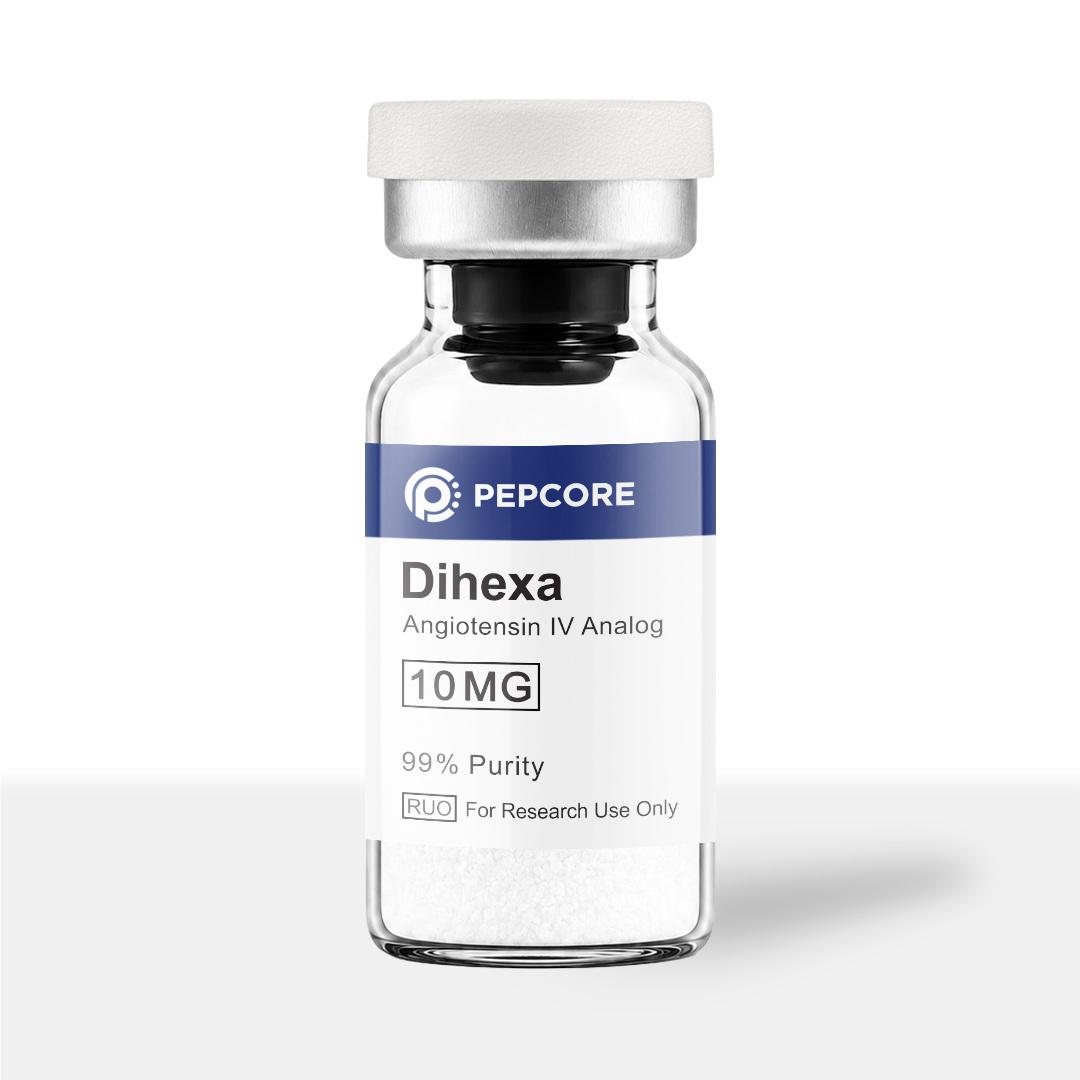
Dihexa
In Stock
Amount (mg)
Bacteriostatic Water
Insulin Syringes
Alcohol Swabs
Quantity
1
Price€54.00
Fast delivery, dispatched same day before 14:00
Tracked delivery, door to door
Shipped discreetly
Secure payments



Order before 14:00 for same-day shipping
Order now, ships today
OrderedToday
ShippedToday
Delivered24-25 November
Dihexa (PNB-0408) is a small, metabolically stable analog of angiotensin IV built on a capped Tyr-Ile core. It crosses the blood-brain barrier in animal models and acts on HGF/c-Met signalling, which is why it is used in memory, synapse formation and neurodegeneration research.
Dihexa is studied for learning and synaptic connectivity, with work in APP/PS1 mice reporting restored spatial learning in the Morris water maze and lower inflammatory markers via PI3K/AKT signalling (Sun et al., 2021, Brain Sciences).
Research Applications
•Studied in memory and learning research models
•Relevant in research on synaptogenesis and dendritic spine growth
•Examined in neurodegeneration and brain injury studies
•Applied in HGF/c-Met signalling work
Supplied as a lyophilized powder for stability.
Scientific Background
Angiotensin IV (AngIV, Val-Tyr-Ile-His-Pro-Phe) is a fragment of the brain renin-angiotensin system that has long been linked to learning and memory in rodent models. Its value as a research tool was limited because the native hexapeptide is degraded quickly and does not readily cross the blood-brain barrier.
Work at Washington State University narrowed the active core of the analog Nle1-AngIV to its first three residues, Nle-Tyr-Ile, and showed that procognitive activity tracked with increases in dendritic spine number and spine head size. Further N- and C-terminal changes, designed to raise stability and hydrophobicity, produced Dihexa (N-hexanoic-Tyr-Ile-(6) aminohexanoic amide).
Dihexa reversed scopolamine-induced deficits in Morris water maze performance, improved performance in aged rats, and showed marked synaptogenic activity, which has made it a research tool in synaptic connectivity and HGF/c-Met studies.
Structure
Peptide ClassSynthetic angiotensin IV-derived peptidomimetic (capped Tyr-Ile dipeptide)
Amino Acid SequenceHexanoyl-Tyr-Ile-Ahx-NH2 (Ahx = 6-aminohexanoic acid)
Molecular FormulaC₂₇H₄₄N₄O₅
Molecular Weight504.7 g/mol
CAS Number1401708-83-5
PubChem CID129010512
SynonymsPNB-0408
Mechanism of Action
Stabilized AngIV Scaffold
Dihexa keeps the Tyr-Ile core of Nle1-AngIV, capped with a hexanoyl group at the N-terminus and a 6-aminohexanoic amide at the C-terminus. These changes raise hydrophobicity and peptidase resistance and allow blood-brain barrier penetration in rodent models.
HGF/c-Met Signalling
Dihexa is described as a hepatocyte growth factor (HGF) mimetic that pairs with endogenous HGF to activate the c-Met receptor. In zebrafish hair-cell models its protective effect was reduced by the HGF antagonist 6-AH and by inhibitors of Akt, TOR and MEK.
Synaptogenesis and Spine Growth
Dihexa showed marked synaptogenic activity in hippocampal models, and across the AngIV analog series procognitive activity tracked with dendritic spine number and spine head size.
PI3K/AKT and Neuroinflammation
In APP/PS1 mice Dihexa activated PI3K/AKT signalling, raised synaptophysin, reduced astrocyte and microglia activation, lowered IL-1β and TNF-α and raised IL-10. The PI3K inhibitor wortmannin reversed its anti-inflammatory and anti-apoptotic effects.
Brain Injury Models
In a rat model of repeated mild traumatic brain injury, Dihexa dose-dependently rescued working memory deficits, and the MET antagonist Hinge blocked this effect.
Conclusion
Dihexa is a stabilized angiotensin IV analog linking the brain AngIV system to HGF/c-Met signalling, a research tool for synaptic connectivity, memory and neuroprotection studies in laboratory models.
References
•McCoy AT et al. (2013). Evaluation of metabolically stabilized angiotensin IV analogs as procognitive/antidementia agents. The Journal of Pharmacology and Experimental Therapeutics. PubMed
•Benoist CC et al. (2011). Facilitation of hippocampal synaptogenesis and spatial memory by C-terminal truncated Nle1-angiotensin IV analogs. The Journal of Pharmacology and Experimental Therapeutics. PubMed
•Wright JW, Harding JW (2015). The Brain Hepatocyte Growth Factor/c-Met Receptor System: A New Target for the Treatment of Alzheimer's Disease. Journal of Alzheimer's Disease. PubMed
•Uribe PM et al. (2015). Hepatocyte growth factor mimetic protects lateral line hair cells from aminoglycoside exposure. Frontiers in Cellular Neuroscience. PubMed
•Sun X et al. (2021). AngIV-Analog Dihexa Rescues Cognitive Impairment and Recovers Memory in the APP/PS1 Mouse via the PI3K/AKT Signaling Pathway. Brain Sciences. PubMed
•Martino KA et al. (2025). Hepatocyte Growth Factor/MET Activator Rescues Working Memory Deficits after Repeated Mild Traumatic Brain Injury. Neurotrauma Reports. PubMed
Research Use Disclaimer
This product is intended for research and laboratory use only. It is designed exclusively for in vitro research purposes. All information provided is for educational and research reference only. This product is not intended for human or animal use. It is not a drug, food, or cosmetic and must not be marketed, labeled, or used as such. Use and handling are restricted to trained and qualified professionals.
What is Dihexa?
Dihexa (PNB-0408) is a small, metabolically stable analog of angiotensin IV built on a capped Tyr-Ile core. It is supplied as a lyophilized powder for laboratory research use only.
What is Dihexa used for in research?
In research, Dihexa is studied in memory and learning research models, in research on synaptogenesis and dendritic spine growth as well as in neurodegeneration and brain injury studies. Related compounds in our Cognitive range include NA Semax and NA Selank.
Where can I buy Dihexa?
Dihexa is available from Pepcore, shipped from the Netherlands to every European country with tracking. A certificate of analysis is available on request.
How is Dihexa reconstituted?
With bacteriostatic water, added slowly down the inside of the glass rather than onto the powder, then swirled gently, never shaken. Bacteriostatic water is optional when you order: you can add a 3 ml vial (+€4.99) or a 10 ml vial (+€12.99), or leave it out. Use our peptide calculator to work out the concentration for your vial size.
How is Dihexa stored, and how long does shipping take?
Lyophilized Dihexa is kept cool, dry and away from light. Once reconstituted, the solution is refrigerated at 2 to 8 °C, see our peptide stability guide. Orders leave the Netherlands the same or next business day: 1 to 2 business days to the Netherlands and Belgium, 2 to 7 to Germany, France, Spain, Italy and Luxembourg, 3 to 8 to the rest of the EU, free from €250, see shipping.
Amount (mg)10 mg
Bacteriostatic Water3 ml or 10 ml, optional
Insulin Syringes10× 1 ml insulin syringes, 10× 0.5 ml insulin syringes, None
Alcohol SwabsYes, No
TestingThird-party HPLC/MS
CAS1401708-83-5
Netherlands & Belgium: 1-2 business days, €8.49-€12.99
Germany: 2-7 business days, €12.99
France, Spain, Italy & Luxembourg: 2-7 business days, €14.90
Rest of the EU: 3-8 business days, €14.90
Poland: 3-8 business days, €15.99
Sweden: 3-8 business days, €15.99
Switzerland, Norway, United Kingdom & other European countries outside the EU: 5-10 business days, €15.99
Canary Islands: 7-12 business days, €24.99
Free shipping on orders from €250
For laboratory and research use only.
Not for human or veterinary use, diagnosis, or treatment.
To be handled only by qualified personnel in a controlled lab setting.
By placing an order, you confirm you have read and agree to these research-use terms.


€54.00