Hair & Skin
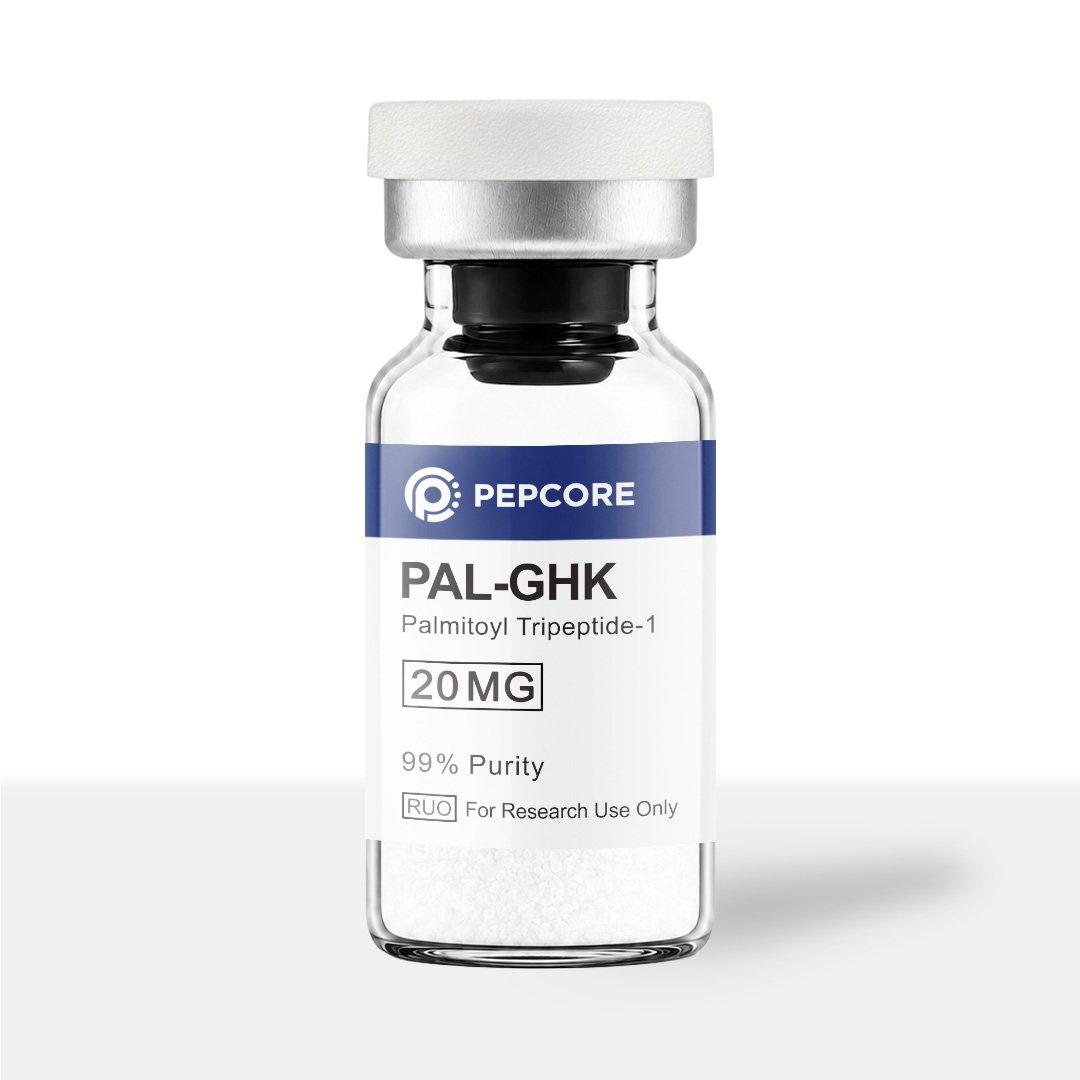
PAL-GHK 20 mg
Out of Stock
Amount (mg)
Bacteriostatic Water
Insulin Syringes
Alcohol Swabs
Quantity
1
Price€49.00
Fast delivery, dispatched same day before 14:00
Tracked delivery, door to door
Shipped discreetly
Secure payments



Order before 14:00 for same-day shipping
Order now, ships today
OrderedToday
ShippedToday
Delivered24-25 November
PAL-GHK combines Gly-His-Lys (GHK) with a palmitoyl fatty-acid chain. This changes how the molecule behaves in water and systems containing lipids. It can assemble into ordered molecular clusters, making its formulation behavior a focus of laboratory research. PAL-GHK does not contain copper.
Self-assembly means that individual molecules group together into larger structures. Published work has observed crystal-like aggregates of C16-GHK and examined how its behavior changes in mixtures with other ingredients. Analytical research also uses PAL-GHK as a reference signal when measuring related peptides in formulations (Castelletto et al., 2013; Zhang et al., 2016; Chirita et al., 2009).
Research Applications
•Studied in skin-care formulation research
•Relevant in peptide self-assembly research
•Examined in lipid–peptide interactions studies
•Applied in gel structure in mixed formulations research
Supplied as a lyophilized powder for stability.
Scientific Background
The GHK sequence contains glycine, histidine and lysine. Palmitoylation adds a 16-carbon acyl group to the amino terminus, creating a lipopeptide with a different chemical structure from unmodified GHK. PubChem CID 10231864 records palmitoyl-Gly-His-Lys-OH, its molecular formula and the CAS identifier associated with palmitoyl tripeptide-1. These identifiers refer to the defined peptide structure, while counterions or other components of a supplied preparation require their own characterization.
Research on peptide amphiphiles considers the relationship between the lipid part and the peptide headgroup. Castelletto et al., 2013 compared C16-GHK with C16-KT and C16-KTTKS using spectroscopy, microscopy and X-ray scattering. Holding the lipid chain length constant allowed the study to examine differences associated with the peptide portion.
A separate analytical context is provided by Chirita et al., 2009, who used PAL-GHK as an internal standard in an LC-MS/MS assay for another palmitoylated peptide. This documents a measurement application of the compound and highlights the importance of distinguishing chemically related lipopeptides during analysis.
Structure
Compound classN-acylated tripeptide amphiphile
Amino acid sequenceGly-His-Lys
N-terminal modificationPalmitoyl group
C-terminal groupFree carboxylic acid
Molecular formulaC₃₀H₅₄N₆O₅
Molecular weight578.8 g/mol
CAS number147732-56-7
PubChem CID10231864
Common identifiersPAL-GHK, C16-GHK, palmitoyl tripeptide-1
Mechanism of Action
Interactions within a peptide amphiphile
PAL-GHK contains a lipid tail and a peptide headgroup that can participate in different noncovalent interactions. Association of the hydrophobic chains, hydrogen bonding and the arrangement of the peptide groups contribute to collective organization. Castelletto et al., 2013 observed crystal-like aggregates for C16-GHK and bilayer-related spacings in scattering measurements. Their comparisons showed that changing the peptide headgroup can change aggregate morphology even when the palmitoyl chain is retained.
Assembly in mixed molecular systems
Zhang et al., 2016 investigated the same Gly-His-Lys amphiphile, termed C16-GK-3 in that paper, with the zwitterionic surfactant C12DMAO. Microscopy, spectroscopy and rheology characterized transitions between different organized states. The authors described a hierarchical progression involving small aggregates, ribbons and nanobelts. These findings relate molecular association to the composition of the studied mixture. They also show why the surrounding matrix forms part of the experimental model when aggregate structure or material properties are measured. PubMed
Chromatographic separation and mass detection
In the LC-MS/MS work of Chirita et al., 2009, PAL-GHK served as an internal standard for measuring pal-KTTKS in complex formulations. Liquid chromatography separates components before tandem mass spectrometry monitors selected molecular signals. An internal standard provides a reference for relating the analyte signal to a known comparison signal within the validated method. This analytical role depends on defined identity and method performance. It does not by itself establish a biological receptor mechanism or make an uncharacterized vial a certified analytical standard.
References
•Castelletto V et al. (2013). Self-assembly of palmitoyl lipopeptides used in skin care products. Langmuir. PubMed
•Zhang H et al. (2016). Modulating self-assembly behavior of a salt-free peptide amphiphile (PA) and zwitterionic surfactant mixed system. Journal of Colloid and Interface Science. PubMed
•Chirita RI et al. (2009). Development of a LC-MS/MS method to monitor palmitoyl peptides content in anti-wrinkle cosmetics. Analytica Chimica Acta. PubMed
Research Use Disclaimer
This product is intended for in vitro laboratory research only. All information is provided for education and research reference. Not for personal use, diagnosis or treatment. Handling is restricted to trained and qualified professionals.
What is PAL-GHK?
PAL-GHK combines Gly-His-Lys (GHK) with a palmitoyl fatty-acid chain. It is supplied as a lyophilized powder for laboratory research use only.
What is PAL-GHK used for in research?
In research, PAL-GHK is studied in skin-care formulation research, in peptide self-assembly research as well as in lipid–peptide interactions studies. Related compounds in our Hair & Skin range include PT-141 and Melanotan 2.
Where can I buy PAL-GHK?
PAL-GHK is available from Pepcore, shipped from the Netherlands to every European country with tracking. A certificate of analysis is available on request.
How is PAL-GHK reconstituted?
With bacteriostatic water, added slowly down the inside of the glass rather than onto the powder, then swirled gently, never shaken. Bacteriostatic water is optional when you order: you can add a 3 ml vial (+€4.99) or a 10 ml vial (+€12.99), or leave it out. Use our peptide calculator to work out the concentration for your vial size.
How is PAL-GHK stored, and how long does shipping take?
Lyophilized PAL-GHK is kept cool, dry and away from light. Once reconstituted, the solution is refrigerated at 2 to 8 °C, see our peptide stability guide. Orders leave the Netherlands the same or next business day: 1 to 2 business days to the Netherlands and Belgium, 2 to 7 to Germany, France, Spain, Italy and Luxembourg, 3 to 8 to the rest of the EU, free from €250, see shipping.
Amount (mg)20 mg
Bacteriostatic Water3 ml or 10 ml, optional
Insulin Syringes10× 1 ml insulin syringes, 10× 0.5 ml insulin syringes, None
Alcohol SwabsYes, No
TestingThird-party HPLC/MS
CAS147732-56-7
Netherlands & Belgium: 1-2 business days, €8.49-€12.99
Germany: 2-7 business days, €12.99
France, Spain, Italy & Luxembourg: 2-7 business days, €14.90
Rest of the EU: 3-8 business days, €14.90
Poland: 3-8 business days, €15.99
Sweden: 3-8 business days, €15.99
Switzerland, Norway, United Kingdom & other European countries outside the EU: 5-10 business days, €15.99
Canary Islands: 7-12 business days, €24.99
Free shipping on orders from €250
For laboratory and research use only.
Not for human or veterinary use, diagnosis, or treatment.
To be handled only by qualified personnel in a controlled lab setting.
By placing an order, you confirm you have read and agree to these research-use terms.
Related products


€49.00