Bioregulators
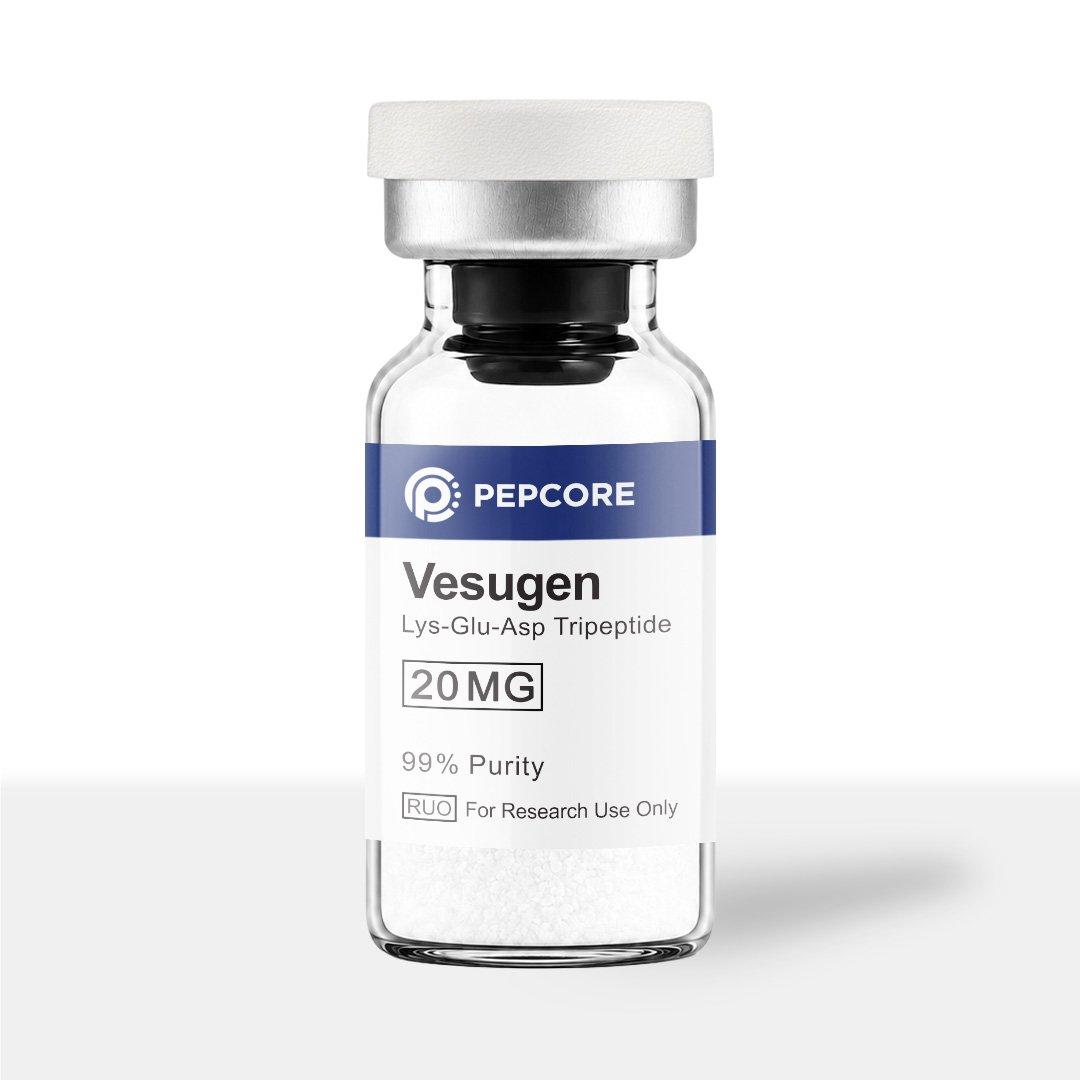
Vesugen 20 mg
In Stock
Amount (mg)
Bacteriostatic Water
Insulin Syringes
Alcohol Swabs
Quantity
1
Price€79.00
Fast delivery, dispatched same day before 14:00
Tracked delivery, door to door
Shipped discreetly
Secure payments



Order before 14:00 for same-day shipping
Order now, ships today
OrderedToday
ShippedToday
Delivered24-25 November
Vesugen is a short Khavinson peptide bioregulator made of just three amino acids, Lys-Glu-Asp (KED). It comes out of the work on peptides from blood-vessel tissue, which is why it is best known in vascular and endothelial research.
Vesugen is studied for how it acts on vascular endothelial cells, with cell-culture work looking at proliferation markers in vessel cells from young and old animals (Khavinson et al., 2014, Advances in Gerontology). Newer studies also use KED in neuron and dendritic spine models (Kraskovskaya et al., 2017).
Research Applications
•Studied in vascular endothelium research models
•Relevant in gene expression and epigenetic regulation studies
•Examined in cell ageing (senescence) research
•Applied in neuronal and dendritic spine models
Each vial holds 20 mg at ≥99% HPLC purity.
Supplied as a lyophilized powder for stability.
Scientific Background
Vesugen belongs to the short peptide bioregulators developed by Vladimir Khavinson and colleagues at the Saint Petersburg Institute of Bioregulation and Gerontology. The group first worked with polypeptide complexes extracted from animal tissues, then identified short sequences that reproduce their tissue-specific activity. Lys-Glu-Asp was identified in the polypeptide complex obtained from bovine vessels and synthesised as Vesugen; in the literature it also appears as KED and as tripeptide T-38.
Much of the vascular research on Vesugen uses endothelial cell cultures, including cells from young and aged animals, in which investigators follow markers of proliferation, cell-to-cell contact and cellular ageing. Later work extended KED to neuronal cultures, mesenchymal stem cell ageing models and induced neurons derived from skin fibroblasts.
Today Vesugen sits within the wider Khavinson framework of peptide-mediated gene regulation, alongside sister bioregulators such as Vilon, Pancragen and Cardiogen, as a compact reference compound for vessel-wall biology.
Structure
Peptide ClassShort peptide bioregulator (Khavinson-school tripeptide)
Amino Acid SequenceLys-Glu-Asp (KED)
Molecular FormulaC₁₅H₂₆N₄O₈
Molecular Weight390.39 g/mol
CAS NumberN/A
PubChem CID87571363
SynonymsKED, T-38, Lysyl-glutamyl-aspartic acid
Mechanism of Action
Vascular Endothelial Cell Regulation
In cultures of vascular endothelial cells, Vesugen has been studied for its effect on the proliferation marker Ki-67, comparing tissue from young and old animals. Together with its origin in a polypeptide complex from bovine vessels, this vessel-directed activity is why it is grouped as a vascular bioregulator within the Khavinson series.
Endothelial Signalling Molecules
In vitro models of normal, atherosclerotic and restenotic endothelium have been used to examine how KED shifts the expression of endothelin-1, connexins and sirtuin-1, molecules linked to vascular tone, cell-to-cell communication and cellular ageing.
Gene Expression and DNA Interaction
Molecular docking studies suggest that KED can bind specific DNA sequences in gene promoter regions, including the promoter of the MKI67 gene that codes Ki-67. In ageing mesenchymal stem cell cultures, KED changed the expression of genes including IGF1, FOXO1, TNKS2 and NFkB, supporting the epigenetic model of Khavinson peptide action.
Neuronal Research Models
KED has been tested in primary hippocampal neuron cultures exposed to amyloid synaptotoxicity, where investigators counted dendritic spines, in a transgenic mouse model of neurodegeneration, and in induced neurons derived from fibroblasts of older donors.
Conclusion
Vesugen (KED) is a Khavinson-school tripeptide studied mainly in vascular endothelial cell models, with further work on gene expression, cellular ageing and neuronal research. Its small, well-defined sequence makes it a practical reference compound for laboratory studies of peptide-mediated regulation in vessel-wall biology.
References
•Khavinson VKh et al. (2014). [Epigenetic aspects of peptidergic regulation of vascular endothelial cell proliferation during aging]. Advances in Gerontology. PubMed
•Kozlov KL et al. (2016). [Molecular aspects of vasoprotective peptide KED activity during atherosclerosis and restenosis]. Advances in Gerontology. PubMed
•Kraskovskaya NA et al. (2017). Tripeptides Restore the Number of Neuronal Spines under Conditions of In Vitro Modeled Alzheimer's Disease. Bulletin of Experimental Biology and Medicine. PubMed
•Ashapkin V et al. (2020). Gene expression in human mesenchymal stem cell aging cultures: modulation by short peptides. Molecular Biology Reports. PubMed
•Khavinson V et al. (2021). Neuroprotective Effects of Tripeptides-Epigenetic Regulators in Mouse Model of Alzheimer's Disease. Pharmaceuticals. PubMed
•Khavinson VK et al. (2021). Peptide Regulation of Gene Expression: A Systematic Review. Molecules. PubMed
•Khavinson V et al. (2022). Senescence-Associated Secretory Phenotype of Cardiovascular System Cells and Inflammaging: Perspectives of Peptide Regulation. Cells. PubMed
•Kraskovskaya N et al. (2024). Short Peptides Protect Fibroblast-Derived Induced Neurons from Age-Related Changes. International Journal of Molecular Sciences. PubMed
Research Use Disclaimer
This product is intended for research and laboratory use only. It is designed exclusively for in vitro research purposes. All information provided is for educational and research reference only. This product is not intended for human or animal use. It is not a drug, food, or cosmetic and must not be marketed, labeled, or used as such. Use and handling are restricted to trained and qualified professionals.
What is Vesugen?
Vesugen is a short Khavinson peptide bioregulator made of just three amino acids, Lys-Glu-Asp (KED). It is supplied as a lyophilized powder for laboratory research use only.
What is Vesugen used for in research?
In research, Vesugen is studied in vascular endothelium research models, in gene expression and epigenetic regulation studies as well as in cell ageing (senescence) research. Related compounds in our Bioregulators range include Thymogen and Testagen.
Where can I buy Vesugen?
Vesugen is available from Pepcore, shipped from the Netherlands to every European country with tracking. A certificate of analysis is available on request.
How is Vesugen reconstituted?
With bacteriostatic water, added slowly down the inside of the glass rather than onto the powder, then swirled gently, never shaken. Bacteriostatic water is optional when you order: you can add a 3 ml vial (+€4.99) or a 10 ml vial (+€12.99), or leave it out. Use our peptide calculator to work out the concentration for your vial size.
How is Vesugen stored, and how long does shipping take?
Lyophilized Vesugen is kept cool, dry and away from light. Once reconstituted, the solution is refrigerated at 2 to 8 °C, see our peptide stability guide. Orders leave the Netherlands the same or next business day: 1 to 2 business days to the Netherlands and Belgium, 2 to 7 to Germany, France, Spain, Italy and Luxembourg, 3 to 8 to the rest of the EU, free from €250, see shipping.
Amount (mg)20 mg
Bacteriostatic Water3 ml or 10 ml, optional
Insulin Syringes10× 1 ml insulin syringes, 10× 0.5 ml insulin syringes, None
Alcohol SwabsYes, No
TestingThird-party HPLC/MS
CASN/A
Netherlands & Belgium: 1-2 business days, €8.49-€12.99
Germany: 2-7 business days, €12.99
France, Spain, Italy & Luxembourg: 2-7 business days, €14.90
Rest of the EU: 3-8 business days, €14.90
Poland: 3-8 business days, €15.99
Sweden: 3-8 business days, €15.99
Switzerland, Norway, United Kingdom & other European countries outside the EU: 5-10 business days, €15.99
Canary Islands: 7-12 business days, €24.99
Free shipping on orders from €250
For laboratory and research use only.
Not for human or veterinary use, diagnosis, or treatment.
To be handled only by qualified personnel in a controlled lab setting.
By placing an order, you confirm you have read and agree to these research-use terms.


€79.00