
Muscle Growth
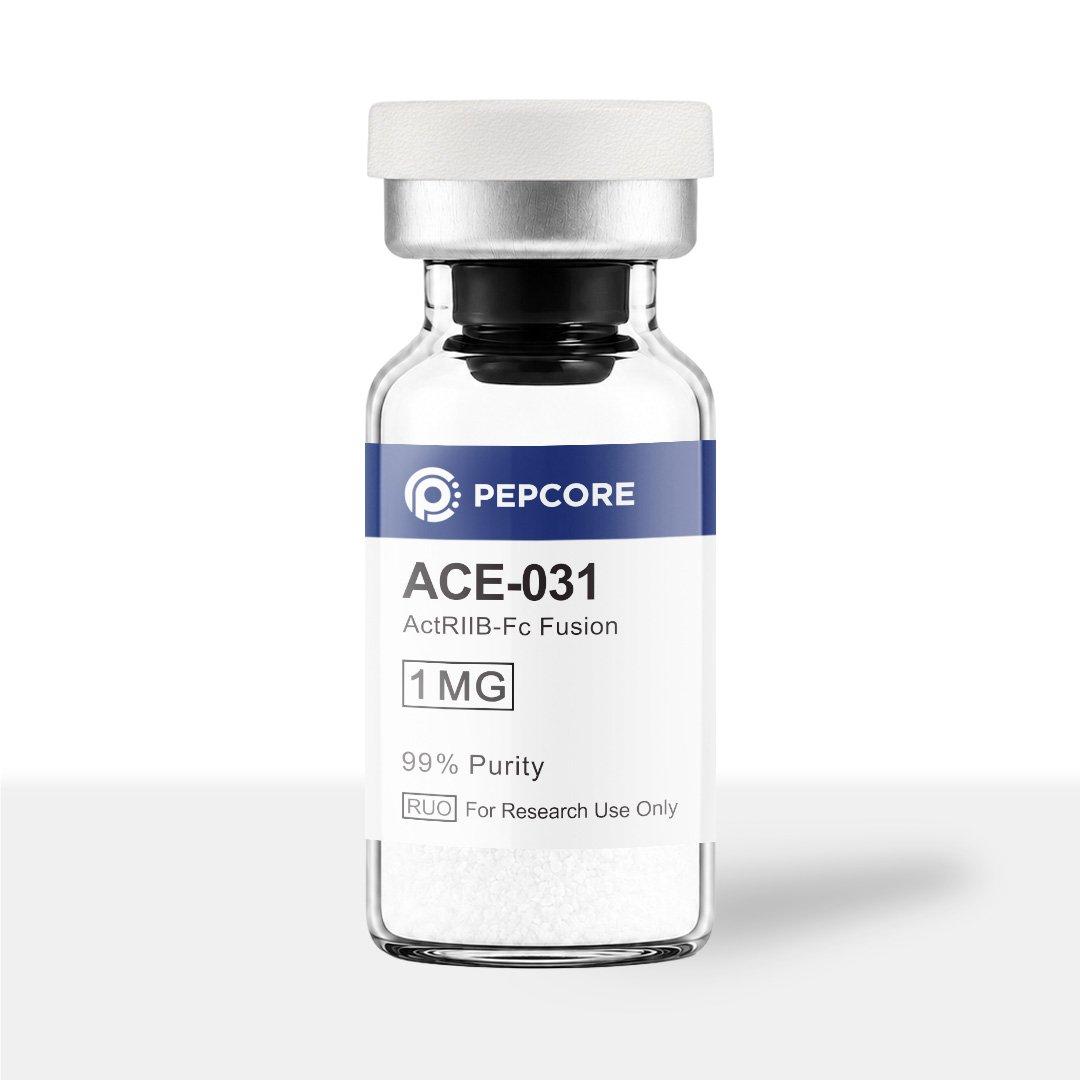
ACE-031 1 mg
In Stock
Amount (mg)
Bacteriostatic Water
Insulin Syringes
Alcohol Swabs
Quantity
1
Price€99.00
Fast delivery, dispatched same day before 14:00
Tracked delivery, door to door
Shipped discreetly
Secure payments



Order before 14:00 for same-day shipping
Order now, ships today
OrderedToday
ShippedToday
Delivered24-25 November
ACE-031 is a soluble activin receptor type IIB–Fc fusion protein studied for the regulation of muscle size and body composition. It captures extracellular signals such as myostatin before they reach cell-surface receptors. By reducing available growth-limiting signals, this ligand-trap approach can alter the balance of pathways involved in muscle maintenance and growth.
Its binding surface comes from the human ActRIIB receptor and is joined to an IgG1 Fc region. It is a broad ligand trap rather than a myostatin-specific antibody. Published human research has measured changes in lean mass and thigh muscle volume, while molecular studies examine ligand binding and signalling. These are different levels of evidence and should remain distinct.
Research Applications
•Studied in muscle-growth regulation through myostatin and activin pathways.
•Relevant in lean-mass mechanisms involving reduced growth-limiting signals.
•Examined in muscle-volume changes reported in human ACE-031 research.
•Applied in myostatin and activin biology with a broad extracellular ligand trap.
Supplied as a lyophilized powder for stability.
Scientific Background
Myostatin, also called GDF-8, is one of several TGF-beta-family proteins that influence muscle regulation. Activins and GDF-11 share parts of the receptor system. A soluble ActRIIB construct can therefore affect more than one ligand pathway, unlike an antibody selected for a single ligand. This breadth is central to the biological interpretation of ACE-031.
The Fc-fusion format presents extracellular receptor domains without the membrane-spanning and intracellular signalling machinery of native ActRIIB. It binds ligands in solution rather than transmitting their signal itself. Structural and cell-assay research with related receptor traps helps explain how receptor-domain composition changes ligand recognition; those constructs are not automatically identical to ACE-031. A placebo-controlled human ACE-031 study reported increased lean mass and thigh muscle volume in the studied cohort. Neither measurement alone establishes improved strength, and neither describes the activity of a particular laboratory batch.
Structure
Protein ClassSoluble receptor Fc fusion protein (ActRIIB extracellular domain linked to human IgG1 Fc)
Chain Composition343 amino acids per chain, assembled as a disulfide-linked homodimer (ActRIIB extracellular domain of 115 residues, a GGG linker, then the human IgG1 Fc region)
Amino Acid SequenceN-terminal GRGEAETRECIYYNANWELERTNQSGLERCEGEQDKRLHCY (start of the ActRIIB extracellular domain, UniProt Q13705)
Molecular FormulaN/A (glycosylated fusion protein)
Molecular Weight~77.5 kDa (polypeptide homodimer, 77,491 Da calculated; N-linked glycans add further mass)
CAS Number1169766-01-1
SynonymsActRIIB-Fc, ACVR2B-Fc, ramatercept
Mechanism of Action
Extracellular ligand capture
The ActRIIB-derived domain supplies a binding surface for myostatin and related ligands, including activins and GDF-11. Captured ligand is less available to engage receptors on a responding cell. ACE-031 thus acts as a soluble decoy, rather than a molecule that enters the cell to inhibit an enzyme. Its effect depends on the ligands present and their relative affinity for the trap.
Reduced receptor-pathway activation
Available ligands normally assemble signalling complexes involving type II and type I receptors. For myostatin and activin pathways, this can drive SMAD2/3-dependent changes in gene expression. Intercepting ligand before complex formation can reduce that signalling. A ligand-binding assay and a cellular reporter assay measure different stages; binding alone does not quantify the complete cellular response.
Muscle-related and integrated outcomes
Reducing growth-limiting signals provides a mechanistic basis for studying muscle-size regulation. Human ACE-031 research has followed lean mass and muscle volume, whereas cell studies can follow pathway activity. Changes in size should not be equated automatically with changes in contractile function. Broad ligand capture also means the response cannot be assigned solely to myostatin without evidence separating the contributions of other ligands.
References
•Attie KM et al. (2013). ACE-031 study in healthy volunteers with lean-mass and muscle-volume measurements. PubMed
•Goebel EJ et al. (2022). Structural and functional studies of related activin receptor ligand traps. PubMed
Research Use Disclaimer
This product is intended for in vitro laboratory research only. All information is provided for education and research reference. Not for personal use, diagnosis or treatment. Handling is restricted to trained and qualified professionals.
What is ACE-031?
ACE-031 is a soluble activin receptor type IIB–Fc fusion protein studied for the regulation of muscle size and body composition. It is supplied as a lyophilized powder for laboratory research use only.
What is ACE-031 used for in research?
In research, ACE-031 is studied in muscle-growth regulation through myostatin and activin pathways., in lean-mass mechanisms involving reduced growth-limiting signals. as well as in muscle-volume changes reported in human ACE-031 research.. Related compounds in our Muscle Growth range include Tesamorelin and Sermorelin.
Where can I buy ACE-031?
ACE-031 is available from Pepcore, shipped from the Netherlands to every European country with tracking. A certificate of analysis is available on request.
How is ACE-031 reconstituted?
With bacteriostatic water, added slowly down the inside of the glass rather than onto the powder, then swirled gently, never shaken. Bacteriostatic water is optional when you order: you can add a 3 ml vial (+€4.99) or a 10 ml vial (+€12.99), or leave it out. Use our peptide calculator to work out the concentration for your vial size.
How is ACE-031 stored, and how long does shipping take?
Lyophilized ACE-031 is kept cool, dry and away from light. Once reconstituted, the solution is refrigerated at 2 to 8 °C, see our peptide stability guide. Orders leave the Netherlands the same or next business day: 1 to 2 business days to the Netherlands and Belgium, 2 to 7 to Germany, France, Spain, Italy and Luxembourg, 3 to 8 to the rest of the EU, free from €250, see shipping.
Amount (mg)1 mg
Bacteriostatic Water3 ml or 10 ml, optional
Insulin Syringes10× 1 ml insulin syringes, 10× 0.5 ml insulin syringes, None
Alcohol SwabsYes, No
TestingThird-party HPLC/MS
CAS1169766-01-1
Netherlands & Belgium: 1-2 business days, €8.49-€12.99
Germany: 2-7 business days, €12.99
France, Spain, Italy & Luxembourg: 2-7 business days, €14.90
Rest of the EU: 3-8 business days, €14.90
Poland: 3-8 business days, €15.99
Sweden: 3-8 business days, €15.99
Switzerland, Norway, United Kingdom & other European countries outside the EU: 5-10 business days, €15.99
Canary Islands: 7-12 business days, €24.99
Free shipping on orders from €250
For laboratory and research use only.
Not for human or veterinary use, diagnosis, or treatment.
To be handled only by qualified personnel in a controlled lab setting.
By placing an order, you confirm you have read and agree to these research-use terms.
Related products


€99.00