
Muscle Growth
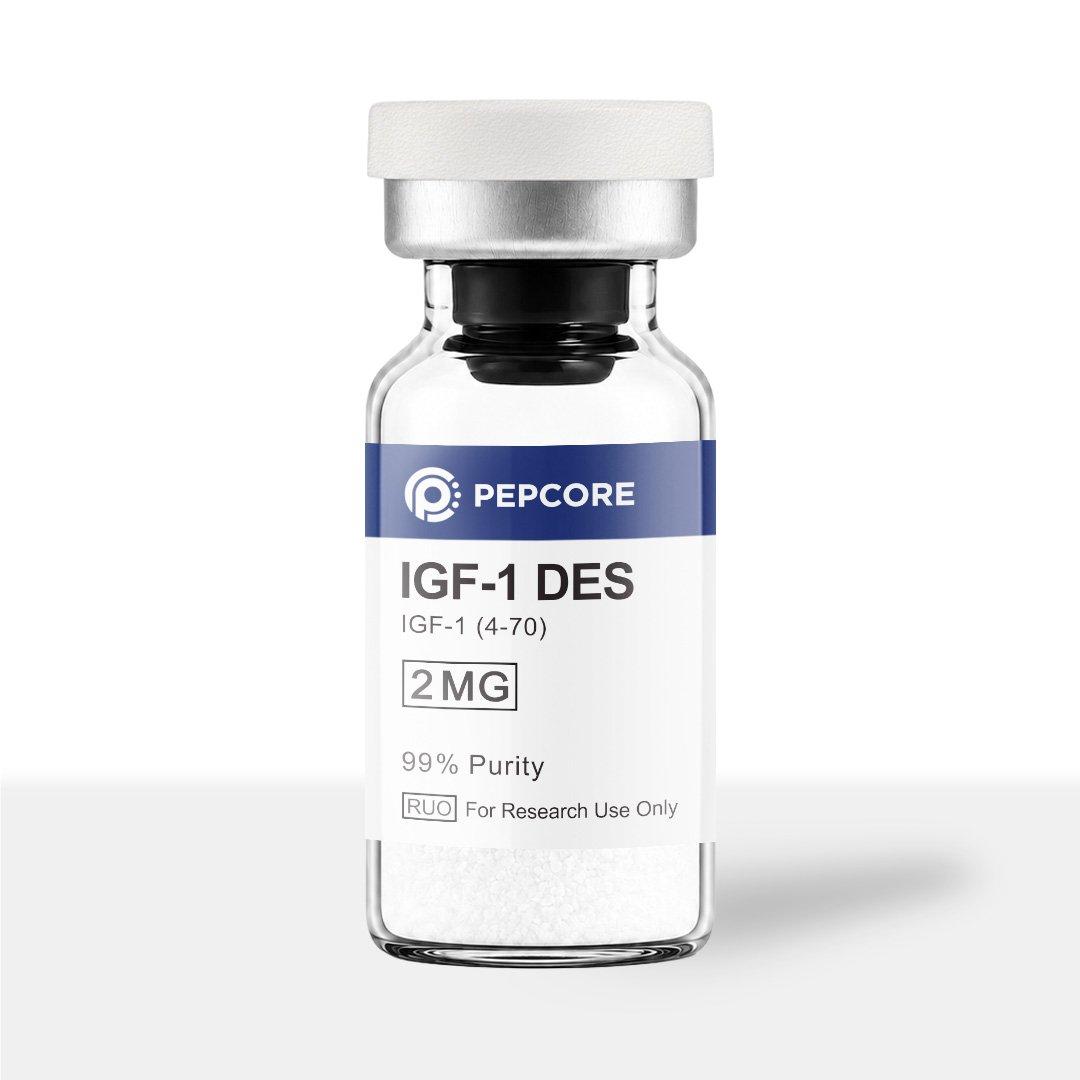
IGF-1 DES 2 mg
In Stock
Amount (mg)
Bacteriostatic Water
Insulin Syringes
Alcohol Swabs
Quantity
1
Price€64.00
Fast delivery, dispatched same day before 14:00
Tracked delivery, door to door
Shipped discreetly
Secure payments



Order before 14:00 for same-day shipping
Order now, ships today
OrderedToday
ShippedToday
Delivered24-25 November
IGF-1 DES is a shortened form of insulin-like growth factor 1 that can stimulate protein production and growth-related responses in cultured cells. It lacks the first three amino acids of the usual IGF-1 sequence, leaving 67 amino acids rather than 70. This small deletion strongly reduces binding to IGF-binding proteins, which can hold onto IGF peptides outside cells.
IGF-1 DES retains the ability to engage the IGF-1 receptor. In cultures containing binding proteins, its weaker association with those proteins can leave more peptide available to reach the receptor. That helps explain why some cell experiments show a stronger response than with ordinary IGF-1, without treating the difference as a universal increase in receptor activation. The cell type, binding proteins and measured response remain important. Francis et al., 1992, Oh et al., 1993.
Research Applications
•Studied in cell growth and protein production models
•Relevant in muscle-cell growth research
•Examined in protein production and breakdown studies
•Applied in growth-factor signaling research
Supplied as a lyophilized powder for stability.
Scientific Background
The usual mature IGF-1 sequence contains 70 amino acids and starts with Gly-Pro-Glu, often shortened to GPE. DES(1–3) means that these three positions have been removed. The remaining chain corresponds to positions 4–70 and contains three disulfide bridges that contribute to its folded structure. A truncated IGF-I form was identified in human tissue during early studies of these growth factors. Sara et al., 1986.
IGF-binding proteins, abbreviated IGFBPs, are distinct from the cell receptor. They bind peptide outside the cell and can change how much is available for receptor interaction. Comparing their binding with receptor binding is therefore important when explaining the behavior of an IGF analogue. Oh et al., 1993.
Published analogue experiments compared peptide binding with biological responses in cell cultures. They showed why a change in the surrounding binding proteins can change apparent potency even when receptor interaction is retained. IGF-1 DES provides a way to study that relationship in a defined experimental system. Francis et al., 1992.
Structure
Peptide classTruncated IGF-1 analogue
Reference length67 amino acids
Reference sequenceTLCGAELVDALQFVCGDRGFYFNKPTGYGSSSRRAPQTGIVDECCFRSCDLRRLEMYCAPLKPAKSA
DeletionN-terminal Gly-Pro-Glu
Reference positionsResidues 4–70 of mature IGF-1
Disulfide bridgesThree
Molecular formulaC₃₁₉H₄₉₅N₉₁O₉₆S₇
Molecular weight~7365 g/mol
CAS number112603-35-7
Other namesDes(1–3)IGF-I, IGF-1 DES
Mechanism of Action
Connecting with the IGF-1 receptor
IGF-1 DES binds to IGF-1R, a receptor on the cell surface. This receptor belongs to a group that passes signals through tyrosine-kinase activity. Removing the first three residues retains the peptide's ability to interact with this receptor. Binding measurements examine the connection itself, while cell-signaling experiments follow what happens after it forms. Oh et al., 1993.
Changing peptide availability outside the cell
The deleted region contributes to interactions with IGF-binding proteins. The shortened peptide binds these proteins more weakly than ordinary IGF-1 in the reported comparisons. Where such proteins are present, less peptide may be held away from the receptor. This changes the available fraction in the experiment and can alter the response without requiring an equally large change in receptor affinity. Francis et al., 1992, Oh et al., 1993.
Following the cultured-cell response
Researchers compare protein synthesis and other growth-related cellular measurements alongside the binding results. These are measured responses of the cells in the experiment. A culture that releases IGF-binding proteins may give a different comparison from a system with fewer of those proteins. Studying the peptide, receptor and surrounding medium together helps explain the result while preserving the distinction between cell-culture activity and effects in a whole person. Francis et al., 1992.
References
•Sara VR et al. (1986). Identification of a truncated IGF-I form in human tissue. Proceedings of the National Academy of Sciences. PubMed
•Francis GL et al. (1992). IGF-I analogues, binding-protein affinity and cell-culture responses. Journal of Molecular Endocrinology. PubMed
•Oh Y et al. (1993). Binding of IGF analogues to IGF-binding proteins and receptors. Endocrinology. PubMed
Research Use Disclaimer
This product is intended for in vitro laboratory research only. All information is provided for education and research reference. Not for personal use, diagnosis or treatment. Handling is restricted to trained and qualified professionals.
What is IGF-1 DES?
IGF-1 DES is a shortened form of insulin-like growth factor 1 that can stimulate protein production and growth-related responses in cultured cells. It is supplied as a lyophilized powder for laboratory research use only.
What is IGF-1 DES used for in research?
In research, IGF-1 DES is studied in cell growth and protein production models, in muscle-cell growth research as well as in protein production and breakdown studies. Related compounds in our Muscle Growth range include Tesamorelin and Sermorelin.
Where can I buy IGF-1 DES?
IGF-1 DES is available from Pepcore, shipped from the Netherlands to every European country with tracking. A certificate of analysis is available on request.
How is IGF-1 DES reconstituted?
With bacteriostatic water, added slowly down the inside of the glass rather than onto the powder, then swirled gently, never shaken. Bacteriostatic water is optional when you order: you can add a 3 ml vial (+€4.99) or a 10 ml vial (+€12.99), or leave it out. Use our peptide calculator to work out the concentration for your vial size.
How is IGF-1 DES stored, and how long does shipping take?
Lyophilized IGF-1 DES is kept cool, dry and away from light. Once reconstituted, the solution is refrigerated at 2 to 8 °C, see our peptide stability guide. Orders leave the Netherlands the same or next business day: 1 to 2 business days to the Netherlands and Belgium, 2 to 7 to Germany, France, Spain, Italy and Luxembourg, 3 to 8 to the rest of the EU, free from €250, see shipping.
Amount (mg)2 mg
Bacteriostatic Water3 ml or 10 ml, optional
Insulin Syringes10× 1 ml insulin syringes, 10× 0.5 ml insulin syringes, None
Alcohol SwabsYes, No
TestingThird-party HPLC/MS
CAS112603-35-7
Netherlands & Belgium: 1-2 business days, €8.49-€12.99
Germany: 2-7 business days, €12.99
France, Spain, Italy & Luxembourg: 2-7 business days, €14.90
Rest of the EU: 3-8 business days, €14.90
Poland: 3-8 business days, €15.99
Sweden: 3-8 business days, €15.99
Switzerland, Norway, United Kingdom & other European countries outside the EU: 5-10 business days, €15.99
Canary Islands: 7-12 business days, €24.99
Free shipping on orders from €250
For laboratory and research use only.
Not for human or veterinary use, diagnosis, or treatment.
To be handled only by qualified personnel in a controlled lab setting.
By placing an order, you confirm you have read and agree to these research-use terms.
Related products


€64.00