
Muscle Growth
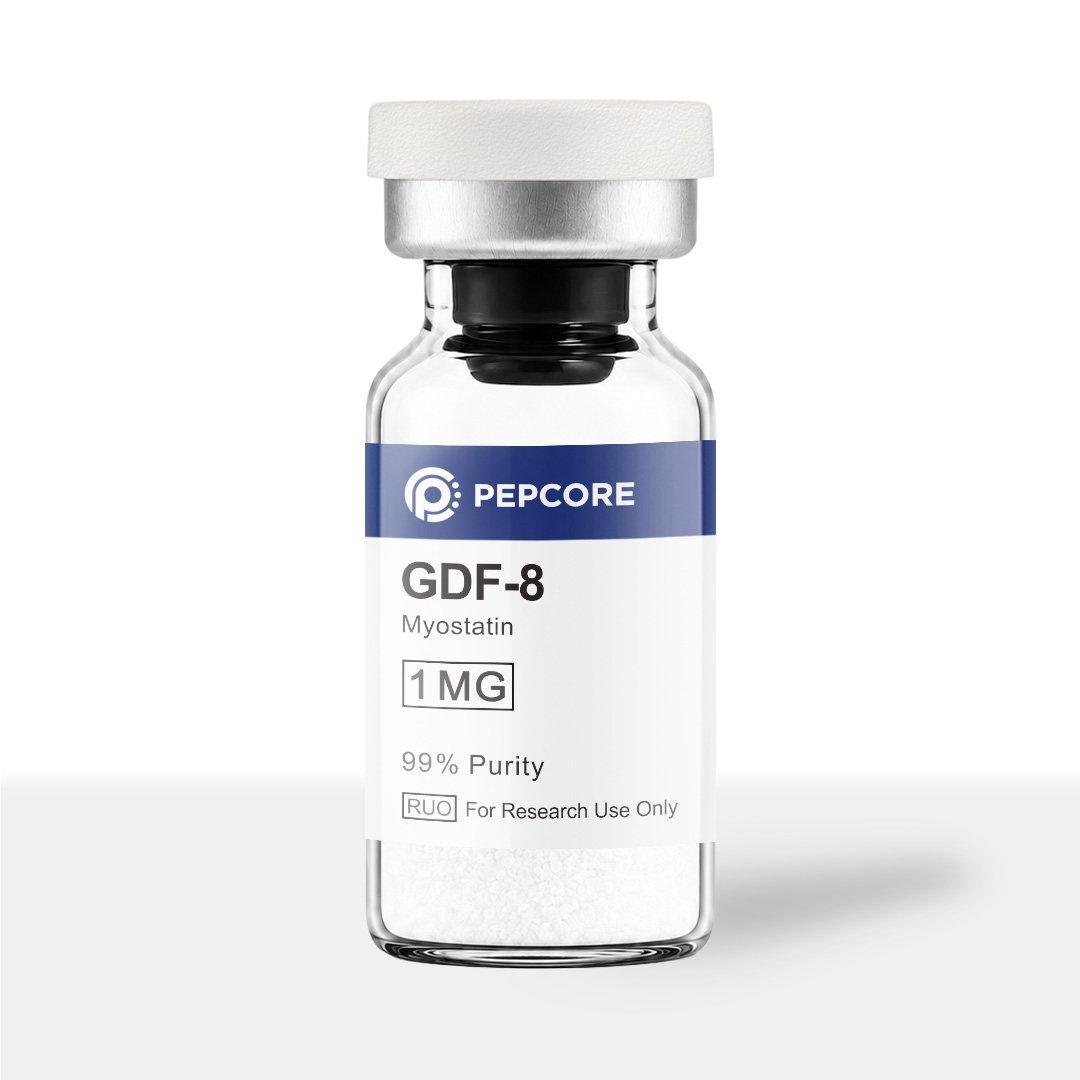
GDF-8 1 mg
In Stock
Amount (mg)
Bacteriostatic Water
Insulin Syringes
Alcohol Swabs
Quantity
1
Price€89.00
Fast delivery, dispatched same day before 14:00
Tracked delivery, door to door
Shipped discreetly
Secure payments



Order before 14:00 for same-day shipping
Order now, ships today
OrderedToday
ShippedToday
Delivered24-25 November
GDF-8, also called myostatin, is a signaling protein that limits skeletal-muscle growth and development. In cultured muscle precursor cells, it can reduce signals needed for their maturation into muscle cells. Researchers use it to understand how growth is restrained and how binding partners can change that restraint.
Its effects include changes in MyoD, Smad signaling and the Akt/mTOR pathway, which help control muscle-cell development and protein production. These responses depend on the cell model and whether the protein is in an active or restrained form. GDF-8 is therefore studied alongside follistatin and its own propeptide, which can limit access to receptors (Langley et al., 2002; Trendelenburg et al., 2009).
Research Applications
•Studied in muscle-growth restraint models
•Relevant in muscle-cell development research
•Examined in muscle protein-production regulation studies
•Applied in signals that limit muscle-cell maturation research
Supplied as a lyophilized powder for stability.
Scientific Background
The human MSTN gene encodes a 375-amino-acid precursor. Processing separates a propeptide from the 109-residue mature chain. Two mature chains join through a disulfide bond to form the signaling dimer. The precursor, mature chain and active dimer are related forms, but they should not be treated as identical laboratory materials. UniProtKB O14793.
The propeptide can remain associated with the mature protein and restrain its activity. Further processing by BMP-1/tolloid-family enzymes is one route that changes this restraint. This is why activation state matters when interpreting a receptor or cell response. Wolfman et al., 2003.
Myostatin belongs to the TGF-β family and shares signaling features with activins and GDF-11. Follistatin can cover receptor-binding surfaces on myostatin. Structural and cell studies together show how the same ligand can produce a different response when a binding partner changes its availability. Cash et al., 2009.
Structure
ClassTGF-β-family growth factor; myostatin
SequenceMature chain 109 residues, DFGLDCDEHSTESRCCRYPL…; human precursor 375 residues
ModificationSignal 1–23; propeptide 24–266; mature 267–375; 4 intrachain bridges/chain + interchain Cys339; homodimer
FormulaC₅₅₀H₈₁₅N₁₄₇O₁₅₈S₁₂ (mature monomer)
Molar mass~12.4 kDa (monomer); ~24.8 kDa (dimer)
CASN/A
DatabaseUniProt O14793; MSTN
SynonymsMyostatin, MSTN, GDF8, growth/differentiation factor 8
Mechanism of Action
Reaching the cell-surface receptors
Active myostatin binds activin type-II receptors, especially ActRIIB, which cooperate with type-I receptors such as ALK4 or ALK5. These receptor proteins receive the external message and start signaling inside the cell. A ligand-binding measurement follows the initial connection; it is distinct from measuring the eventual change in muscle-cell behavior.
Slowing parts of muscle development
The receptor pathway activates Smad proteins that influence gene responses. Published myoblast experiments linked myostatin to lower MyoD expression and reduced differentiation. Other culture work connected it with less Akt/mTOR-pathway activity and smaller differentiated myotubes. These observations explain its description as a brake, while remaining specific to the measured model. Langley et al., 2002; Trendelenburg et al., 2009.
Changing availability with binding partners
Follistatin and the propeptide can reduce receptor access in different ways. The propeptide maintains a restrained complex, while follistatin wraps around receptor-contacting surfaces of the mature ligand. Comparing free and bound GDF-8 helps researchers connect molecular binding with downstream activity. Protein form, cellular receptors and the experimental setting all affect the final response.
References
•Langley B et al. (2002). Myostatin, MyoD expression and myoblast differentiation in culture. PubMed
•Trendelenburg AU et al. (2009). Myostatin effects on Akt/mTOR signaling and cultured muscle-cell development. PubMed
Research Use Disclaimer
This product is intended for in vitro laboratory research only. All information is provided for education and research reference. Not for personal use, diagnosis or treatment. Handling is restricted to trained and qualified professionals.
What is GDF-8?
GDF-8, also called myostatin, is a signaling protein that limits skeletal-muscle growth and development. It is supplied as a lyophilized powder for laboratory research use only.
What is GDF-8 used for in research?
In research, GDF-8 is studied in muscle-growth restraint models, in muscle-cell development research as well as in muscle protein-production regulation studies. Related compounds in our Muscle Growth range include Tesamorelin and Sermorelin.
Where can I buy GDF-8?
GDF-8 is available from Pepcore, shipped from the Netherlands to every European country with tracking. A certificate of analysis is available on request.
How is GDF-8 reconstituted?
With bacteriostatic water, added slowly down the inside of the glass rather than onto the powder, then swirled gently, never shaken. Bacteriostatic water is optional when you order: you can add a 3 ml vial (+€4.99) or a 10 ml vial (+€12.99), or leave it out. Use our peptide calculator to work out the concentration for your vial size.
How is GDF-8 stored, and how long does shipping take?
Lyophilized GDF-8 is kept cool, dry and away from light. Once reconstituted, the solution is refrigerated at 2 to 8 °C, see our peptide stability guide. Orders leave the Netherlands the same or next business day: 1 to 2 business days to the Netherlands and Belgium, 2 to 7 to Germany, France, Spain, Italy and Luxembourg, 3 to 8 to the rest of the EU, free from €250, see shipping.
Amount (mg)1 mg
Bacteriostatic Water3 ml or 10 ml, optional
Insulin Syringes10× 1 ml insulin syringes, 10× 0.5 ml insulin syringes, None
Alcohol SwabsYes, No
TestingThird-party HPLC/MS
CASN/A
Netherlands & Belgium: 1-2 business days, €8.49-€12.99
Germany: 2-7 business days, €12.99
France, Spain, Italy & Luxembourg: 2-7 business days, €14.90
Rest of the EU: 3-8 business days, €14.90
Poland: 3-8 business days, €15.99
Sweden: 3-8 business days, €15.99
Switzerland, Norway, United Kingdom & other European countries outside the EU: 5-10 business days, €15.99
Canary Islands: 7-12 business days, €24.99
Free shipping on orders from €250
For laboratory and research use only.
Not for human or veterinary use, diagnosis, or treatment.
To be handled only by qualified personnel in a controlled lab setting.
By placing an order, you confirm you have read and agree to these research-use terms.
Related products


€89.00