Bioregulators
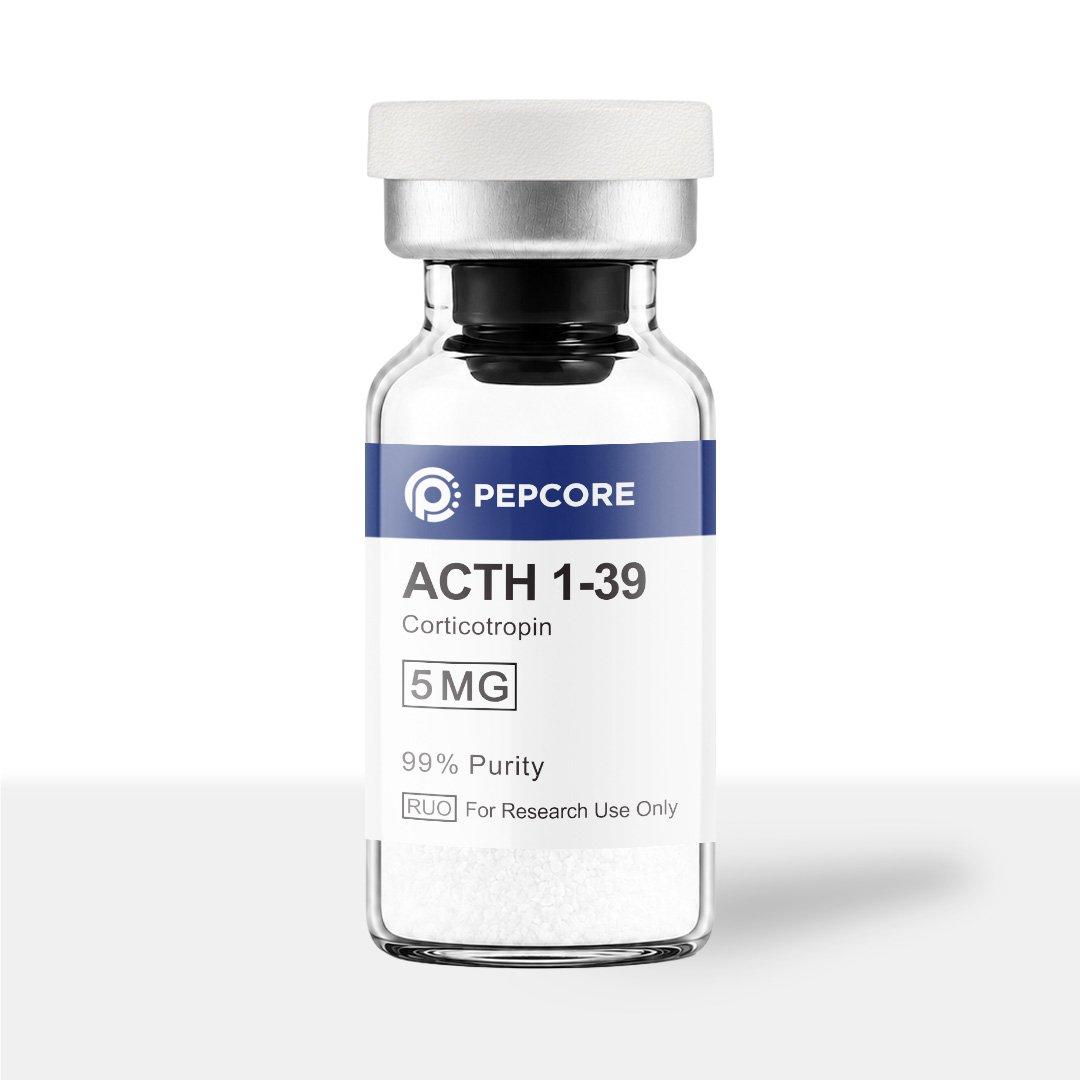
ACTH 1-39 5 mg
In Stock
Amount (mg)
Bacteriostatic Water
Insulin Syringes
Alcohol Swabs
Quantity
1
Price€49.00
Fast delivery, dispatched same day before 14:00
Tracked delivery, door to door
Shipped discreetly
Secure payments



Order before 14:00 for same-day shipping
Order now, ships today
OrderedToday
ShippedToday
Delivered24-25 November
ACTH (1–39), also called corticotropin, is the full-length peptide signal that stimulates steroid-hormone production in the adrenal cortex. Its best-known biological role is to promote cortisol synthesis through the melanocortin-2 receptor (MC2R). It is studied in adrenal signalling, steroidogenesis and the relationship between receptor activation and hormone-producing cell responses.
The human reference contains 39 residues derived from the larger POMC precursor. Full-length ACTH provides a reference for examining how peptide recognition, the accessory protein MRAP1 and intracellular signalling work together. Research with primary human adrenal cells also shows why cell identity matters when interpreting an ACTH response.
Research Applications
•Studied in cortisol production and adrenal steroid-hormone synthesis.
•Relevant in stress-hormone signalling through the ACTH–MC2R pathway.
•Examined in adrenal cell function and steroidogenic gene regulation.
•Applied in POMC-derived hormone biology linking ACTH recognition with adrenal responses.
Supplied as a lyophilized powder for stability.
Scientific Background
The human reference sequence for ACTH corresponds to residues 138–176 of proopiomelanocortin (POMC). POMC is a larger precursor that is cleaved into several peptides. Corticotropin is one of those products, and ACTH (1–39) identifies its complete 39-residue sequence. UniProt P01189
Several melanocortin peptides share a four-residue sequence of histidine, phenylalanine, arginine, and tryptophan, abbreviated HFRW. ACTH also contains a basic KKRR segment farther along its sequence. Those two regions provide a way to study why peptides with a common motif can behave differently at related receptors. Structural comparisons with other melanocortin receptors have shown that even the shared motif can adopt a different position in the MC2R binding pocket. Luo et al., 2023
In cell studies of human MC2R, researchers compared full-length and shortened ACTH analogues. They also altered individual amino acids in the receptor to see which substitutions affected the peptide's binding and its ability to trigger a signal. These complementary experiments help identify which parts of the ligand and receptor contribute to recognition. Chen et al., 2007
Structure
ReferenceHuman corticotropin, neutral parent peptide
Residues39
Amino Acid SequenceSYSMEHFRWGKPVGKKRRPVKVYPNGAEDESAEAFPLEF
Molecular FormulaC₂₀₇H₃₀₈N₅₆O₅₈S
Molecular Weight4541.1 g/mol
CAS Number9002-60-2
Mechanism of Action
Ligand Recognition at MC2R
MC2R is a class A G protein-coupled receptor. In the ACTH-bound complex, the amino-terminal portion of the peptide sits in the receptor's binding pocket. The HFRW segment contacts the receptor, while part of the basic region farther along the peptide lies near MRAP1 at the entrance to the pocket. The deposited cryo-electron microscopy structure provides a model of these contacts that researchers can test with changes to the peptide or receptor. PDB 8GY7
How MRAP1 Supports Receptor Function
MRAP1 helps MC2R reach the cell surface and contributes to its ability to respond once there. Experiments with engineered receptor and accessory-protein constructs identified an important role for the portion of MRAP1 exposed outside the cell. Later structural work showed how that portion contacts ACTH and MC2R, helping stabilize the peptide in the binding pocket. Measuring how much receptor reaches the surface helps researchers interpret whether a change in response reflects receptor availability or a change in its function. Malik et al., 2015 and Luo et al., 2023
From cAMP to steroidogenesis
ACTH-activated MC2R couples to Gs, stimulating adenylyl cyclase and cAMP-dependent signalling. In responsive adrenal cortical cells this signal supports steroid synthesis, including cortisol production. Primary human cell research has measured changes in steroidogenic genes such as CYP11B1, which encodes the enzyme for the final step of cortisol synthesis. A cAMP signal, a gene-expression change and a hormone measurement capture different stages of this response; none should be substituted for the others. Wellman et al., 2021
References
•Wellman K et al. (2021). Steroidogenic gene responses in primary human adrenal cortical cells. PubMed
Research Use Disclaimer
This product is intended for in vitro laboratory research only. All information is provided for education and research reference. Not for personal use, diagnosis or treatment. Handling is restricted to trained and qualified professionals.
What is ACTH 1-39?
ACTH (1–39), also called corticotropin, is the full-length peptide signal that stimulates steroid-hormone production in the adrenal cortex. It is supplied as a lyophilized powder for laboratory research use only.
What is ACTH 1-39 used for in research?
In research, ACTH 1-39 is studied in cortisol production and adrenal steroid-hormone synthesis., in stress-hormone signalling through the ACTH–MC2R pathway. as well as in adrenal cell function and steroidogenic gene regulation.. Related compounds in our Bioregulators range include Thymogen and Testagen.
Where can I buy ACTH 1-39?
ACTH 1-39 is available from Pepcore, shipped from the Netherlands to every European country with tracking. A certificate of analysis is available on request.
How is ACTH 1-39 reconstituted?
With bacteriostatic water, added slowly down the inside of the glass rather than onto the powder, then swirled gently, never shaken. Bacteriostatic water is optional when you order: you can add a 3 ml vial (+€4.99) or a 10 ml vial (+€12.99), or leave it out. Use our peptide calculator to work out the concentration for your vial size.
How is ACTH 1-39 stored, and how long does shipping take?
Lyophilized ACTH 1-39 is kept cool, dry and away from light. Once reconstituted, the solution is refrigerated at 2 to 8 °C, see our peptide stability guide. Orders leave the Netherlands the same or next business day: 1 to 2 business days to the Netherlands and Belgium, 2 to 7 to Germany, France, Spain, Italy and Luxembourg, 3 to 8 to the rest of the EU, free from €250, see shipping.
Amount (mg)5 mg
Bacteriostatic Water3 ml or 10 ml, optional
Insulin Syringes10× 1 ml insulin syringes, 10× 0.5 ml insulin syringes, None
Alcohol SwabsYes, No
TestingThird-party HPLC/MS
CAS9002-60-2
Netherlands & Belgium: 1-2 business days, €8.49-€12.99
Germany: 2-7 business days, €12.99
France, Spain, Italy & Luxembourg: 2-7 business days, €14.90
Rest of the EU: 3-8 business days, €14.90
Poland: 3-8 business days, €15.99
Sweden: 3-8 business days, €15.99
Switzerland, Norway, United Kingdom & other European countries outside the EU: 5-10 business days, €15.99
Canary Islands: 7-12 business days, €24.99
Free shipping on orders from €250
For laboratory and research use only.
Not for human or veterinary use, diagnosis, or treatment.
To be handled only by qualified personnel in a controlled lab setting.
By placing an order, you confirm you have read and agree to these research-use terms.


€49.00