
Muscle Growth
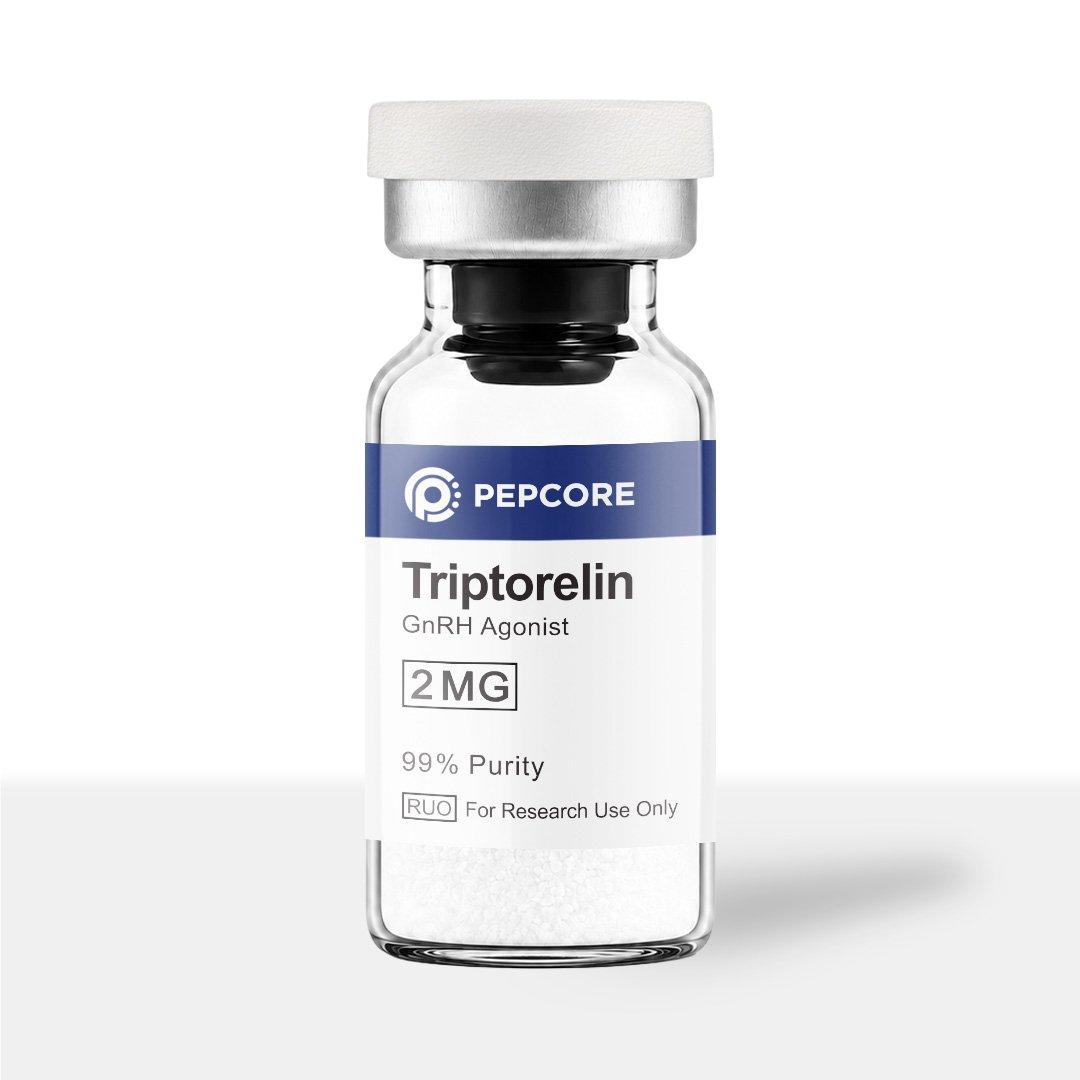
Triptorelin 2 mg
In Stock
Amount (mg)
Bacteriostatic Water
Insulin Syringes
Alcohol Swabs
Quantity
1
Price€34.00
Fast delivery, dispatched same day before 14:00
Tracked delivery, door to door
Shipped discreetly
Secure payments



Order before 14:00 for same-day shipping
Order now, ships today
OrderedToday
ShippedToday
Delivered24-25 November
Triptorelin is a synthetic analogue of gonadotropin-releasing hormone (GnRH), the signal that prompts the pituitary to release luteinizing hormone (LH) and follicle-stimulating hormone (FSH). It acts as a GnRH receptor agonist. Its biological response depends on timing: initial stimulation and reduced pituitary responsiveness during sustained exposure are different phases of the same signalling system.
The peptide contains D-tryptophan at position 6 of the GnRH sequence. Researchers use it to study receptor binding, the duration of ligand–receptor interactions and changes in hormone responsiveness. Human pituitary-response studies and receptor assays offer complementary evidence, with the exposure pattern and experimental system remaining central to interpretation.
Research Applications
•Studied in LH and FSH release within pituitary hormone regulation.
•Relevant in reproductive hormone signalling through the GnRH pathway.
•Examined in pituitary responsiveness during sustained GnRH receptor stimulation.
•Applied in hypothalamic–pituitary–gonadal regulation and gonadotropin responses.
Supplied as a lyophilized powder for stability.
Scientific Background
GnRH links hypothalamic signals to pituitary gonadotropin release. Triptorelin preserves the decapeptide framework while replacing the glycine at position 6 with D-tryptophan. This change distinguishes it from native GnRH and supplies a useful reference agonist for receptor pharmacology.
In assays with the human GnRH receptor, researchers have used radiolabelled triptorelin and a separate fluorescence-based method to compare the binding kinetics of peptide agonists. Affinity describes how strongly a ligand occupies a receptor at equilibrium; residence time describes how long an individual interaction persists. Closely matched affinities can therefore coexist with different binding kinetics. Human studies of repeated triptorelin exposure have also measured diminished LH responses to a GnRH challenge. Such endocrine observations establish response adaptation in that study context, rather than a result that can be inferred from a short binding experiment.
Structure
Peptide ClassSynthetic GnRH (LH-RH) decapeptide analog
Amino Acid SequencepGlu-His-Trp-Ser-Tyr-D-Trp-Leu-Arg-Pro-Gly-NH2
ModificationD-tryptophan replaces glycine at position 6; C-terminal glycinamide
Molecular FormulaC₆₄H₈₂N₁₈O₁₃
Molecular Weight1311.47 g/mol
CAS Number57773-63-4
PubChem CID25074470
SynonymsD-Trp6-LH-RH, (D-Trp6)-GnRH, CL-118532, AY-25650
Mechanism of Action
Receptor stimulation
Triptorelin binds the GnRH receptor and favours its active state. In responsive pituitary cells, receptor signalling engages Gq/11-linked phospholipase C, inositol-phosphate and calcium pathways that support gonadotropin secretion. This explains why an agonist can initially stimulate LH and FSH rather than directly block their receptors. The response requires a cell with the appropriate receptor and hormone-release machinery.
Adaptation with sustained stimulation
The pituitary response changes when stimulation is sustained rather than transient. Human triptorelin studies have documented reduced LH responsiveness to a subsequent GnRH challenge. This is an endocrine adaptation, not evidence that triptorelin changes into a receptor antagonist. A short signalling assay cannot by itself establish the later state of a functioning pituitary system.
Binding and function
Receptor occupancy, ligand dissociation and hormone release sit at different levels of the pathway. The human-receptor kinetic study shows why equilibrium affinity alone does not fully describe an agonist’s interaction. Comparing binding data with signalling or secretion measurements can reveal where responses diverge. Results should retain the receptor system, observation time and endpoint used in the experiment rather than be treated as universal measures of potency.
References
•Nederpelt I et al. (2016). Characterization of 12 GnRH peptide agonists: receptor-binding kinetics. PubMed
•Janssens RM et al. (1998). Pituitary desensitization and LH responses during triptorelin research. PubMed
Research Use Disclaimer
This product is intended for in vitro laboratory research only. All information is provided for education and research reference. Not for personal use, diagnosis or treatment. Handling is restricted to trained and qualified professionals.
What is Triptorelin?
Triptorelin is a synthetic analogue of gonadotropin-releasing hormone (GnRH), the signal that prompts the pituitary to release luteinizing hormone (LH) and follicle-stimulating hormone (FSH). It is supplied as a lyophilized powder for laboratory research use only.
What is Triptorelin used for in research?
In research, Triptorelin is studied in LH and FSH release within pituitary hormone regulation., in reproductive hormone signalling through the GnRH pathway. as well as in pituitary responsiveness during sustained GnRH receptor stimulation.. Related compounds in our Muscle Growth range include Tesamorelin and Sermorelin.
Where can I buy Triptorelin?
Triptorelin is available from Pepcore, shipped from the Netherlands to every European country with tracking. A certificate of analysis is available on request.
How is Triptorelin reconstituted?
With bacteriostatic water, added slowly down the inside of the glass rather than onto the powder, then swirled gently, never shaken. Bacteriostatic water is optional when you order: you can add a 3 ml vial (+€4.99) or a 10 ml vial (+€12.99), or leave it out. Use our peptide calculator to work out the concentration for your vial size.
How is Triptorelin stored, and how long does shipping take?
Lyophilized Triptorelin is kept cool, dry and away from light. Once reconstituted, the solution is refrigerated at 2 to 8 °C, see our peptide stability guide. Orders leave the Netherlands the same or next business day: 1 to 2 business days to the Netherlands and Belgium, 2 to 7 to Germany, France, Spain, Italy and Luxembourg, 3 to 8 to the rest of the EU, free from €250, see shipping.
Amount (mg)2 mg
Bacteriostatic Water3 ml or 10 ml, optional
Insulin Syringes10× 1 ml insulin syringes, 10× 0.5 ml insulin syringes, None
Alcohol SwabsYes, No
TestingThird-party HPLC/MS
CAS57773-63-4
Netherlands & Belgium: 1-2 business days, €8.49-€12.99
Germany: 2-7 business days, €12.99
France, Spain, Italy & Luxembourg: 2-7 business days, €14.90
Rest of the EU: 3-8 business days, €14.90
Poland: 3-8 business days, €15.99
Sweden: 3-8 business days, €15.99
Switzerland, Norway, United Kingdom & other European countries outside the EU: 5-10 business days, €15.99
Canary Islands: 7-12 business days, €24.99
Free shipping on orders from €250
For laboratory and research use only.
Not for human or veterinary use, diagnosis, or treatment.
To be handled only by qualified personnel in a controlled lab setting.
By placing an order, you confirm you have read and agree to these research-use terms.
Related products


€34.00