
Weight Management
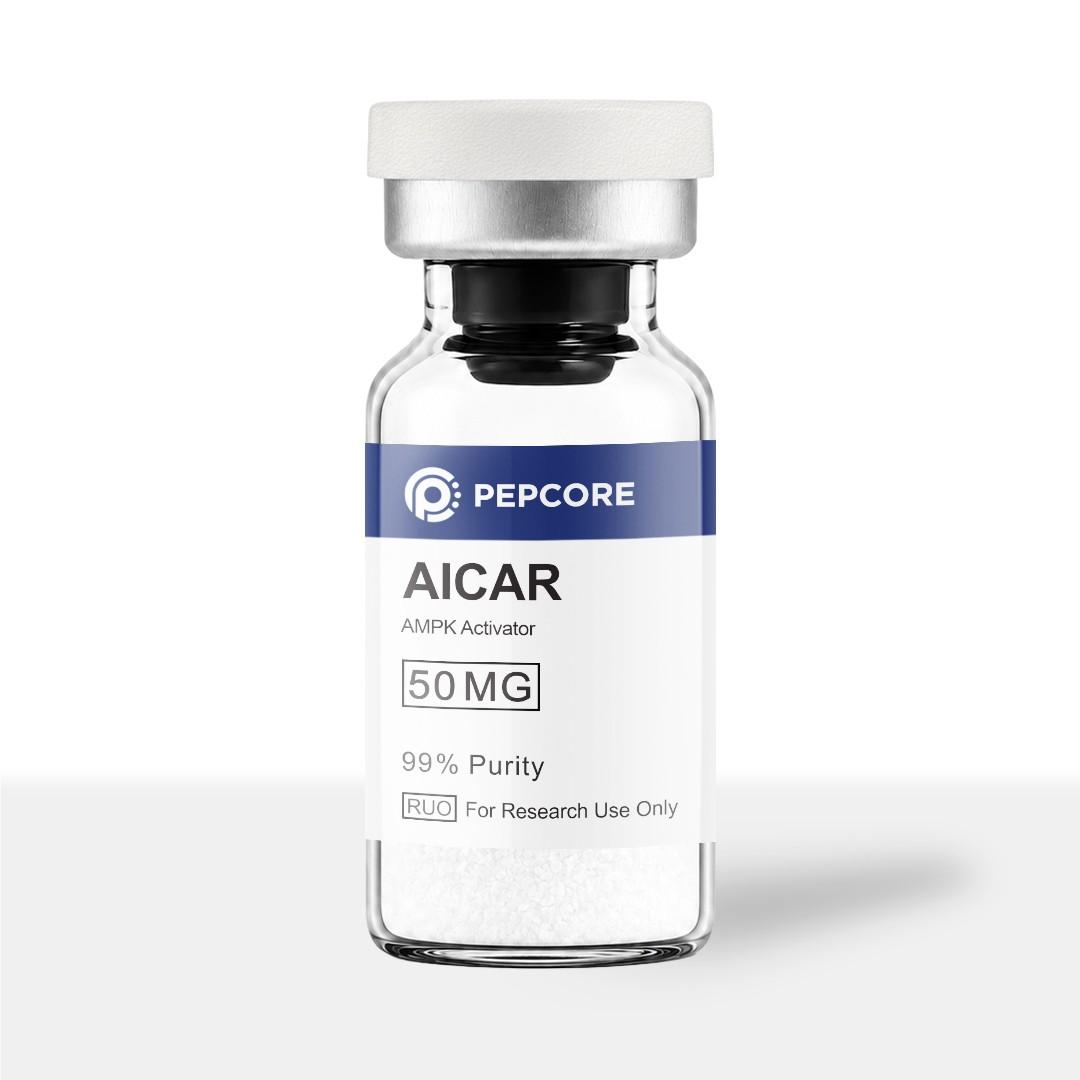
AICAR 50 mg
In Stock
Amount (mg)
Bacteriostatic Water
Insulin Syringes
Alcohol Swabs
Quantity
1
Price€79.00
Fast delivery, dispatched same day before 14:00
Tracked delivery, door to door
Shipped discreetly
Secure payments



Order before 14:00 for same-day shipping
Order now, ships today
OrderedToday
ShippedToday
Delivered24-25 November
AICAR is a lab-made molecule that switches on AMPK, the enzyme cells use as their energy sensor. In research it is known as an exercise mimetic: it reproduces the signal muscle gets from training, which is why it is used in endurance, fat-oxidation and glucose-uptake models.
AICAR is studied for what AMPK activation does to muscle, liver and fat cells, with published work showing it raises running endurance and fatty-acid burning in laboratory models without any training (Narkar et al., 2008, Cell).
Research Applications
•Studied in endurance and exercise-mimetic models
•Relevant in research on fat oxidation and glucose uptake
•Examined in mitochondrial biogenesis and muscle-fibre studies
•Applied in AMPK and energy-metabolism signalling work
Supplied as a lyophilized powder for stability.
Scientific Background
AMP-activated protein kinase (AMPK) is the master energy sensor of the cell. When ATP falls and AMP rises, AMPK switches cells from storing energy to producing it, driving glucose uptake, fatty acid oxidation, and mitochondrial growth. Researchers needed a clean way to switch it on in the laboratory.
AICAR was established as that tool in the mid-1990s. Once inside the cell it is phosphorylated to ZMP, which mimics AMP and activates AMPK without changing the cell's ATP, ADP, or AMP levels, so observed effects can be attributed to the kinase itself.
This selectivity made AICAR a reference compound across metabolic, muscle, and exercise-physiology research. Studies with it helped map how AMPK reprograms skeletal muscle toward an oxidative, endurance-type profile, work that gave rise to the term exercise mimetic.
Structure
Compound ClassNucleoside analogue (AMPK activator)
Chemical Name5-Aminoimidazole-4-carboxamide-1-β-D-ribofuranoside
Molecular FormulaC₉H₁₄N₄O₅
Molecular Weight258.23 g/mol
CAS Number2627-69-2
Mechanism of Action
Conversion to ZMP
AICAR crosses the cell membrane and is phosphorylated by adenosine kinase to ZMP (AICA ribotide). ZMP mimics AMP at the regulatory γ-subunit of AMPK, activating the kinase without altering cellular ATP or ADP levels in research models.
Glucose Uptake and Fatty Acid Oxidation
Active AMPK phosphorylates acetyl-CoA carboxylase, lowering malonyl-CoA and releasing the brake on fatty acid entry into mitochondria. In muscle models this is paired with increased GLUT4 translocation and insulin-independent glucose uptake.
Mitochondrial Biogenesis
Sustained AMPK activation raises PGC-1α and nuclear respiratory factor-1 activity, increasing mitochondrial enzymes such as citrate synthase and cytochrome c in skeletal-muscle studies.
Exercise-Mimetic Gene Programming
AMPK signaling, in concert with PPARδ, shifts muscle fibers toward an oxidative, endurance-type profile, which in laboratory models has translated into greater running endurance without training.
Conclusion
AICAR is a well-characterized nucleoside analogue that gives researchers direct pharmacological control over AMPK, the cell's central energy sensor. By linking a single, defined trigger to downstream changes in substrate use, mitochondrial content, and muscle gene expression, it provides a versatile tool for weight-management, metabolic, and exercise-physiology research.
References
•Corton JM et al. (1995). 5-aminoimidazole-4-carboxamide ribonucleoside. A specific method for activating AMP-activated protein kinase in intact cells? European Journal of Biochemistry. PubMed
•Merrill GF et al. (1997). AICA riboside increases AMP-activated protein kinase, fatty acid oxidation, and glucose uptake in rat muscle. American Journal of Physiology. PubMed
•Winder WW et al. (2000). Activation of AMP-activated protein kinase increases mitochondrial enzymes in skeletal muscle. Journal of Applied Physiology. PubMed
Research Use Disclaimer
This product is intended for research and laboratory use only. It is designed exclusively for in vitro research purposes. All information provided is for educational and research reference only. This product is not intended for human or animal use. It is not a drug, food, or cosmetic and must not be marketed, labeled, or used as such. Use and handling are restricted to trained and qualified professionals.
What is AICAR?
AICAR is a lab-made molecule that switches on AMPK, the enzyme cells use as their energy sensor. It is supplied as a lyophilized powder for laboratory research use only.
What is AICAR used for in research?
In research, AICAR is studied in endurance and exercise-mimetic models, in research on fat oxidation and glucose uptake as well as in mitochondrial biogenesis and muscle-fibre studies. Related compounds in our Weight Management range include Tirzepatide and SLU-PP-332.
Where can I buy AICAR?
AICAR is available from Pepcore, shipped from the Netherlands to every European country with tracking. A certificate of analysis is available on request.
How is AICAR reconstituted?
With bacteriostatic water, added slowly down the inside of the glass rather than onto the powder, then swirled gently, never shaken. Bacteriostatic water is optional when you order: you can add a 3 ml vial (+€4.99) or a 10 ml vial (+€12.99), or leave it out. Use our peptide calculator to work out the concentration for your vial size.
How is AICAR stored, and how long does shipping take?
Lyophilized AICAR is kept cool, dry and away from light. Once reconstituted, the solution is refrigerated at 2 to 8 °C, see our peptide stability guide. Orders leave the Netherlands the same or next business day: 1 to 2 business days to the Netherlands and Belgium, 2 to 7 to Germany, France, Spain, Italy and Luxembourg, 3 to 8 to the rest of the EU, free from €250, see shipping.
Amount (mg)50 mg
Bacteriostatic Water3 ml or 10 ml, optional
Insulin Syringes10× 1 ml insulin syringes, 10× 0.5 ml insulin syringes, None
Alcohol SwabsYes, No
TestingThird-party HPLC/MS
CAS2627-69-2
Netherlands & Belgium: 1-2 business days, €8.49-€12.99
Germany: 2-7 business days, €12.99
France, Spain, Italy & Luxembourg: 2-7 business days, €14.90
Rest of the EU: 3-8 business days, €14.90
Poland: 3-8 business days, €15.99
Sweden: 3-8 business days, €15.99
Switzerland, Norway, United Kingdom & other European countries outside the EU: 5-10 business days, €15.99
Canary Islands: 7-12 business days, €24.99
Free shipping on orders from €250
For laboratory and research use only.
Not for human or veterinary use, diagnosis, or treatment.
To be handled only by qualified personnel in a controlled lab setting.
By placing an order, you confirm you have read and agree to these research-use terms.


€79.00