
Muscle Growth
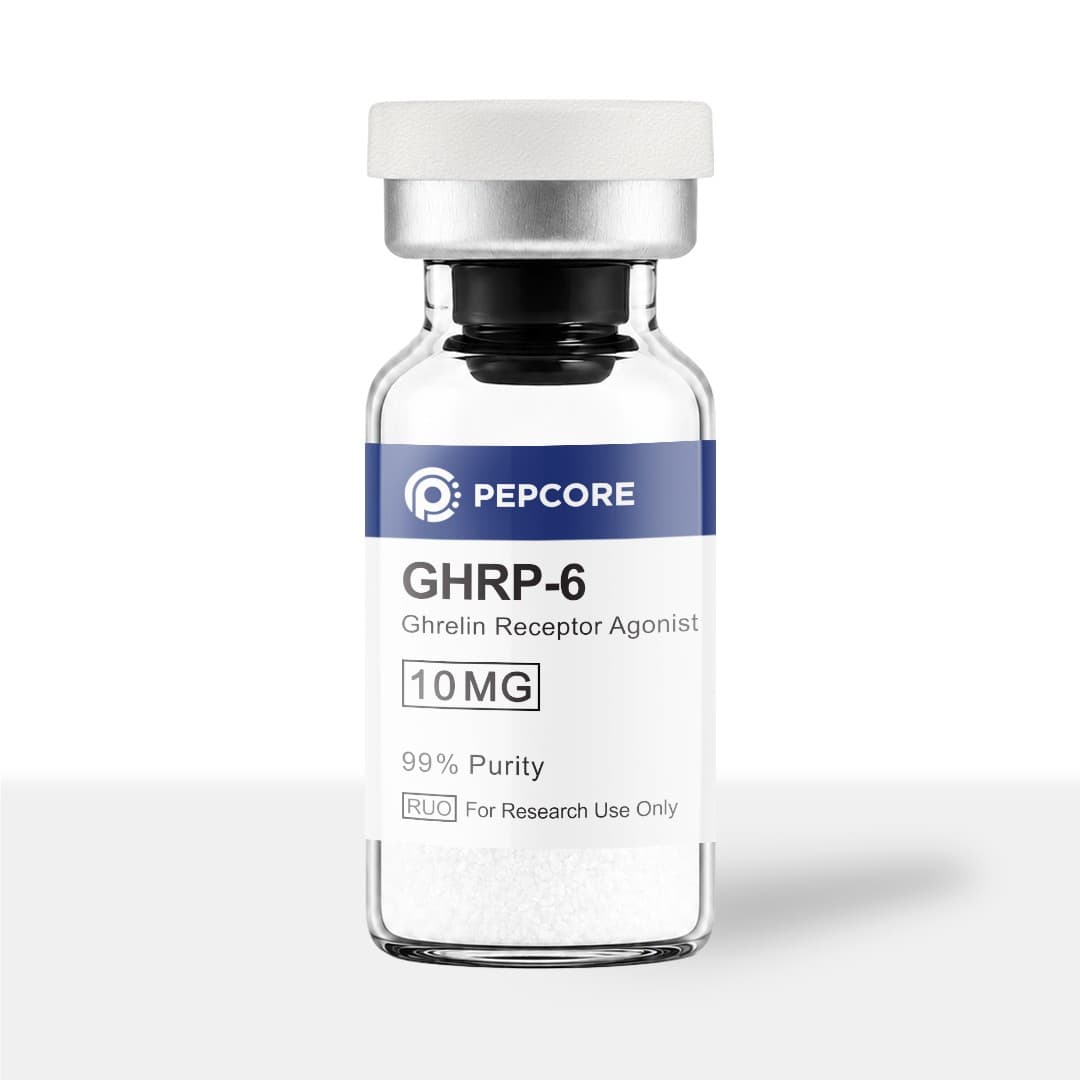
GHRP-6 10 mg
In Stock
Amount (mg)
Bacteriostatic Water
Insulin Syringes
Alcohol Swabs
Quantity
1
Price€54.00
Fast delivery, dispatched same day before 14:00
Tracked delivery, door to door
Shipped discreetly
Secure payments



Order before 14:00 for same-day shipping
Order now, ships today
OrderedToday
ShippedToday
Delivered24-25 November
GHRP-6 is a synthetic hexapeptide and the original member of the growth-hormone-releasing peptide family. It acts on the ghrelin receptor (GHS-R1a) on the pituitary, and because everything that came after it was measured against it, it is the reference point for the whole secretagogue class.
Its research base covers both pituitary signaling and a large body of later work on cytoprotection in tissues well outside the pituitary (Lei et al., 1995, Journal of Molecular Endocrinology). That second strand is what distinguishes it from the more potent GHRP-2.
Research Applications
•Ghrelin-receptor signaling research
•Growth-hormone secretagogue studies
•Cytoprotection and tissue-injury research models
•Comparative secretagogue potency studies
Supplied as a lyophilized powder for stability.
Scientific Background
GHRP-6 was the first synthetic hexapeptide shown to act directly on the pituitary to release growth hormone through a receptor separate from the growth-hormone-releasing-hormone receptor. Its discovery established that a distinct secretagogue pathway existed at all, and the search for the receptor it acted on led to the identification of GHS-R1a and, subsequently, to ghrelin as that receptor's endogenous ligand.
Every later compound in the series, GHRP-2, Hexarelin and the selective agonist Ipamorelin, was developed against GHRP-6 as the benchmark. It is less potent than its successors, which is exactly why it remains the standard comparator in structure-activity research on the class.
A second and largely independent research literature has grown around GHS-R1a expression outside the pituitary, where GHRP-6 has been investigated as a cytoprotective agent in laboratory models of excitotoxicity, ischemic and cardiac injury, and multi-organ stress. This dual position, prototype secretagogue and cytoprotection tool compound, is unusual within the family.
Structure
Peptide ClassSynthetic hexapeptide; growth-hormone secretagogue (GHS-R1a agonist)
Amino Acid SequenceHis-D-Trp-Ala-Trp-D-Phe-Lys-NH2
Molecular FormulaC₄₆H₅₆N₁₂O₆
Molecular Weight~873.02 g/mol
CAS Number87616-84-0
PubChem CID4345065
SynonymsGrowth hormone-releasing hexapeptide, GHRP, SKF-110679
Mechanism of Action
GHS-R1a Engagement and Phosphoinositide Turnover
GHRP-6 binds the growth-hormone secretagogue receptor (GHS-R1a), a Gq-coupled class A GPCR on anterior-pituitary somatotrophs. Receptor research in rat and human pituitary cells has characterised the resulting activation of phospholipase-C, inositol-1,4,5-trisphosphate generation, diacylglycerol production and intracellular calcium mobilization.
Prototype Status in Structure-Activity Research
As the founding member of the series, GHRP-6 is the compound against which the potency and selectivity of GHRP-2, Hexarelin and Ipamorelin are defined. It is routinely included as the baseline comparator in laboratory investigations of secretagogue structure-activity relationships.
Extra-Pituitary GHS-R1a Research
GHS-R1a is expressed in cardiac, vascular, renal, pulmonary and neural tissue. GHRP-6 is investigated in laboratory research models of glutamate excitotoxicity, ischemia-reperfusion injury and cytotoxic tissue damage, where the research question concerns receptor-mediated survival signaling rather than growth-hormone release.
Non-Selective Endocrine Profile
In common with other first-generation secretagogues and unlike Ipamorelin, GHRP-6 is characterised in laboratory research models as producing collateral activity at adjacent endocrine pathways. That profile is itself studied when the research question concerns class selectivity.
Conclusion
GHRP-6 represents the founding hexapeptide of the growth-hormone secretagogue class and the compound whose study led to the identification of GHS-R1a and ghrelin. Its combination of well-mapped pituitary signaling, an extensive extra-pituitary cytoprotection literature, and benchmark status in structure-activity research makes it a reference compound for laboratory investigation of ghrelin-receptor biology.
References
•Lei T et al. (1995). Growth hormone releasing peptide (GHRP-6) stimulates phosphatidylinositol (PI) turnover in human pituitary somatotroph cells. Journal of Molecular Endocrinology. PubMed
•Mau SE et al. (1995). Growth hormone releasing hexapeptide (GHRP-6) activates the inositol (1,4,5)-trisphosphate/diacylglycerol pathway in rat anterior pituitary cells. Journal of Receptor and Signal Transduction Research. PubMed
•Howard AD et al. (1996). A receptor in pituitary and hypothalamus that functions in growth hormone release. Science. PubMed
•Pombo M et al. (1996). Growth hormone releasing hexapeptide-6 (GHRP-6) test in the diagnosis of GH-deficiency. Journal of Pediatric Endocrinology & Metabolism. PubMed
•Delgado-Rubín de Célix A et al. (2006). Growth hormone releasing peptide-6 acts as a survival factor in glutamate-induced excitotoxicity. Journal of Neurochemistry. PubMed
•Berlanga-Acosta J et al. (2024). Growth hormone releasing peptide-6 (GHRP-6) prevents doxorubicin-induced myocardial and extra-myocardial damages by activating prosurvival mechanisms. Frontiers in Pharmacology. PubMed
Research Use Disclaimer
This product is intended for research and laboratory use only. It is designed exclusively for in vitro research purposes. All information provided is for educational and research reference only. This product is not intended for human or animal use. It is not a drug, food, or cosmetic and must not be marketed, labeled, or used as such. Use and handling are restricted to trained and qualified professionals.
What is GHRP-6?
GHRP-6 is a synthetic hexapeptide and the original member of the growth-hormone-releasing peptide family. It is supplied as a lyophilized powder for laboratory research use only.
What is GHRP-6 used for in research?
In research, GHRP-6 is studied in areas such as: Ghrelin-receptor signaling research, Growth-hormone secretagogue studies and Cytoprotection and tissue-injury research models. Related compounds in our Muscle Growth range include Tesamorelin and Sermorelin.
Where can I buy GHRP-6?
GHRP-6 is available from Pepcore, shipped from the Netherlands to every European country with tracking. A certificate of analysis is available on request.
How is GHRP-6 reconstituted?
With bacteriostatic water, added slowly down the inside of the glass rather than onto the powder, then swirled gently, never shaken. Bacteriostatic water is optional when you order: you can add a 3 ml vial (+€4.99) or a 10 ml vial (+€12.99), or leave it out. Use our peptide calculator to work out the concentration for your vial size.
How is GHRP-6 stored, and how long does shipping take?
Lyophilized GHRP-6 is kept cool, dry and away from light. Once reconstituted, the solution is refrigerated at 2 to 8 °C, see our peptide stability guide. Orders leave the Netherlands the same or next business day: 1 to 2 business days to the Netherlands and Belgium, 2 to 7 to Germany, France, Spain, Italy and Luxembourg, 3 to 8 to the rest of the EU, free from €250, see shipping.
Amount (mg)10 mg
Bacteriostatic Water3 ml or 10 ml, optional
Insulin Syringes10× 1 ml insulin syringes, 10× 0.5 ml insulin syringes, None
Alcohol SwabsYes, No
TestingThird-party HPLC/MS
CAS87616-84-0
Netherlands & Belgium: 1-2 business days, €8.49-€12.99
Germany: 2-7 business days, €12.99
France, Spain, Italy & Luxembourg: 2-7 business days, €14.90
Rest of the EU: 3-8 business days, €14.90
Poland: 3-8 business days, €15.99
Sweden: 3-8 business days, €15.99
Switzerland, Norway, United Kingdom & other European countries outside the EU: 5-10 business days, €15.99
Canary Islands: 7-12 business days, €24.99
Free shipping on orders from €250
For laboratory and research use only.
Not for human or veterinary use, diagnosis, or treatment.
To be handled only by qualified personnel in a controlled lab setting.
By placing an order, you confirm you have read and agree to these research-use terms.


€54.00