
Muscle Growth
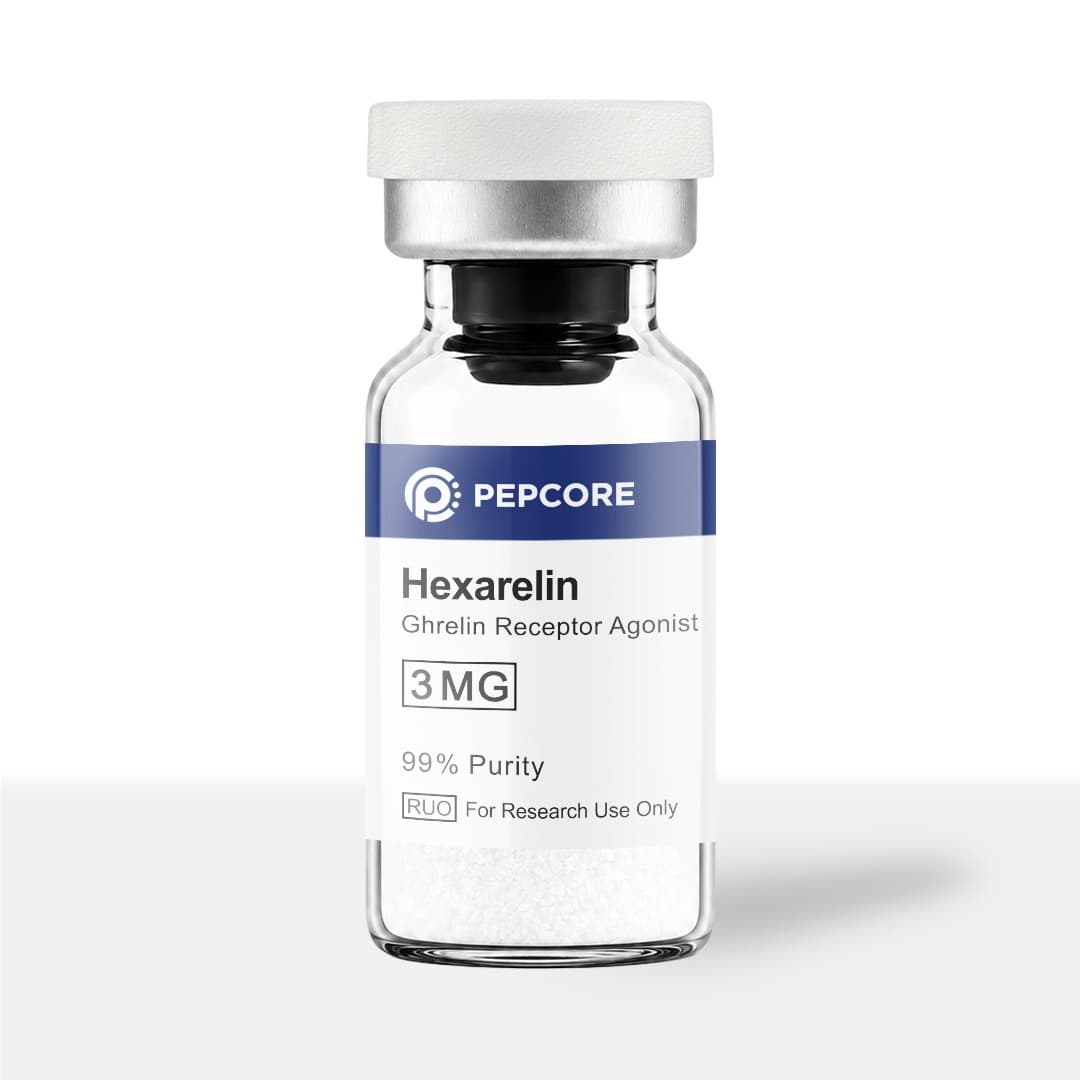
Hexarelin 3 mg
In Stock
Amount (mg)
Bacteriostatic Water
Insulin Syringes
Alcohol Swabs
Quantity
1
Price€44.00
Fast delivery, dispatched same day before 14:00
Tracked delivery, door to door
Shipped discreetly
Secure payments



Order before 14:00 for same-day shipping
Order now, ships today
OrderedToday
ShippedToday
Delivered24-25 November
Hexarelin is a synthetic hexapeptide of the growth-hormone-releasing peptide family, structurally a methylated derivative of GHRP-6. Like the rest of the class it engages the ghrelin receptor (GHS-R1a), but it is studied for a second receptor interaction the others do not share.
That second target is CD36, a scavenger receptor expressed on cardiac and vascular tissue, and it is the reason a substantial cardiovascular research literature has grown around this peptide specifically (Mao et al., 2014, Journal of Geriatric Cardiology). It is also known as examorelin.
Research Applications
•Ghrelin-receptor signaling research
•CD36 receptor-binding studies
•Cardiovascular and cardiac-fibrosis research models
•Growth-hormone secretagogue studies
Supplied as a lyophilized powder for stability.
Scientific Background
Hexarelin was developed as a modified analogue of GHRP-6, carrying a 2-methyl group on the tryptophan residue that increases metabolic stability and potency relative to the parent hexapeptide. It is registered as examorelin and carries the development code EP-23905.
Where the peptide separates from the rest of the series is its second receptor. Alongside GHS-R1a, Hexarelin binds CD36, a class B scavenger receptor expressed on cardiomyocytes, vascular endothelium and macrophages. Receptor research established that a substantial part of its cardiovascular activity in laboratory models proceeds through CD36 rather than through the growth-hormone axis at all.
That dual-receptor profile is why Hexarelin occupies a distinct position in this catalog. GHRP-2 and GHRP-6 are studied primarily as secretagogues; Hexarelin is studied as a secretagogue and, separately, as a CD36 ligand in cardiac research models of fibrosis, ischemia-reperfusion injury and post-infarct remodelling.
Structure
Peptide ClassSynthetic hexapeptide; growth-hormone secretagogue (GHS-R1a agonist) and CD36 ligand
Amino Acid SequenceHis-D-2-methyl-Trp-Ala-Trp-D-Phe-Lys-NH2
Molecular FormulaC₄₇H₅₈N₁₂O₆
Molecular Weight~887.05 g/mol
CAS Number140703-51-1
PubChem CID6918297
SynonymsExamorelin, EP-23905
Mechanism of Action
GHS-R1a Engagement
Hexarelin binds the growth-hormone secretagogue receptor (GHS-R1a), a Gq-coupled class A GPCR on anterior-pituitary somatotrophs. Receptor engagement activates phospholipase-C, generates inositol-1,4,5-trisphosphate and mobilizes intracellular calcium in laboratory research models, the shared mechanism across the hexapeptide series.
CD36 Binding
Distinct from the rest of the class, Hexarelin binds CD36, a class B scavenger receptor expressed on cardiomyocytes, vascular endothelium and macrophages. This interaction is independent of the somatotropic axis, and receptor research has attributed a substantial share of the peptide's cardiovascular activity in laboratory models to this pathway.
Cardiac Research Models
Through the CD36 route, Hexarelin is investigated in laboratory models of cardiac fibroblast proliferation and collagen synthesis, myocardial ischemia-reperfusion injury, and post-infarct ventricular remodelling, where the research endpoint is tissue morphology rather than growth-hormone output.
Structure-Activity Position
The 2-methyl-tryptophan substitution that separates Hexarelin from GHRP-6 increases both metabolic stability and potency, making the pair a standard comparison in structure-activity research on the hexapeptide scaffold.
Conclusion
Hexarelin represents a structurally defined hexapeptide that engages two unrelated receptors, GHS-R1a and CD36. That dual profile makes it the member of the growth-hormone secretagogue family most used outside pituitary research, serving as a tool compound for cardiovascular and CD36-mediated signaling investigations in controlled laboratory models.
References
•Ghigo E et al. (1997). Growth hormone-releasing peptides. European Journal of Endocrinology. PubMed
•Bisi G et al. (1999). Acute cardiovascular and hormonal effects of GH and hexarelin, a synthetic GH-releasing peptide, in humans. Journal of Endocrinological Investigation. PubMed
•Muccioli G et al. (2000). Growth hormone-releasing peptides and the cardiovascular system. Annales d'Endocrinologie. PubMed
•Marleau S et al. (2006). Cardiac and peripheral actions of growth hormone and its releasing peptides: relevance for the treatment of cardiomyopathies. Cardiovascular Research. PubMed
•Xu X et al. (2007). Hexarelin suppresses cardiac fibroblast proliferation and collagen synthesis in rat. American Journal of Physiology Heart and Circulatory Physiology. PubMed
•Mao Y et al. (2014). The cardiovascular action of hexarelin. Journal of Geriatric Cardiology. PubMed
Research Use Disclaimer
This product is intended for research and laboratory use only. It is designed exclusively for in vitro research purposes. All information provided is for educational and research reference only. This product is not intended for human or animal use. It is not a drug, food, or cosmetic and must not be marketed, labeled, or used as such. Use and handling are restricted to trained and qualified professionals.
What is Hexarelin?
Hexarelin is a synthetic hexapeptide of the growth-hormone-releasing peptide family, structurally a methylated derivative of GHRP-6. It is supplied as a lyophilized powder for laboratory research use only.
What is Hexarelin used for in research?
In research, Hexarelin is studied in areas such as: Ghrelin-receptor signaling research, CD36 receptor-binding studies and Cardiovascular and cardiac-fibrosis research models. Related compounds in our Muscle Growth range include Tesamorelin and Sermorelin.
Where can I buy Hexarelin?
Hexarelin is available from Pepcore, shipped from the Netherlands to every European country with tracking. A certificate of analysis is available on request.
How is Hexarelin reconstituted?
With bacteriostatic water, added slowly down the inside of the glass rather than onto the powder, then swirled gently, never shaken. Bacteriostatic water is optional when you order: you can add a 3 ml vial (+€4.99) or a 10 ml vial (+€12.99), or leave it out. Use our peptide calculator to work out the concentration for your vial size.
How is Hexarelin stored, and how long does shipping take?
Lyophilized Hexarelin is kept cool, dry and away from light. Once reconstituted, the solution is refrigerated at 2 to 8 °C, see our peptide stability guide. Orders leave the Netherlands the same or next business day: 1 to 2 business days to the Netherlands and Belgium, 2 to 7 to Germany, France, Spain, Italy and Luxembourg, 3 to 8 to the rest of the EU, free from €250, see shipping.
Amount (mg)3 mg
Bacteriostatic Water3 ml or 10 ml, optional
Insulin Syringes10× 1 ml insulin syringes, 10× 0.5 ml insulin syringes, None
Alcohol SwabsYes, No
TestingThird-party HPLC/MS
CAS140703-51-1
Netherlands & Belgium: 1-2 business days, €8.49-€12.99
Germany: 2-7 business days, €12.99
France, Spain, Italy & Luxembourg: 2-7 business days, €14.90
Rest of the EU: 3-8 business days, €14.90
Poland: 3-8 business days, €15.99
Sweden: 3-8 business days, €15.99
Switzerland, Norway, United Kingdom & other European countries outside the EU: 5-10 business days, €15.99
Canary Islands: 7-12 business days, €24.99
Free shipping on orders from €250
For laboratory and research use only.
Not for human or veterinary use, diagnosis, or treatment.
To be handled only by qualified personnel in a controlled lab setting.
By placing an order, you confirm you have read and agree to these research-use terms.


€44.00