Healthy Aging
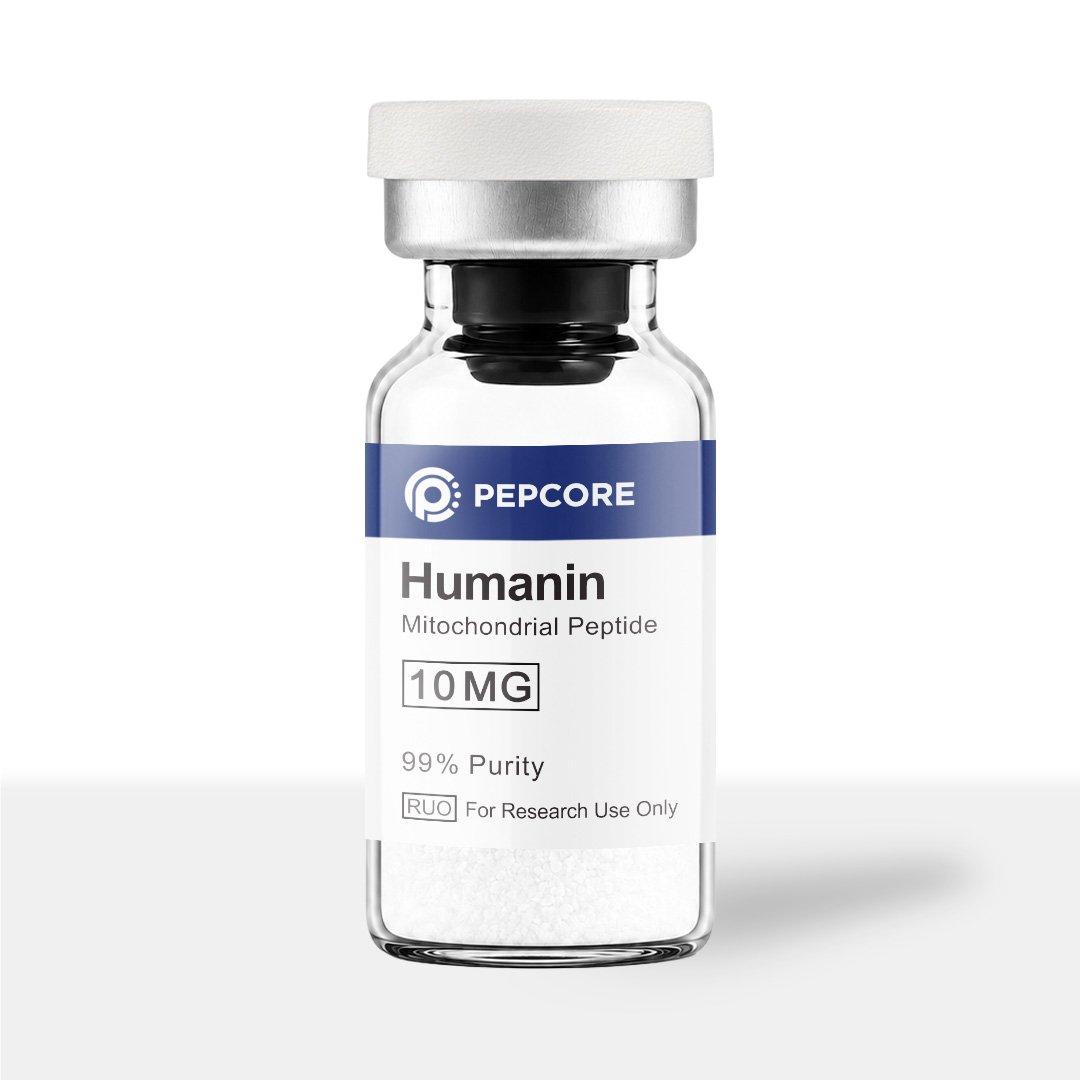
Humanin 10 mg
In Stock
Amount (mg)
Bacteriostatic Water
Insulin Syringes
Alcohol Swabs
Quantity
1
Price€59.00
Fast delivery, dispatched same day before 14:00
Tracked delivery, door to door
Shipped discreetly
Secure payments



Order before 14:00 for same-day shipping
Order now, ships today
OrderedToday
ShippedToday
Delivered24-25 November
Humanin is a 24-amino-acid peptide studied for its ability to reduce selected cell-death responses in laboratory models. It can interact with proteins involved in programmed cell death and with receptors that pass survival-related messages into cells. This makes it relevant to research on neuronal stress and communication between mitochondria and the rest of the cell.
Humanin's effects depend on the cell type, stress signal and peptide sequence. Early neuronal-cell experiments found protection against particular amyloid-related challenges, while other challenges did not produce the same response. Later work identified Bax, IGFBP-3 and cell-surface receptor systems as separate routes to examine. These findings describe cellular biology rather than a single universal protective effect (Hashimoto et al., 2001; Guo et al., 2003).
Research Applications
•Studied in nerve-cell survival models
•Relevant in mitochondrial stress responses research
•Examined in programmed cell death studies
•Applied in cellular survival signaling research
Supplied as a lyophilized powder for stability.
Scientific Background
The human reference sequence is MAPRGFSCLLLLTSEIDLPVKRRA. Its coding region corresponds to a short open reading frame within mitochondrial 16S rRNA, with related sequences also present in the nuclear genome. This sequence relationship places Humanin among mitochondrial-derived peptides; it does not by itself explain where every detected peptide molecule was produced.
Humanin was identified through a screen for sequences that changed neuronal-cell survival. Subsequent cell and cell-free work showed direct interaction with Bax, a protein that can move to mitochondria and promote release of cell-death signals. These experiments connect peptide binding with a specific cellular process. Guo et al., 2003.
Native Humanin should also be distinguished from modified analogs such as S14G-Humanin, often called HNG. A changed residue can change activity, so results for an analog should not automatically be assigned to the native sequence. Cell-surface signaling and intracellular binding offer complementary, rather than interchangeable, research perspectives.
Structure
ClassMitochondrial-derived peptide
SequenceMAPRGFSCLLLLTSEIDLPVKRRA (24)
ModificationNative 24-residue human reference; not S14G-Humanin (HNG)
FormulaC₁₁₉H₂₀₄N₃₄O₃₂S₂
Molar mass2687.2 g/mol
CAS330936-69-1
DatabasePubChem CID 16131438; UniProt Q8IVG9
SynonymsHN, Humanin (human), MT-RNR2 encoded peptide
Mechanism of Action
Interacting with the cell-death machinery
Bax normally changes shape and moves toward mitochondrial membranes when activated. Humanin bound Bax in published experiments and reduced its association with isolated mitochondria, alongside less cytochrome-c release. Researchers use these endpoints to follow programmed cell-death pathways. This is a defined experimental interaction, not evidence that the peptide blocks every form of cellular damage. Guo et al., 2003.
Sending signals through surface receptors
Reported receptor systems include FPRL1 and a complex involving CNTFR, WSX-1 and gp130. Their contributions differ between cell models. The latter complex is associated with survival-related signaling involving STAT3, a protein that helps regulate gene responses. Studying receptor requirements helps explain why two cell types can respond differently to the same peptide. Ying et al., 2004; Hashimoto et al., 2009.
Binding partners change the response
Humanin also binds IGFBP-3. Cell experiments found different outcomes depending on the cell system and stimulus, including a reduced apoptosis response in a particular human cell line. Comparing the peptide alone with peptide–partner combinations helps identify which interactions contribute to a measured survival response. Ikonen et al., 2003.
References
Research Use Disclaimer
This product is intended for in vitro laboratory research only. All information is provided for education and research reference. Not for personal use, diagnosis or treatment. Handling is restricted to trained and qualified professionals.
What is Humanin?
Humanin is a 24-amino-acid peptide studied for its ability to reduce selected cell-death responses in laboratory models. It is supplied as a lyophilized powder for laboratory research use only.
What is Humanin used for in research?
In research, Humanin is studied in nerve-cell survival models, in mitochondrial stress responses research as well as in programmed cell death studies. Related compounds in our Healthy Aging range include NAD⁺ and MOTS-c.
Where can I buy Humanin?
Humanin is available from Pepcore, shipped from the Netherlands to every European country with tracking. A certificate of analysis is available on request.
How is Humanin reconstituted?
With bacteriostatic water, added slowly down the inside of the glass rather than onto the powder, then swirled gently, never shaken. Bacteriostatic water is optional when you order: you can add a 3 ml vial (+€4.99) or a 10 ml vial (+€12.99), or leave it out. Use our peptide calculator to work out the concentration for your vial size.
How is Humanin stored, and how long does shipping take?
Lyophilized Humanin is kept cool, dry and away from light. Once reconstituted, the solution is refrigerated at 2 to 8 °C, see our peptide stability guide. Orders leave the Netherlands the same or next business day: 1 to 2 business days to the Netherlands and Belgium, 2 to 7 to Germany, France, Spain, Italy and Luxembourg, 3 to 8 to the rest of the EU, free from €250, see shipping.
Amount (mg)10 mg
Bacteriostatic Water3 ml or 10 ml, optional
Insulin Syringes10× 1 ml insulin syringes, 10× 0.5 ml insulin syringes, None
Alcohol SwabsYes, No
TestingThird-party HPLC/MS
CAS330936-69-1
Netherlands & Belgium: 1-2 business days, €8.49-€12.99
Germany: 2-7 business days, €12.99
France, Spain, Italy & Luxembourg: 2-7 business days, €14.90
Rest of the EU: 3-8 business days, €14.90
Poland: 3-8 business days, €15.99
Sweden: 3-8 business days, €15.99
Switzerland, Norway, United Kingdom & other European countries outside the EU: 5-10 business days, €15.99
Canary Islands: 7-12 business days, €24.99
Free shipping on orders from €250
For laboratory and research use only.
Not for human or veterinary use, diagnosis, or treatment.
To be handled only by qualified personnel in a controlled lab setting.
By placing an order, you confirm you have read and agree to these research-use terms.


€59.00