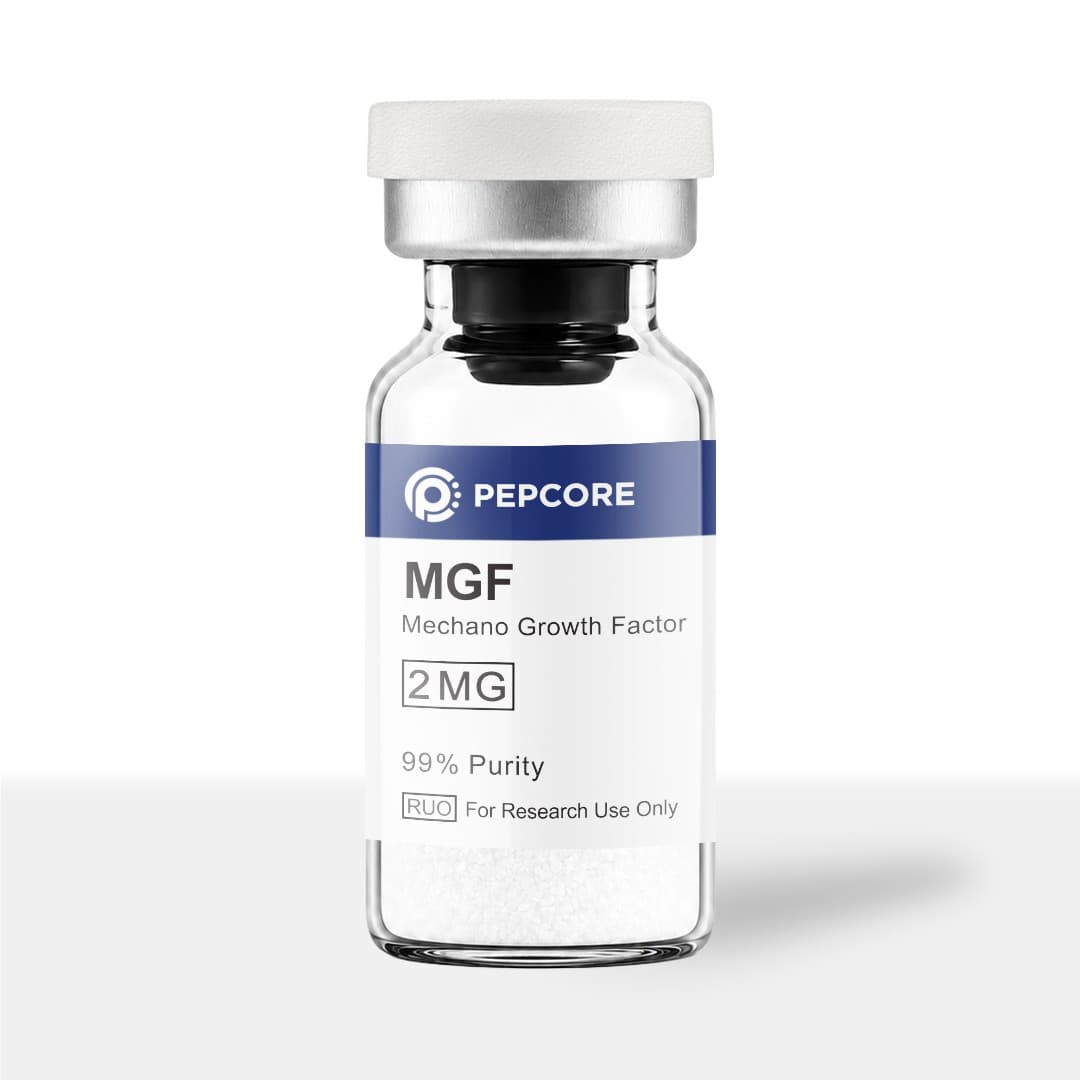
Muscle Growth
MGF 2 mg (amide)
In Stock
Amount (mg)
Bacteriostatic Water
Insulin Syringes
Alcohol Swabs
Quantity
1
Price€59.00
Fast delivery, dispatched same day before 14:00
Tracked delivery, door to door
Shipped discreetly
Secure payments



Order before 14:00 for same-day shipping
Order now, ships today
OrderedToday
ShippedToday
Delivered24-25 November
MGF (Mechano Growth Factor) is the 24-amino-acid repair signal that muscle releases after loading or damage. It is a splice variant of IGF-1, and it wakes up muscle stem cells (satellite cells) so they multiply before repair starts, which is why it is used in muscle growth, repair and recovery research.
MGF is studied for the early phase of muscle repair, with published work showing the IGF-1Ec splice variant appears in muscle as satellite cells activate after local damage (Hill et al., 2003, The Journal of Physiology).
Research Applications
•Studied in muscle repair and regeneration models
•Relevant in research on satellite-cell activation and myoblast growth
•Examined in mechanical-loading and hypertrophy studies
•Applied in ageing-muscle progenitor-cell work
Supplied as a lyophilized powder for stability.
Scientific Background
Skeletal muscle answers mechanical load and injury with a timed program of growth-factor signalling. One of the earliest signals is a local switch in IGF-1 splicing: loaded or damaged muscle briefly favors the IGF-1Ec transcript, whose E-domain differs from the systemic IGF-1Ea form because a short exon 5 insert shifts the reading frame.
That E-domain gave the peptide its name, mechano growth factor. Synthetic MGF reproduces its C-terminal 24 amino acids as an amide, giving researchers a defined tool for studying the E-peptide apart from the mature IGF-1 cleaved from the same precursor.
In cell and tissue models the E-peptide has been studied for its effect on myoblast proliferation and on the activation of human muscle progenitor cells across donor ages, positioning MGF as a reference compound in muscle-regeneration and IGF-1 splice-variant research.
Structure
Peptide ClassSynthetic IGF-1 splice-variant (IGF-1Ec) E-domain peptide
Amino Acid SequenceYQPPSTNKNTKSQRRKGSTFEERK-NH₂ (24 amino acids, C-terminal amide)
Molecular FormulaC₁₂₁H₂₀₀N₄₂O₃₉
Molecular Weight2867.2 g/mol
CAS NumberN/A
Mechanism of Action
Satellite-Cell Activation
In muscle research models, expression of the IGF-1Ec E-domain rises within hours of mechanical loading or local damage, coinciding with activation of quiescent satellite cells, the resident stem-cell pool that supplies new myonuclei for repair.
Myoblast Proliferation Before Differentiation
In C2C12 myoblast studies, the E-peptide increased proliferation while holding back terminal differentiation, a role distinct from mature IGF-1, which favors fusion into myotubes. This sequencing lets the progenitor pool expand before repair proceeds.
Signalling Separate From Mature IGF-1
The E-domain peptide is reported to act through a route distinct from the IGF-1 receptor pathway used by mature IGF-1, which is why the two are studied side by side in signalling work.
Human Progenitor-Cell Response Across Ages
Human muscle progenitor cells from donors of different ages respond to the E-peptide with increased activation and fusion potential in culture, making MGF relevant to age-related regeneration research.
Conclusion
MGF gives researchers a defined synthetic tool for isolating the E-domain signal of IGF-1Ec from mature IGF-1, used to study mechanotransduction, satellite-cell activation, and the early proliferative phase of muscle repair, including ageing-muscle and regeneration models.
References
•Yang SY et al. (2002). Different roles of the IGF-I Ec peptide (MGF) and mature IGF-I in myoblast proliferation and differentiation. FEBS Letters. PubMed
•Hill M et al. (2003). Expression and splicing of the insulin-like growth factor gene in rodent muscle is associated with muscle satellite (stem) cell activation following local tissue damage. The Journal of Physiology. PubMed
•Matheny RW Jr et al. (2010). Minireview: Mechano-growth factor: a putative product of IGF-I gene expression involved in tissue repair and regeneration. Endocrinology. PubMed
•Kandalla PK et al. (2011). Mechano Growth Factor E peptide (MGF-E), derived from an isoform of IGF-1, activates human muscle progenitor cells and induces an increase in their fusion potential at different ages. Mechanisms of Ageing and Development. PubMed
Research Use Disclaimer
This product is intended for research and laboratory use only. It is designed exclusively for in vitro research purposes. All information provided is for educational and research reference only. This product is not intended for human or animal use. It is not a drug, food, or cosmetic and must not be marketed, labeled, or used as such. Use and handling are restricted to trained and qualified professionals.
What is MGF?
MGF (Mechano Growth Factor) is the 24-amino-acid repair signal that muscle releases after loading or damage. It is supplied as a lyophilized powder for laboratory research use only.
What is MGF used for in research?
In research, MGF is studied in muscle repair and regeneration models, in research on satellite-cell activation and myoblast growth as well as in mechanical-loading and hypertrophy studies. Related compounds in our Muscle Growth range include Tesamorelin and Sermorelin.
Where can I buy MGF?
MGF is available from Pepcore, shipped from the Netherlands to every European country with tracking. A certificate of analysis is available on request.
How is MGF reconstituted?
With bacteriostatic water, added slowly down the inside of the glass rather than onto the powder, then swirled gently, never shaken. Bacteriostatic water is optional when you order: you can add a 3 ml vial (+€4.99) or a 10 ml vial (+€12.99), or leave it out. Use our peptide calculator to work out the concentration for your vial size.
How is MGF stored, and how long does shipping take?
Lyophilized MGF is kept cool, dry and away from light. Once reconstituted, the solution is refrigerated at 2 to 8 °C, see our peptide stability guide. Orders leave the Netherlands the same or next business day: 1 to 2 business days to the Netherlands and Belgium, 2 to 7 to Germany, France, Spain, Italy and Luxembourg, 3 to 8 to the rest of the EU, free from €250, see shipping.
Amount (mg)2 mg
Bacteriostatic Water3 ml or 10 ml, optional
Insulin Syringes10× 1 ml insulin syringes, 10× 0.5 ml insulin syringes, None
Alcohol SwabsYes, No
TestingThird-party HPLC/MS
CASN/A
Netherlands & Belgium: 1-2 business days, €8.49-€12.99
Germany: 2-7 business days, €12.99
France, Spain, Italy & Luxembourg: 2-7 business days, €14.90
Rest of the EU: 3-8 business days, €14.90
Poland: 3-8 business days, €15.99
Sweden: 3-8 business days, €15.99
Switzerland, Norway, United Kingdom & other European countries outside the EU: 5-10 business days, €15.99
Canary Islands: 7-12 business days, €24.99
Free shipping on orders from €250
For laboratory and research use only.
Not for human or veterinary use, diagnosis, or treatment.
To be handled only by qualified personnel in a controlled lab setting.
By placing an order, you confirm you have read and agree to these research-use terms.


€59.00