
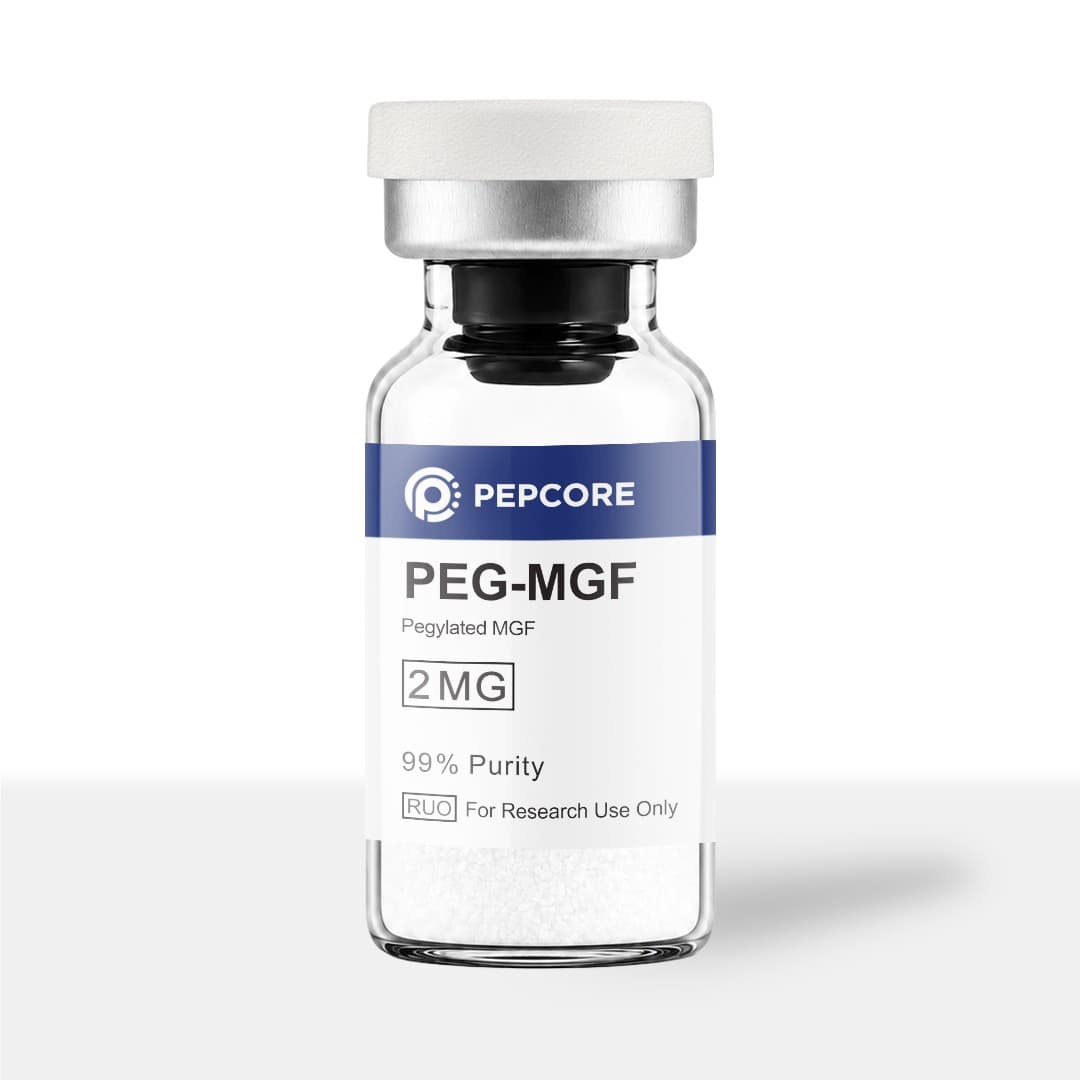
Muscle Growth
PEG-MGF 2 mg
In Stock
Amount (mg)
Bacteriostatic Water
Insulin Syringes
Alcohol Swabs
Quantity
1
Price€69.00
Fast delivery, dispatched same day before 14:00
Tracked delivery, door to door
Shipped discreetly
Secure payments



Order before 14:00 for same-day shipping
Order now, ships today
OrderedToday
ShippedToday
Delivered24-25 November
PEG-MGF is Mechano Growth Factor with a PEG chain attached, which makes the peptide last much longer in research models than plain MGF. It carries the same muscle repair signal that activates satellite cells after training or injury, so it is used in muscle regeneration, hypertrophy and recovery research where a longer-acting form is needed.
PEG-MGF is studied for the same E-domain signal as MGF: work in myoblasts shows it drives muscle-cell proliferation through a route separate from mature IGF-1 (Yang et al., 2002, FEBS Letters).
Research Applications
•Studied in muscle regeneration and repair models
•Relevant in research on satellite-cell activation and hypertrophy
•Examined in long-acting peptide and half-life studies
•Applied in neuronal and cardiac tissue-protection work
Supplied as a lyophilized powder for stability.
Scientific Background
Skeletal muscle repair depends on satellite cells, the resident stem cells that proliferate and fuse into damaged fibres after mechanical stress. The IGF-1 gene responds to loading by alternative splicing, producing the IGF-1Ec isoform whose C-terminal E-domain, known as Mechano Growth Factor (MGF), is expressed within hours of injury and precedes the systemic IGF-1 response.
The native E-peptide is short-lived in solution, which complicates work on its independent signaling. PEG-MGF addresses this by conjugating a polyethylene glycol chain to the synthetic peptide, extending its half-life in research models while preserving the sequence responsible for satellite cell activation.
This makes PEG-MGF a practical tool for laboratory work on muscle regeneration, myoblast kinetics, and the tissue-protective actions of the E-domain reported in cardiac and neuronal models.
Structure
Peptide ClassPEGylated synthetic IGF-1Ec E-domain peptide (Mechano Growth Factor analogue)
Amino Acid SequencePEG-Tyr-Gln-Pro-Pro-Ser-Thr-Asn-Lys-Asn-Thr-Lys-Ser-Gln-Arg-Arg-Lys-Gly-Ser-Thr-Phe-Glu-Glu-Arg-Lys-NH₂
Molecular FormulaN/A
Molecular WeightN/A (polydisperse PEG conjugate)
CAS NumberN/A
Mechanism of Action
Satellite Cell Activation
The MGF E-domain signals resident muscle satellite cells to leave quiescence and enter the cell cycle, expanding the pool of progenitors available for fibre repair in research models.
Proliferation Distinct From Mature IGF-1
Studies in C2C12 myoblasts show the E-peptide increases proliferation while delaying terminal differentiation, an effect not blocked by IGF-1 receptor antibodies, pointing to a signaling route separate from mature IGF-1.
Extended Exposure Through PEGylation
The polyethylene glycol chain shields the peptide from rapid clearance and enzymatic breakdown, extending its half-life so that the E-domain remains available to tissue for a longer period in experimental systems.
Tissue-Protective Signaling
Beyond muscle, the E-peptide has been reported to reduce neuronal loss in brain ischemia models and to preserve cardiac function in experimental infarction models, indicating conserved protective signaling across tissues.
Conclusion
PEG-MGF is a stabilized research form of Mechano Growth Factor that lets investigators study the E-domain's contribution to satellite cell activation, myoblast proliferation, and tissue repair over a longer window than the native peptide allows. It is a versatile tool for regeneration, hypertrophy, and tissue-protection research.
References
•Yang SY et al. (2002). Different roles of the IGF-I Ec peptide (MGF) and mature IGF-I in myoblast proliferation and differentiation. FEBS Letters. PubMed
•Hill M et al. (2003). Expression and splicing of the insulin-like growth factor gene in rodent muscle is associated with muscle satellite (stem) cell activation following local tissue damage. The Journal of Physiology. PubMed
•Dluzniewska J et al. (2005). A strong neuroprotective effect of the autonomous C-terminal peptide of IGF-1 Ec (MGF) in brain ischemia. FASEB Journal. PubMed
•Matheny RW Jr et al. (2010). Minireview: Mechano-growth factor: a putative product of IGF-I gene expression involved in tissue repair and regeneration. Endocrinology. PubMed
Research Use Disclaimer
This product is intended for research and laboratory use only. It is designed exclusively for in vitro research purposes. All information provided is for educational and research reference only. This product is not intended for human or animal use. It is not a drug, food, or cosmetic and must not be marketed, labeled, or used as such. Use and handling are restricted to trained and qualified professionals.
What is PEG-MGF?
PEG-MGF is Mechano Growth Factor with a PEG chain attached, which makes the peptide last much longer in research models than plain MGF. It is supplied as a lyophilized powder for laboratory research use only.
What is PEG-MGF used for in research?
In research, PEG-MGF is studied in muscle regeneration and repair models, in research on satellite-cell activation and hypertrophy as well as in long-acting peptide and half-life studies. Related compounds in our Muscle Growth range include Tesamorelin and Sermorelin.
Where can I buy PEG-MGF?
PEG-MGF is available from Pepcore, shipped from the Netherlands to every European country with tracking. A certificate of analysis is available on request.
How is PEG-MGF reconstituted?
With bacteriostatic water, added slowly down the inside of the glass rather than onto the powder, then swirled gently, never shaken. Bacteriostatic water is optional when you order: you can add a 3 ml vial (+€4.99) or a 10 ml vial (+€12.99), or leave it out. Use our peptide calculator to work out the concentration for your vial size.
How is PEG-MGF stored, and how long does shipping take?
Lyophilized PEG-MGF is kept cool, dry and away from light. Once reconstituted, the solution is refrigerated at 2 to 8 °C, see our peptide stability guide. Orders leave the Netherlands the same or next business day: 1 to 2 business days to the Netherlands and Belgium, 2 to 7 to Germany, France, Spain, Italy and Luxembourg, 3 to 8 to the rest of the EU, free from €250, see shipping.
Amount (mg)2 mg
Bacteriostatic Water3 ml or 10 ml, optional
Insulin Syringes10× 1 ml insulin syringes, 10× 0.5 ml insulin syringes, None
Alcohol SwabsYes, No
TestingThird-party HPLC/MS
CASN/A
Netherlands & Belgium: 1-2 business days, €8.49-€12.99
Germany: 2-7 business days, €12.99
France, Spain, Italy & Luxembourg: 2-7 business days, €14.90
Rest of the EU: 3-8 business days, €14.90
Poland: 3-8 business days, €15.99
Sweden: 3-8 business days, €15.99
Switzerland, Norway, United Kingdom & other European countries outside the EU: 5-10 business days, €15.99
Canary Islands: 7-12 business days, €24.99
Free shipping on orders from €250
For laboratory and research use only.
Not for human or veterinary use, diagnosis, or treatment.
To be handled only by qualified personnel in a controlled lab setting.
By placing an order, you confirm you have read and agree to these research-use terms.


€69.00