Bioregulators
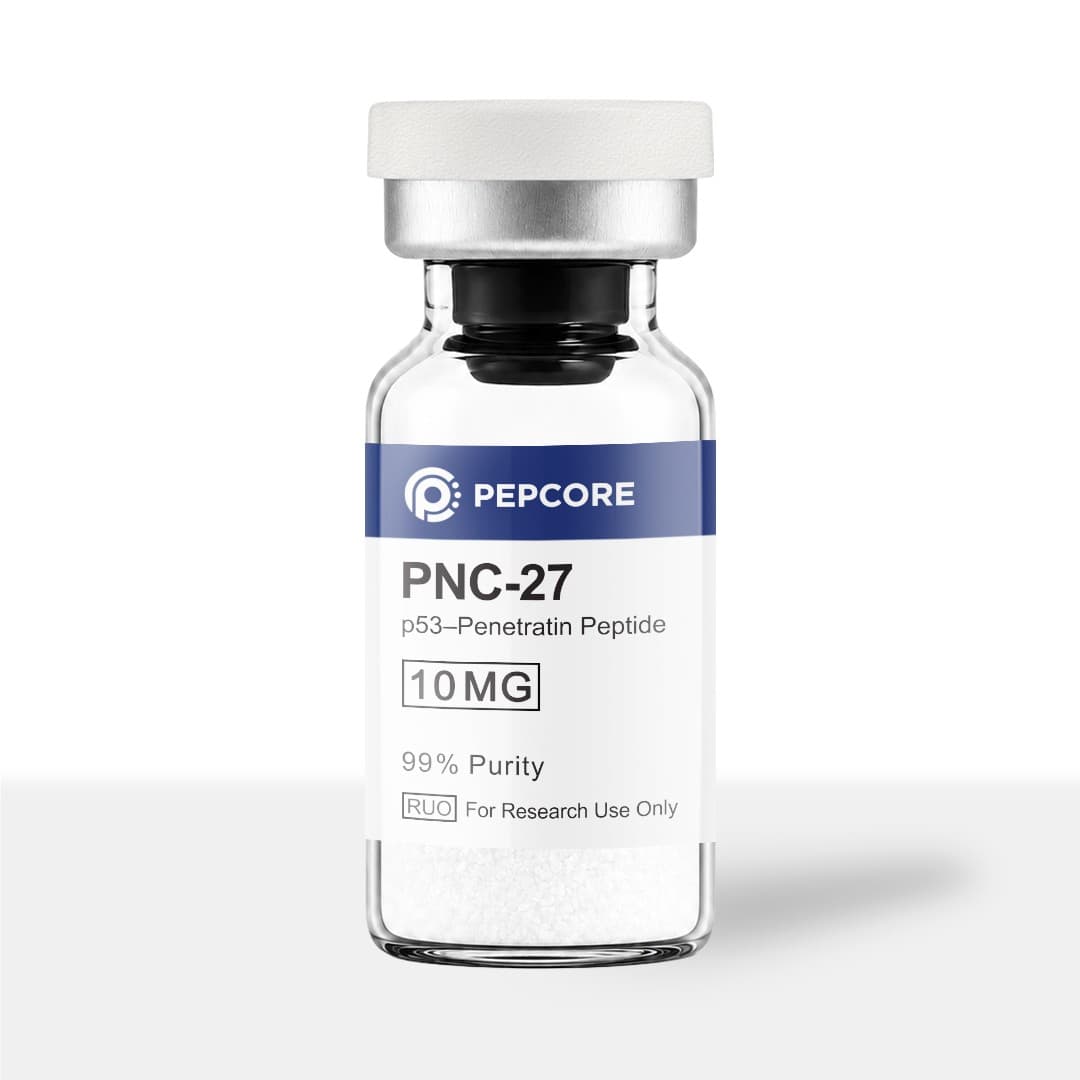
PNC-27 10 mg
Out of Stock
Amount (mg)
Bacteriostatic Water
Insulin Syringes
Alcohol Swabs
Quantity
1
Price€129.00
Fast delivery, dispatched same day before 14:00
Tracked delivery, door to door
Shipped discreetly
Secure payments



Order before 14:00 for same-day shipping
Order now, ships today
OrderedToday
ShippedToday
Delivered24-25 November
PNC-27 is a synthetic chimeric peptide built from 32 amino acids. It pairs a fragment of the p53 protein with a small penetratin cell-entry tag, and it is best known in research for its role in studying the p53 signaling pathway.
It also carries a research base, with work exploring how its design interacts with cellular stress pathways in lab models (Sarafraz-Yazdi et al., 2022, Biomedicines). That makes it a useful reference peptide for this kind of investigative work.
Research Applications
•p53 signaling pathway research
•Cellular stress lab models
•Cell-penetrating peptide studies
•Research-model cell biology
Supplied as a lyophilized powder for stability.
Scientific Background
PNC-27 is a chimeric research peptide constructed by fusing residues 12-26 of the human p53 protein (a region that mediates p53 binding to MDM2/HDM-2) with the antennapedia-derived penetratin sequence, a well-characterized cellular-penetration peptide motif. The resulting 32-residue peptide was developed to combine MDM2/HDM-2 ligand-binding research with penetratin-mediated cellular access for use in p53-pathway research models and peptide-membrane interaction research.
MDM2 and its human homolog HDM-2 are E3 ubiquitin-ligase research targets traditionally studied as intracellular regulators of p53 stability. Laboratory research has reported that HDM-2 can also be detected at the surface of certain research-model cell systems, providing an extracellular interaction site that PNC-27 has been used to investigate. Structural research with two-dimensional NMR and conformational-energy modelling has shown that PNC-27 adopts a p53-peptide-like α-helical conformation when engaged with HDM-2, supporting its use as a structural research tool for p53-pathway research.
This positioning at the intersection of p53-pathway research, chimeric peptide chemistry, and peptide-membrane interaction research has made PNC-27 a widely used research compound in cellular-stress research peptide investigations and research-model cell biology studies.
Structure
Peptide ClassSynthetic chimeric p53-penetratin research peptide
Amino Acid SequencePPLSQETFSDLWKLLKKWKMRRNQFWVKVQRG
Residue Count32 amino acids
Key Domainsp53 residues 12-26 (MDM2/HDM-2-binding region) fused to antennapedia penetratin cellular-penetration domain
Molecular FormulaC₁₈₈H₂₉₃N₅₃O₄₄S
Molecular Weight~4031.7 g/mol
CAS Number1159861-00-3
Mechanism of Action
MDM2 / HDM-2 Ligand Engagement
The p53-derived N-terminal segment of PNC-27 engages HDM-2 in research models through the same interface used by native p53. Structural research has reported that PNC-27 adopts a p53-peptide-like α-helical conformation when bound to HDM-2, supporting its use as a mechanistic tool in p53-pathway research models and MDM2/HDM-2 ligand-binding research (Sarafraz-Yazdi et al., 2022, Biomedicines).
Penetratin-Mediated Cellular Access
The C-terminal penetratin sequence derived from the antennapedia homeodomain provides PNC-27 with cellular-penetration capacity in research models. Penetratin is a well-characterized cell-penetrating peptide motif, and its inclusion in PNC-27 supports laboratory research on peptide-membrane interaction research and chimeric peptide design.
Peptide-Membrane Interaction Research
Structural and biophysical research has reported that PNC-27, when engaged with membrane-localized HDM-2 in research-model cell membrane studies, can assemble into pore-like structures observable by transmembrane microscopy. These observations are investigated in laboratory research on peptide-membrane interaction research, membrane-pore-formation research, and research-model cell biology of chimeric peptide systems.
Conformational Determinants
Research with conformational-energy calculations and structural assays has mapped the residues required for PNC-27 engagement with HDM-2 and for peptide-membrane research outcomes. These structure-function research studies inform the broader peptide-design research literature on chimeric research peptides combining ligand-binding and cell-penetrating motifs.
Conclusion
PNC-27 is a synthetic chimeric research peptide combining a p53-derived MDM2/HDM-2-binding sequence with the antennapedia penetratin cellular-penetration domain. By integrating ligand-binding and cellular-penetration motifs within a single 32-residue research peptide, PNC-27 supports laboratory research on p53-pathway research models, MDM2/HDM-2 ligand-binding research, peptide-membrane interaction research, and research-model cell biology investigations of chimeric peptide systems.
References
•Sarafraz-Yazdi E et al. (2022). PNC-27, a Chimeric p53-Penetratin Peptide Binds to HDM-2 in a p53 Peptide-like Structure, Induces Selective Membrane-Pore Formation and Leads to Cancer Cell Lysis. Biomedicines. PubMed
•Michl J et al. (2006). PNC-28, a p53-derived peptide that is cytotoxic to cancer cells, blocks pancreatic cancer cell growth in vivo. International Journal of Cancer. PubMed
•Sookraj KA et al. (2010). The anti-cancer peptide, PNC-27, induces tumor cell lysis as the intact peptide. Cancer Chemotherapy and Pharmacology. PubMed
•Bowne WB et al. (2008). The penetratin sequence in the anticancer PNC-28 peptide causes tumor cell necrosis rather than apoptosis of human pancreatic cancer cells. Annals of Surgical Oncology. PubMed
•Derossi D et al. (1994). The third helix of the Antennapedia homeodomain translocates through biological membranes. The Journal of Biological Chemistry. PubMed
•Chène P (2003). Inhibiting the p53-MDM2 interaction: an important target for cancer therapy. Nature Reviews Cancer. PubMed
Research Use Disclaimer
This product is intended for research and laboratory use only. It is designed exclusively for in vitro research purposes. All information provided is for educational and research reference only. This product is not intended for human or animal use. It is not a drug, food, or cosmetic and must not be marketed, labeled, or used as such. Use and handling are restricted to trained and qualified professionals.
What is PNC-27?
PNC-27 is a synthetic chimeric peptide built from 32 amino acids. It is supplied as a lyophilized powder for laboratory research use only.
What is PNC-27 used for in research?
In research, PNC-27 is studied in areas such as: p53 signaling pathway research, Cellular stress lab models and Cell-penetrating peptide studies. Related compounds in our Bioregulators range include Thymogen and Testagen.
Where can I buy PNC-27?
PNC-27 is available from Pepcore, shipped from the Netherlands to every European country with tracking. A certificate of analysis is available on request.
How is PNC-27 reconstituted?
With bacteriostatic water, added slowly down the inside of the glass rather than onto the powder, then swirled gently, never shaken. Bacteriostatic water is optional when you order: you can add a 3 ml vial (+€4.99) or a 10 ml vial (+€12.99), or leave it out. Use our peptide calculator to work out the concentration for your vial size.
How is PNC-27 stored, and how long does shipping take?
Lyophilized PNC-27 is kept cool, dry and away from light. Once reconstituted, the solution is refrigerated at 2 to 8 °C, see our peptide stability guide. Orders leave the Netherlands the same or next business day: 1 to 2 business days to the Netherlands and Belgium, 2 to 7 to Germany, France, Spain, Italy and Luxembourg, 3 to 8 to the rest of the EU, free from €250, see shipping.
Amount (mg)10 mg
Bacteriostatic Water3 ml or 10 ml, optional
Insulin Syringes10× 1 ml insulin syringes, 10× 0.5 ml insulin syringes, None
Alcohol SwabsYes, No
TestingThird-party HPLC/MS
CASN/A
Netherlands & Belgium: 1-2 business days, €8.49-€12.99
Germany: 2-7 business days, €12.99
France, Spain, Italy & Luxembourg: 2-7 business days, €14.90
Rest of the EU: 3-8 business days, €14.90
Poland: 3-8 business days, €15.99
Sweden: 3-8 business days, €15.99
Switzerland, Norway, United Kingdom & other European countries outside the EU: 5-10 business days, €15.99
Canary Islands: 7-12 business days, €24.99
Free shipping on orders from €250
For laboratory and research use only.
Not for human or veterinary use, diagnosis, or treatment.
To be handled only by qualified personnel in a controlled lab setting.
By placing an order, you confirm you have read and agree to these research-use terms.


€129.00