Cognitive
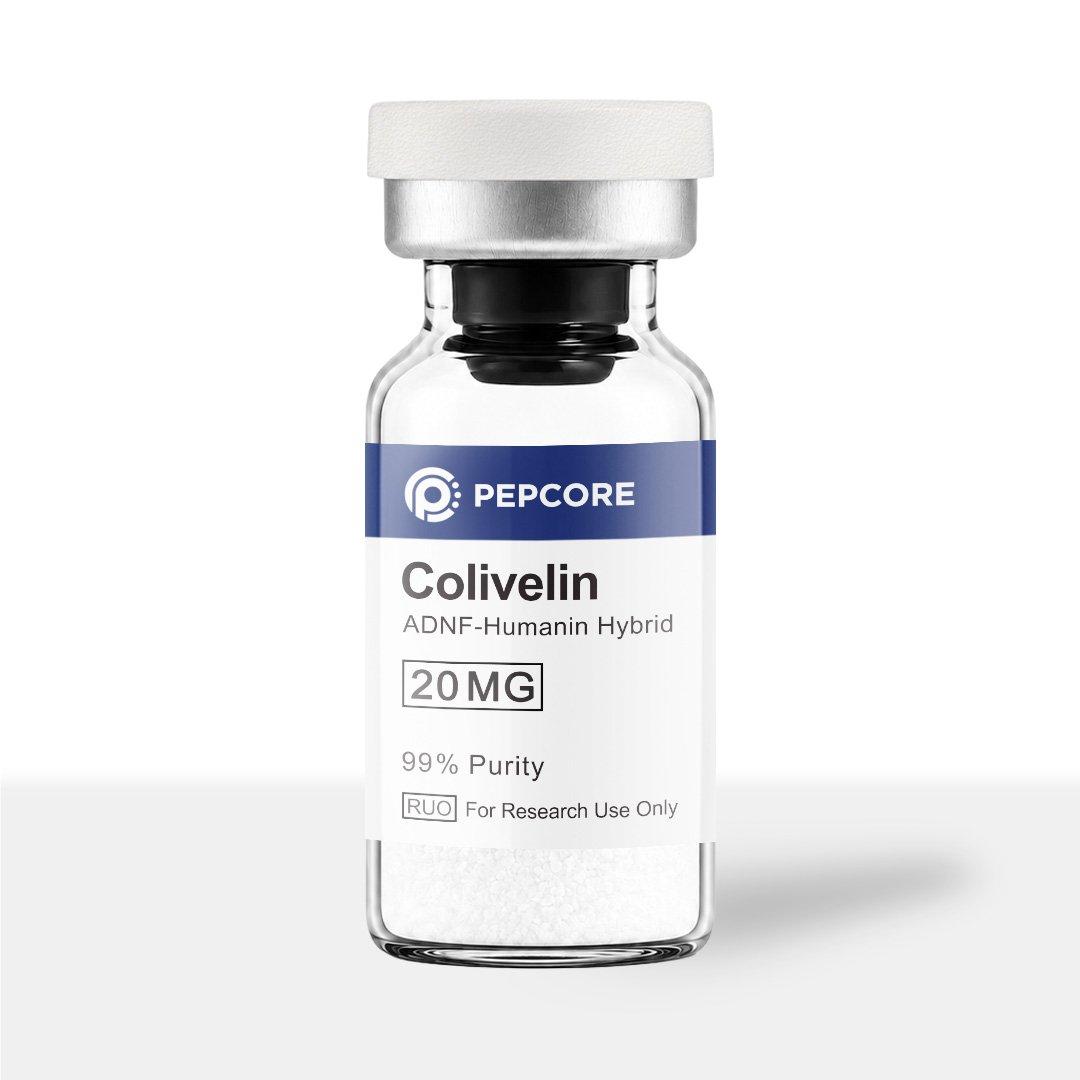
Colivelin 20 mg
Out of Stock
Amount (mg)
Bacteriostatic Water
Insulin Syringes
Alcohol Swabs
Quantity
1
Price€79.00
Fast delivery, dispatched same day before 14:00
Tracked delivery, door to door
Shipped discreetly
Secure payments



Order before 14:00 for same-day shipping
Order now, ships today
OrderedToday
ShippedToday
Delivered24-25 November
Colivelin is a synthetic peptide studied for its ability to reduce cell death in stressed neuronal-cell models. It joins a short ADNF9 sequence to a modified Humanin segment, bringing two peptide designs together in one chain. Published cell experiments linked its survival response to STAT3 and CaMKIV, proteins involved in passing signals inside cells.
The original work examined cultured neuronal cells challenged with experimental protein-related stress. Colivelin reduced cell death in those defined models, providing a way to investigate cell-survival signaling. Later studies explored its shape and developed labelled versions for imaging and molecular-interaction tests. These experiments help researchers connect the hybrid sequence with what it does in the particular cellular or molecular system being measured. Chiba et al., 2005, Arakawa et al., 2008, Kostomoiri et al., 2015.
Research Applications
•Studied in nerve-cell survival models
•Relevant in cellular stress responses research
•Examined in cell-death regulation studies
•Applied in STAT3 and CaMKIV survival signals research
Supplied as a lyophilized powder for stability.
Scientific Background
Colivelin was introduced in 2005 by linking ADNF9, with sequence SALLRSIPA, to the Humanin analogue AGA-(C8R)HNG17, with sequence PAGASRLLLLTGEIDLP. The complete reference peptide therefore has 26 residues. The Humanin-derived segment contains deliberate sequence changes and truncation, so the hybrid is studied as its own molecular entity.
The two-part design provided a way to compare the hybrid with each contributing sequence under the same experimental conditions. The original investigators used neuronal models and molecular interventions to examine how the combined chain related to downstream responses. This work provided the starting point for later studies of the scaffold.
Physical characterization adds another dimension. Measurements of peptide shape and association compared Colivelin, ADNF9 and Humanin. Under the tested solution conditions, Colivelin's folding and association behavior resembled ADNF9 more closely than a simple average of the two components. Subsequent work introduced fluorescent, biotin and radiolabel-bearing derivatives for tracking and binding experiments. These studies treat peptide structure, molecular interaction and cellular response as related but distinct questions (Arakawa et al., 2008; Kostomoiri et al., 2015).
Structure
Peptide ClassSynthetic ADNF9–Humanin-analogue hybrid
Reference SequenceSALLRSIPAPAGASRLLLLTGEIDLP
Residues26
Molecular FormulaC₁₁₉H₂₀₆N₃₂O₃₅
Molecular Weight2645.1 g/mol
Reference CAS Number867021-83-8
Mechanism of Action
Following survival in stressed cells
The original experiments used the F11 neuronal-cell model to examine cell death caused by specific experimental protein stresses. Colivelin reduced cell death under the tested conditions. Researchers measured the surviving population and compared the hybrid with its contributing peptide sequences. This connected the sequence design with a biological response in a defined culture model. Chiba et al., 2005.
Examining the internal survival signals
The investigators introduced forms of STAT3 and CaMKIV that interfere with normal signaling. The pattern of changes supported involvement of both pathways in Colivelin's survival response. Such experiments ask which internal signal routes contribute to the effect. They help explain the measured cell response while keeping the question of direct molecular binding separate. Chiba et al., 2005.
Connecting sequence with molecular behavior
Physical measurements found that Colivelin behaved as a single peptide molecule under the solution conditions examined. Later work added fluorescent or biotin labels to follow particular interactions, including experiments in F11 cells and with amyloid-β. The labels change the molecule, so the tagged forms are identified separately. These approaches add information about peptide shape and molecular contacts to the cell-survival experiments. Arakawa et al., 2008, Kostomoiri et al., 2015.
References
•Chiba T et al. (2005). Colivelin hybrid design and neuronal-cell survival experiments. Journal of Neuroscience. DOI
•Arakawa T et al. (2008). Colivelin structure and association measurements. Journal of Peptide Science. DOI
•Kostomoiri M et al. (2015). Labelled Colivelin derivatives and molecular-probe experiments. Archives of Biochemistry and Biophysics. DOI
Research Use Disclaimer
This product is intended for in vitro laboratory research only. All information is provided for education and research reference. Not for personal use, diagnosis or treatment. Handling is restricted to trained and qualified professionals.
What is Colivelin?
Colivelin is a synthetic peptide studied for its ability to reduce cell death in stressed neuronal-cell models. It is supplied as a lyophilized powder for laboratory research use only.
What is Colivelin used for in research?
In research, Colivelin is studied in nerve-cell survival models, in cellular stress responses research as well as in cell-death regulation studies. Related compounds in our Cognitive range include NA Semax and NA Selank.
Where can I buy Colivelin?
Colivelin is available from Pepcore, shipped from the Netherlands to every European country with tracking. A certificate of analysis is available on request.
How is Colivelin reconstituted?
With bacteriostatic water, added slowly down the inside of the glass rather than onto the powder, then swirled gently, never shaken. Bacteriostatic water is optional when you order: you can add a 3 ml vial (+€4.99) or a 10 ml vial (+€12.99), or leave it out. Use our peptide calculator to work out the concentration for your vial size.
How is Colivelin stored, and how long does shipping take?
Lyophilized Colivelin is kept cool, dry and away from light. Once reconstituted, the solution is refrigerated at 2 to 8 °C, see our peptide stability guide. Orders leave the Netherlands the same or next business day: 1 to 2 business days to the Netherlands and Belgium, 2 to 7 to Germany, France, Spain, Italy and Luxembourg, 3 to 8 to the rest of the EU, free from €250, see shipping.
Amount (mg)20 mg
Bacteriostatic Water3 ml or 10 ml, optional
Insulin Syringes10× 1 ml insulin syringes, 10× 0.5 ml insulin syringes, None
Alcohol SwabsYes, No
TestingThird-party HPLC/MS
CAS867021-83-8
Netherlands & Belgium: 1-2 business days, €8.49-€12.99
Germany: 2-7 business days, €12.99
France, Spain, Italy & Luxembourg: 2-7 business days, €14.90
Rest of the EU: 3-8 business days, €14.90
Poland: 3-8 business days, €15.99
Sweden: 3-8 business days, €15.99
Switzerland, Norway, United Kingdom & other European countries outside the EU: 5-10 business days, €15.99
Canary Islands: 7-12 business days, €24.99
Free shipping on orders from €250
For laboratory and research use only.
Not for human or veterinary use, diagnosis, or treatment.
To be handled only by qualified personnel in a controlled lab setting.
By placing an order, you confirm you have read and agree to these research-use terms.


€79.00