Cognitive
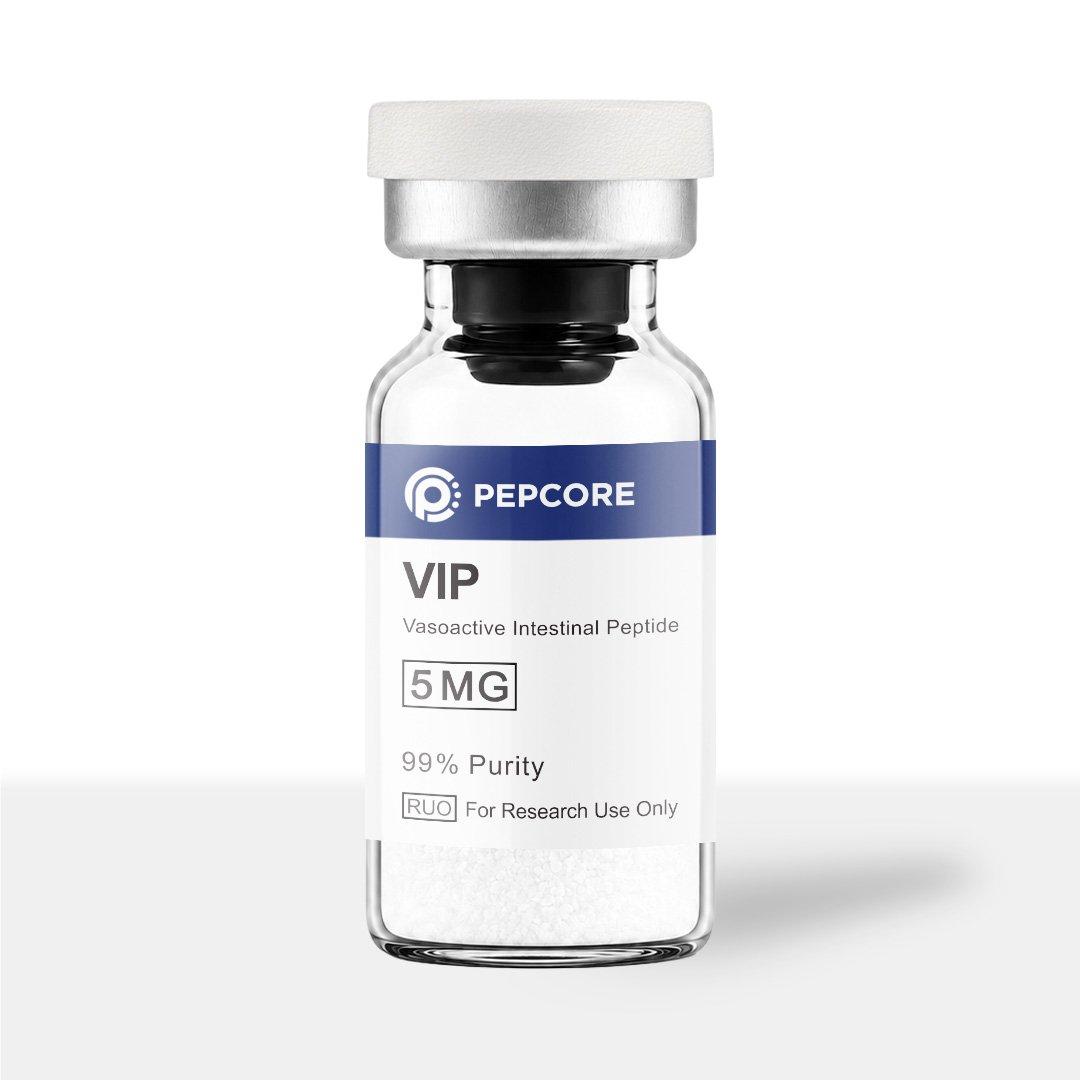
VIP 5 mg
In Stock
Amount (mg)
Bacteriostatic Water
Insulin Syringes
Alcohol Swabs
Quantity
1
Price€49.00
Fast delivery, dispatched same day before 14:00
Tracked delivery, door to door
Shipped discreetly
Secure payments



Order before 14:00 for same-day shipping
Order now, ships today
OrderedToday
ShippedToday
Delivered24-25 November
VIP (vasoactive intestinal peptide) is a naturally occurring peptide that can relax smooth muscle in certain tissues and widen blood vessels. In the digestive system, it can increase the amount of water and salts in the intestine. It also influences how certain immune cells respond to inflammatory signals.
VIP's relaxing action is studied in smooth-muscle and blood-vessel research. Its effects on intestinal water and salt transport are examined alongside immune-cell responses, with the response depending on the tissue, cell type and experimental setting. These actions involve VPAC1 and VPAC2 receptors and pathways such as cAMP signaling (Saga and Said, 1984; Frase et al., 1987; Krejs et al., 1980; Chedid et al., 2017).
Research Applications
•Studied in blood flow and vascular tone models
•Relevant in smooth-muscle relaxation research
•Examined in digestive secretion and fluid transport studies
•Applied in immune-cell responses research
Supplied as a lyophilized powder for stability.
Scientific Background
VIP is a short chain of 28 amino acids, the building blocks of peptides. The human reference sequence has a modified end called an amide group. Its sequence and end group form part of its identity, alongside the molecular formula and mass listed below. UniProtKB P01282.
Its main receptors, VPAC1 and VPAC2, are proteins that help cells recognise incoming messages. They also respond to PACAP, a related peptide. Comparing VIP and PACAP helps researchers understand why similar messengers can interact differently with the same receptor. A third receptor, PAC1, generally responds more strongly to PACAP than to VIP. Liao et al., 2021.
Researchers study VIP using receptor-binding tests, cell-signaling measurements and detailed images of receptor complexes. A published VIP–VPAC1 structure shows where the peptide sits when the receptor is active. Together, these approaches connect the peptide's shape with the way it passes on a signal. Piper et al., 2022.
Structure
Peptide classVasoactive intestinal peptide, human reference
Length28 amino acids
Reference sequenceHSDAVFTDNY TRLRKQMAVK KYLNSILN-NH₂
Reference C-terminusAmidated asparagine
Reference molecular formulaC₁₄₇H₂₃₈N₄₄O₄₂S
Reference molar mass~3325.8 g/mol
Disulfide bondsNone in the reference sequence
UniProt accessionP01282, precursor residues 125–152
Mechanism of Action
Connecting with cell receptors
VIP binds to VPAC receptors at the cell surface. The receptor acts as a receiver: it recognises the peptide and changes shape when activated. Structural research shows how different parts of VIP contact VPAC1, helping explain which features matter for this connection. Binding is the first step; researchers then measure what happens inside the cell. Piper et al., 2022.
Passing the message inside the cell
Activated VPAC receptors can work with a protein called Gs. This helps switch on adenylyl cyclase, an enzyme that produces cAMP. cAMP carries the message onward inside the cell. Measuring it gives researchers a way to follow receptor activity and compare responses under different laboratory conditions. Studies in isolated intestinal cells have linked VIP binding with this internal signaling step. Broyart et al., 1981.
Different cells, different responses
The effect of a signal depends on the cell receiving it. In isolated human immune-cell experiments, VIP changed the response of monocytes to a particular stimulus, while neutrophils did not show the same response. This helps explain why VIP is studied in immune regulation, while also showing why one result cannot describe every cell type. Researchers compare receptor levels, cell types and experimental conditions to understand these differences. Chedid et al., 2017.
References
•Piper SJ et al. (2022). VIP receptor structure and peptide selectivity. Nature Communications. PubMed
•Liao C et al. (2021). VIP/PACAP receptor recognition and dynamics. Frontiers in Molecular Biosciences. PubMed
•Broyart JP et al. (1981). VIP binding and cAMP in isolated human intestinal cells. Journal of Clinical Endocrinology & Metabolism. PubMed
•Chedid P et al. (2017). VIP signaling experiments in primary human immune cells. Mucosal Immunology. PubMed
•Saga T and Said SI (1984). VIP relaxation of isolated human airway and pulmonary arterial tissue. PubMed
Research Use Disclaimer
This product is intended for in vitro laboratory research only. All information is provided for education and research reference. Not for personal use, diagnosis or treatment. Handling is restricted to trained and qualified professionals.
What is VIP?
VIP (vasoactive intestinal peptide) is a naturally occurring peptide that can relax smooth muscle in certain tissues and widen blood vessels. It is supplied as a lyophilized powder for laboratory research use only.
What is VIP used for in research?
In research, VIP is studied in blood flow and vascular tone models, in smooth-muscle relaxation research as well as in digestive secretion and fluid transport studies. Related compounds in our Cognitive range include NA Semax and NA Selank.
Where can I buy VIP?
VIP is available from Pepcore, shipped from the Netherlands to every European country with tracking. A certificate of analysis is available on request.
How is VIP reconstituted?
With bacteriostatic water, added slowly down the inside of the glass rather than onto the powder, then swirled gently, never shaken. Bacteriostatic water is optional when you order: you can add a 3 ml vial (+€4.99) or a 10 ml vial (+€12.99), or leave it out. Use our peptide calculator to work out the concentration for your vial size.
How is VIP stored, and how long does shipping take?
Lyophilized VIP is kept cool, dry and away from light. Once reconstituted, the solution is refrigerated at 2 to 8 °C, see our peptide stability guide. Orders leave the Netherlands the same or next business day: 1 to 2 business days to the Netherlands and Belgium, 2 to 7 to Germany, France, Spain, Italy and Luxembourg, 3 to 8 to the rest of the EU, free from €250, see shipping.
Amount (mg)5 mg
Bacteriostatic Water3 ml or 10 ml, optional
Insulin Syringes10× 1 ml insulin syringes, 10× 0.5 ml insulin syringes, None
Alcohol SwabsYes, No
TestingThird-party HPLC/MS
CAS37221-79-7
Netherlands & Belgium: 1-2 business days, €8.49-€12.99
Germany: 2-7 business days, €12.99
France, Spain, Italy & Luxembourg: 2-7 business days, €14.90
Rest of the EU: 3-8 business days, €14.90
Poland: 3-8 business days, €15.99
Sweden: 3-8 business days, €15.99
Switzerland, Norway, United Kingdom & other European countries outside the EU: 5-10 business days, €15.99
Canary Islands: 7-12 business days, €24.99
Free shipping on orders from €250
For laboratory and research use only.
Not for human or veterinary use, diagnosis, or treatment.
To be handled only by qualified personnel in a controlled lab setting.
By placing an order, you confirm you have read and agree to these research-use terms.


€49.00