Bioregulators
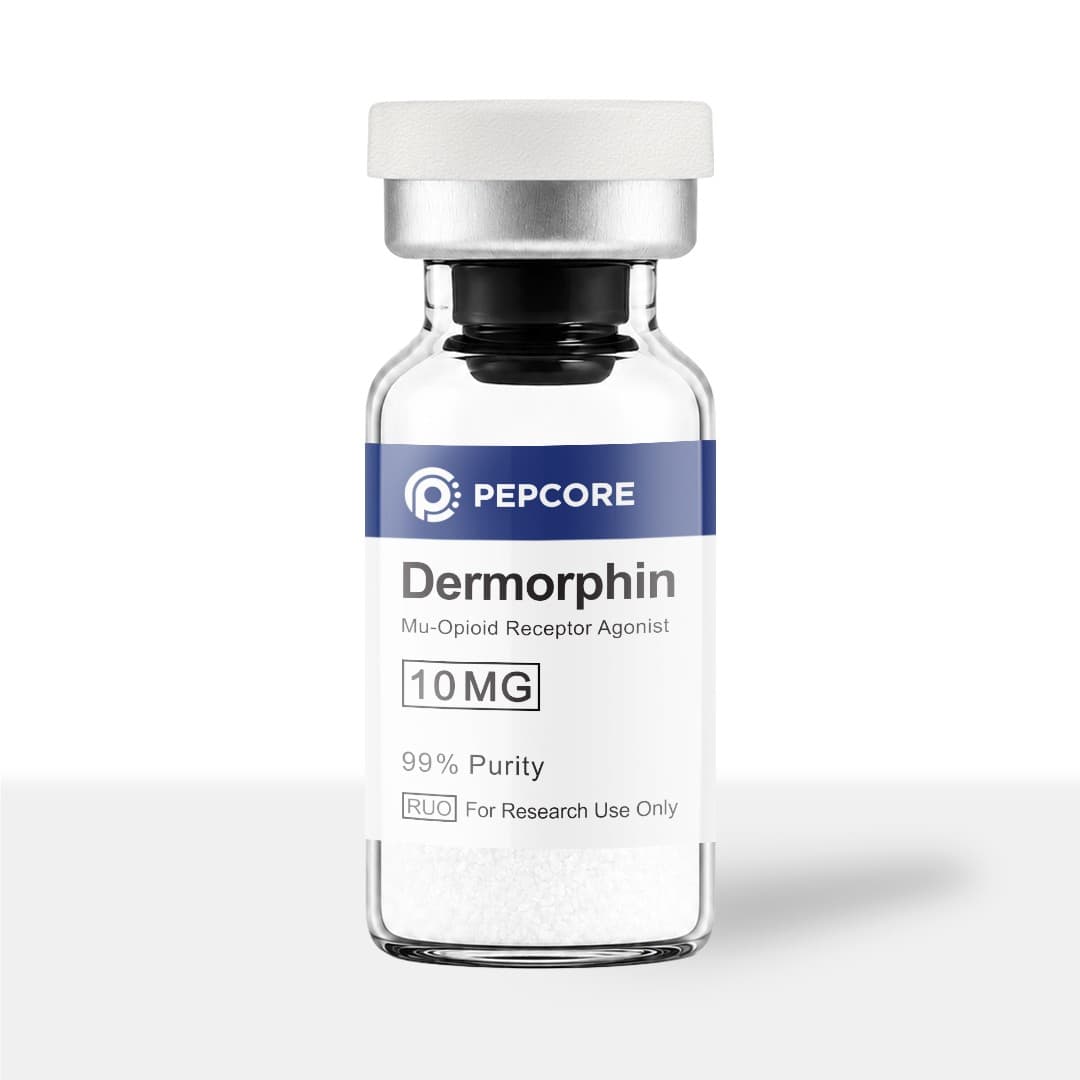
Dermorphin 10 mg
In Stock
Amount (mg)
Bacteriostatic Water
Insulin Syringes
Alcohol Swabs
Quantity
1
Price€69.00
Fast delivery, dispatched same day before 14:00
Tracked delivery, door to door
Shipped discreetly
Secure payments



Order before 14:00 for same-day shipping
Order now, ships today
OrderedToday
ShippedToday
Delivered24-25 November
Dermorphin is a naturally occurring opioid peptide made of seven amino acids, first found in the skin of a South American tree frog. It is best known in opioid-receptor research, and a rare D-alanine building block in its sequence is the unusual feature that sets it apart from peptides found in mammals.
It also has a solid research history, going back to the work that first described and sequenced it (Montecucchi et al., 1981). That early footing is part of why it still turns up as a reference peptide in this field.
Research Applications
•Opioid-receptor signaling research
•Neuropeptide receptor studies
•Peptide stability research models
•Amphibian-derived peptide studies
Supplied as a lyophilized powder for stability.
Scientific Background
Dermorphin was first isolated and characterized in 1981 from methanol extracts of the skin of Phyllomedusa sauvagei by Montecucchi, Erspamer, and colleagues. The peptide was identified as the prototype of a novel class of opioid peptides distinguished by the incorporation of a D-amino acid at position 2, produced through post-translational isomerization of encoded L-alanine by a specialized amino-acid isomerase in the frog's skin secretory granules.
The dermorphin sequence (H-Tyr-D-Ala-Phe-Gly-Tyr-Pro-Ser-NH2) differs markedly from mammalian enkephalins and endorphins, lacking the traditional N-terminal Tyr-Gly-Gly-Phe motif. Despite this structural divergence, it binds with exceptionally high affinity and selectivity to μ-opioid receptors in research models. The D-Ala2 residue is essential for this activity in receptor-binding research, as replacement with L-alanine renders the peptide essentially inactive at the receptor.
Since its discovery, more than one hundred dermorphin analogs have been synthesized, establishing comprehensive structure-activity relationships for this peptide family. This positioning at the intersection of amphibian peptide chemistry, opioid-receptor signaling research, and neuropeptide receptor binding studies has made dermorphin a widely used reference compound in laboratory research models of opioid-receptor pharmacology.
Structure
Peptide ClassNaturally occurring amphibian opioid heptapeptide research compound
Amino Acid SequenceH-Tyr-D-Ala-Phe-Gly-Tyr-Pro-Ser-NH2
Residue Count7 amino acids
Molecular FormulaC₄₀H₅₀N₈O₁₀
Molecular Weight~802.87 g/mol
CAS Number77614-16-5
PubChem CID5485199
SourceIsolated from skin secretions of Phyllomedusa sauvagei
Mechanism of Action
μ-Opioid Receptor Engagement
Dermorphin is studied as one of the most potent and selective naturally occurring μ-opioid receptor agonists in research models. In receptor-binding research it demonstrates high affinity for μ-receptors with markedly lower affinity for δ- and κ-opioid receptor subtypes. This selectivity makes it a precision tool for opioid-receptor signaling research, G-protein coupling studies, and downstream intracellular pathway investigations.
Receptor-Signaling Cascades
Upon μ-opioid receptor engagement, dermorphin modulates Gαi/o-coupled signaling in research models, including inhibition of adenylyl cyclase activity, modulation of intracellular cyclic AMP, and activation of inwardly rectifying potassium channels. These cascades are widely investigated in neuropeptide receptor binding studies and opioid-receptor signaling research.
Enzymatic Stability via D-Ala2
The presence of the D-Ala2 residue confers resistance to degradation by mammalian aminopeptidases and endopeptidases in research models, resulting in prolonged engagement at the receptor compared to L-amino-acid opioid peptides. This property is investigated in laboratory research examining how D-amino-acid substitution influences peptide stability, blood-brain barrier permeability research, and duration of receptor occupancy in research models.
Structure-Activity Research
By systematic modification of the dermorphin sequence, including substitutions at positions 2, 4, and 6, truncation studies, and additional D-amino-acid replacements, researchers map the structural determinants of μ-receptor selectivity, binding affinity, and agonist efficacy. The N-terminal tetrapeptide (Tyr-D-Ala-Phe-Gly) has been identified in research models as the minimal sequence requirement for μ-opioid receptor engagement.
Conclusion
Dermorphin is a naturally occurring amphibian heptapeptide research compound investigated as a high-affinity, μ-selective opioid-receptor agonist in research models. Its incorporation of a D-alanine residue at position 2, a rare feature among vertebrate peptides, confers exceptional enzymatic stability and distinguishes it structurally from all mammalian opioid peptides. By serving as a prototype for a distinct class of opioid peptide research compounds, dermorphin provides a valuable research tool for opioid-receptor signaling research, neuropeptide receptor binding studies, and peptide structure-activity research in research models.
References
•Montecucchi PC et al. (1981). Amino acid composition and sequence of dermorphin, a novel opiate-like peptide from the skin of Phyllomedusa sauvagei. International Journal of Peptide and Protein Research. PubMed
•Broccardo M et al. (1981). Pharmacological data on dermorphins, a new class of potent opioid peptides from amphibian skin. British Journal of Pharmacology. PubMed
•Lazarus LH et al. (1989). Dermorphin gene sequence peptide with high affinity and selectivity for delta-opioid receptors. The Journal of Biological Chemistry. PubMed
•Erspamer V et al. (1989). Deltorphins: a family of naturally occurring peptides with high affinity and selectivity for delta opioid binding sites. Proceedings of the National Academy of Sciences of the United States of America. PubMed
•Salvadori S et al. (1995). Delta opioidmimetic antagonists: prototypes for designing a new generation of ultraselective opioid peptides. Molecular Medicine. PubMed
Research Use Disclaimer
This product is intended for research and laboratory use only. It is designed exclusively for in vitro research purposes. All information provided is for educational and research reference only. This product is not intended for human or animal use. It is not a drug, food, or cosmetic and must not be marketed, labeled, or used as such. Use and handling are restricted to trained and qualified professionals.
What is Dermorphin?
Dermorphin is a naturally occurring opioid peptide made of seven amino acids, first found in the skin of a South American tree frog. It is supplied as a lyophilized powder for laboratory research use only.
What is Dermorphin used for in research?
In research, Dermorphin is studied in areas such as: Opioid-receptor signaling research, Neuropeptide receptor studies and Peptide stability research models. Related compounds in our Bioregulators range include Thymogen and Testagen.
Where can I buy Dermorphin?
Dermorphin is available from Pepcore, shipped from the Netherlands to every European country with tracking. A certificate of analysis is available on request.
How is Dermorphin reconstituted?
With bacteriostatic water, added slowly down the inside of the glass rather than onto the powder, then swirled gently, never shaken. Bacteriostatic water is optional when you order: you can add a 3 ml vial (+€4.99) or a 10 ml vial (+€12.99), or leave it out. Use our peptide calculator to work out the concentration for your vial size.
How is Dermorphin stored, and how long does shipping take?
Lyophilized Dermorphin is kept cool, dry and away from light. Once reconstituted, the solution is refrigerated at 2 to 8 °C, see our peptide stability guide. Orders leave the Netherlands the same or next business day: 1 to 2 business days to the Netherlands and Belgium, 2 to 7 to Germany, France, Spain, Italy and Luxembourg, 3 to 8 to the rest of the EU, free from €250, see shipping.
Amount (mg)10 mg
Bacteriostatic Water3 ml or 10 ml, optional
Insulin Syringes10× 1 ml insulin syringes, 10× 0.5 ml insulin syringes, None
Alcohol SwabsYes, No
TestingThird-party HPLC/MS
CAS77614-16-5
Netherlands & Belgium: 1-2 business days, €8.49-€12.99
Germany: 2-7 business days, €12.99
France, Spain, Italy & Luxembourg: 2-7 business days, €14.90
Rest of the EU: 3-8 business days, €14.90
Poland: 3-8 business days, €15.99
Sweden: 3-8 business days, €15.99
Switzerland, Norway, United Kingdom & other European countries outside the EU: 5-10 business days, €15.99
Canary Islands: 7-12 business days, €24.99
Free shipping on orders from €250
For laboratory and research use only.
Not for human or veterinary use, diagnosis, or treatment.
To be handled only by qualified personnel in a controlled lab setting.
By placing an order, you confirm you have read and agree to these research-use terms.


€69.00