
Cognitive
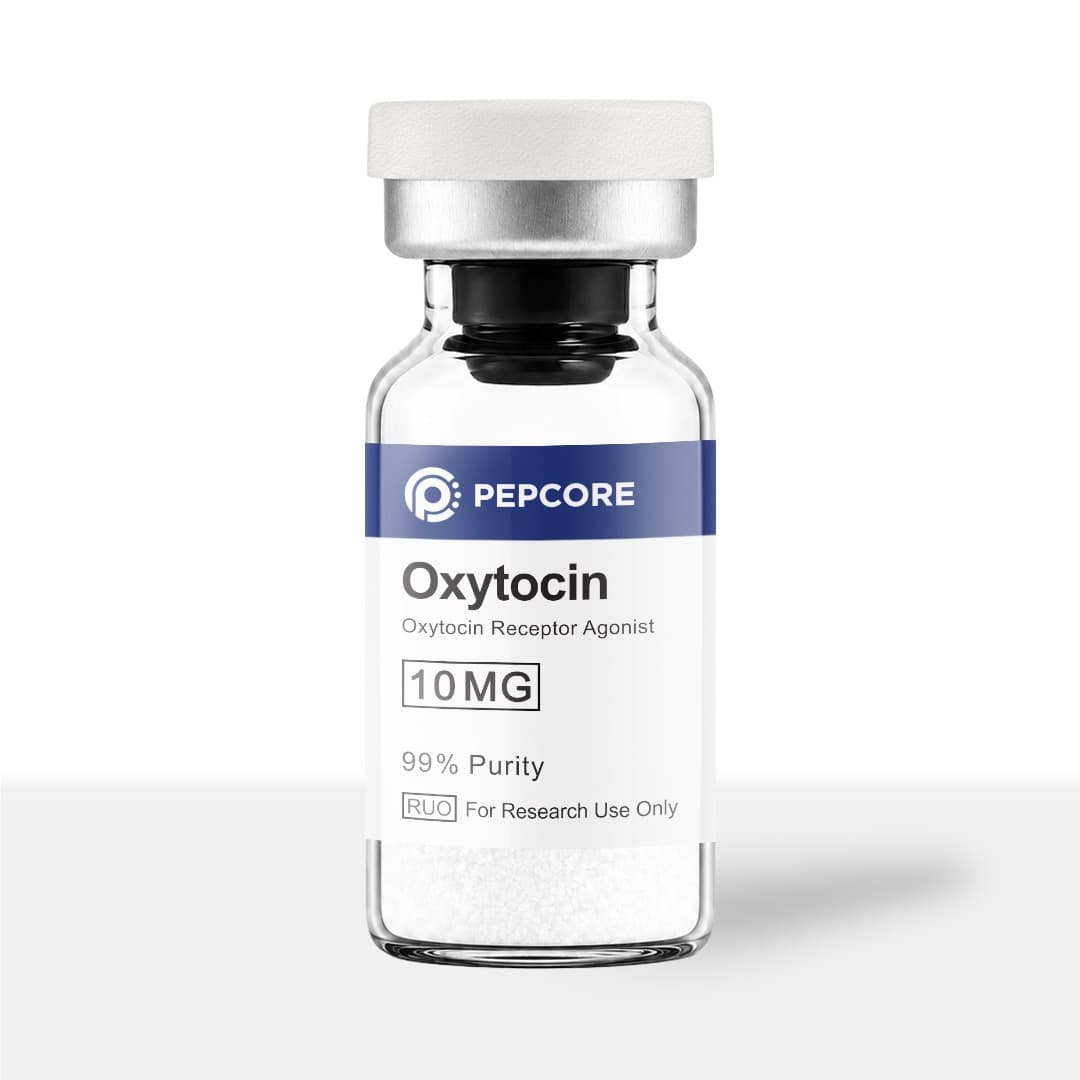
Oxytocin 10 mg
In Stock
Amount (mg)
Bacteriostatic Water
Insulin Syringes
Alcohol Swabs
Quantity
1
Price€49.00
Fast delivery, dispatched same day before 14:00
Tracked delivery, door to door
Shipped discreetly
Secure payments



Order before 14:00 for same-day shipping
Order now, ships today
OrderedToday
ShippedToday
Delivered24-25 November
Oxytocin is a nonapeptide, a nine-residue chain closed into a ring by a disulfide bridge. It occupies a unique place in this field: it was the first polypeptide hormone to be sequenced and then chemically synthesised, work that won du Vigneaud the Nobel Prize in Chemistry in 1955 and established the methods every synthetic peptide sold today still depends on.
In modern research it is studied through its own receptor, OXTR, a G-protein-coupled receptor found in the brain as well as in peripheral tissue (Gimpl and Fahrenholz, 2001, Physiological Reviews).
Research Applications
•Oxytocin-receptor (OXTR) signaling research
•Social and affiliative neuroscience models
•Neural plasticity research
•Peptide structure-activity reference standard
Supplied as a lyophilized powder for stability.
Scientific Background
Oxytocin was isolated from posterior pituitary extract and its nine-residue sequence determined by Vincent du Vigneaud, who then synthesised the molecule chemically in 1953. It was the first polypeptide hormone for which this was achieved, and the Nobel Prize in Chemistry followed in 1955. The synthetic strategy developed for it is the direct ancestor of the solid-phase methods used to make every research peptide in this catalog.
Structurally it is a cyclic nonapeptide: a disulfide bridge between the cysteine residues at positions 1 and 6 closes a six-residue ring, leaving a three-residue tail. It differs from vasopressin at only two positions, and that near-identity is why receptor cross-reactivity between the two systems is a recurring subject in laboratory research.
Its receptor, OXTR, is a class A G-protein-coupled receptor expressed in the central nervous system and in peripheral tissue. Since the 1990s a large body of work has examined OXTR signaling in laboratory models of social behaviour, neural plasticity and affiliative processes, which is where most current research interest sits.
Structure
Peptide ClassCyclic nonapeptide hormone; oxytocin-receptor (OXTR) agonist
Amino Acid SequenceCys-Tyr-Ile-Gln-Asn-Cys-Pro-Leu-Gly-NH2 (disulfide bridge Cys1-Cys6)
Molecular FormulaC₄₃H₆₆N₁₂O₁₂S₂
Molecular Weight~1007.19 g/mol
CAS Number50-56-6
PubChem CID439302
SynonymsOcytocin, alpha-hypophamine
Mechanism of Action
OXTR Engagement
Oxytocin binds OXTR, a class A G-protein-coupled receptor. Coupling is predominantly through Gq, activating phospholipase-C, generating inositol-1,4,5-trisphosphate and diacylglycerol, and mobilizing intracellular calcium in laboratory research models. Gi-coupled signaling has also been characterised, giving the receptor a context-dependent output.
Central Nervous System Research Models
OXTR is expressed across limbic and cortical regions. Oxytocin is investigated in laboratory research models of social recognition, affiliative behaviour and salience processing, where the research question concerns receptor-mediated modulation of neural circuit activity.
Neural Plasticity Research
Oxytocin is studied for effects on synaptic gain and cortical plasticity in laboratory models, including work on how OXTR activation alters the balance of excitation and inhibition in sensory and social circuits.
Structural Relationship to Vasopressin
Oxytocin and vasopressin differ at two of nine residues and their receptors show measurable cross-reactivity. Comparative receptor-binding research uses the pair to probe selectivity within the neurohypophysial peptide family.
Conclusion
Oxytocin represents a structurally defined cyclic nonapeptide and the historical foundation of synthetic peptide chemistry. Through OXTR-mediated signaling it serves as a reference compound for laboratory investigation of receptor-coupled second-messenger pathways, social and affiliative neuroscience models, and neural plasticity research.
References
•du Vigneaud V et al. (1960). Synthesis of 1-beta-mercantopropionic acid oxytocin (desamino-oxytocin), a highly potent analogue of oxytocin. The Journal of Biological Chemistry. PubMed
•Gimpl G, Fahrenholz F (2001). The oxytocin receptor system: structure, function, and regulation. Physiological Reviews. PubMed
•Shamay-Tsoory SG, Abu-Akel A (2016). The Social Salience Hypothesis of Oxytocin. Biological Psychiatry. PubMed
•Jurek B, Neumann ID (2018). The Oxytocin Receptor: From Intracellular Signaling to Behavior. Physiological Reviews. PubMed
•Froemke RC, Young LJ (2021). Oxytocin, Neural Plasticity, and Social Behavior. Annual Review of Neuroscience. PubMed
Research Use Disclaimer
This product is intended for research and laboratory use only. It is designed exclusively for in vitro research purposes. All information provided is for educational and research reference only. This product is not intended for human or animal use. It is not a drug, food, or cosmetic and must not be marketed, labeled, or used as such. Use and handling are restricted to trained and qualified professionals.
What is Oxytocin?
Oxytocin is a nonapeptide, a nine-residue chain closed into a ring by a disulfide bridge. It is supplied as a lyophilized powder for laboratory research use only.
What is Oxytocin used for in research?
In research, Oxytocin is studied in areas such as: Oxytocin-receptor (OXTR) signaling research, Social and affiliative neuroscience models and Neural plasticity research. Related compounds in our Cognitive range include NA Semax and NA Selank. Further reading: Oxytocin: how it works and the research.
Where can I buy Oxytocin?
Oxytocin is available from Pepcore, shipped from the Netherlands to every European country with tracking. A certificate of analysis is available on request.
How is Oxytocin reconstituted?
With bacteriostatic water, added slowly down the inside of the glass rather than onto the powder, then swirled gently, never shaken. Bacteriostatic water is optional when you order: you can add a 3 ml vial (+€4.99) or a 10 ml vial (+€12.99), or leave it out. Use our peptide calculator to work out the concentration for your vial size.
How is Oxytocin stored, and how long does shipping take?
Lyophilized Oxytocin is kept cool, dry and away from light. Once reconstituted, the solution is refrigerated at 2 to 8 °C, see our peptide stability guide. Orders leave the Netherlands the same or next business day: 1 to 2 business days to the Netherlands and Belgium, 2 to 7 to Germany, France, Spain, Italy and Luxembourg, 3 to 8 to the rest of the EU, free from €250, see shipping.
Amount (mg)10 mg
Bacteriostatic Water3 ml or 10 ml, optional
Insulin Syringes10× 1 ml insulin syringes, 10× 0.5 ml insulin syringes, None
Alcohol SwabsYes, No
TestingThird-party HPLC/MS
CAS50-56-6
Netherlands & Belgium: 1-2 business days, €8.49-€12.99
Germany: 2-7 business days, €12.99
France, Spain, Italy & Luxembourg: 2-7 business days, €14.90
Rest of the EU: 3-8 business days, €14.90
Poland: 3-8 business days, €15.99
Sweden: 3-8 business days, €15.99
Switzerland, Norway, United Kingdom & other European countries outside the EU: 5-10 business days, €15.99
Canary Islands: 7-12 business days, €24.99
Free shipping on orders from €250
For laboratory and research use only.
Not for human or veterinary use, diagnosis, or treatment.
To be handled only by qualified personnel in a controlled lab setting.
By placing an order, you confirm you have read and agree to these research-use terms.


€49.00