Cognitive
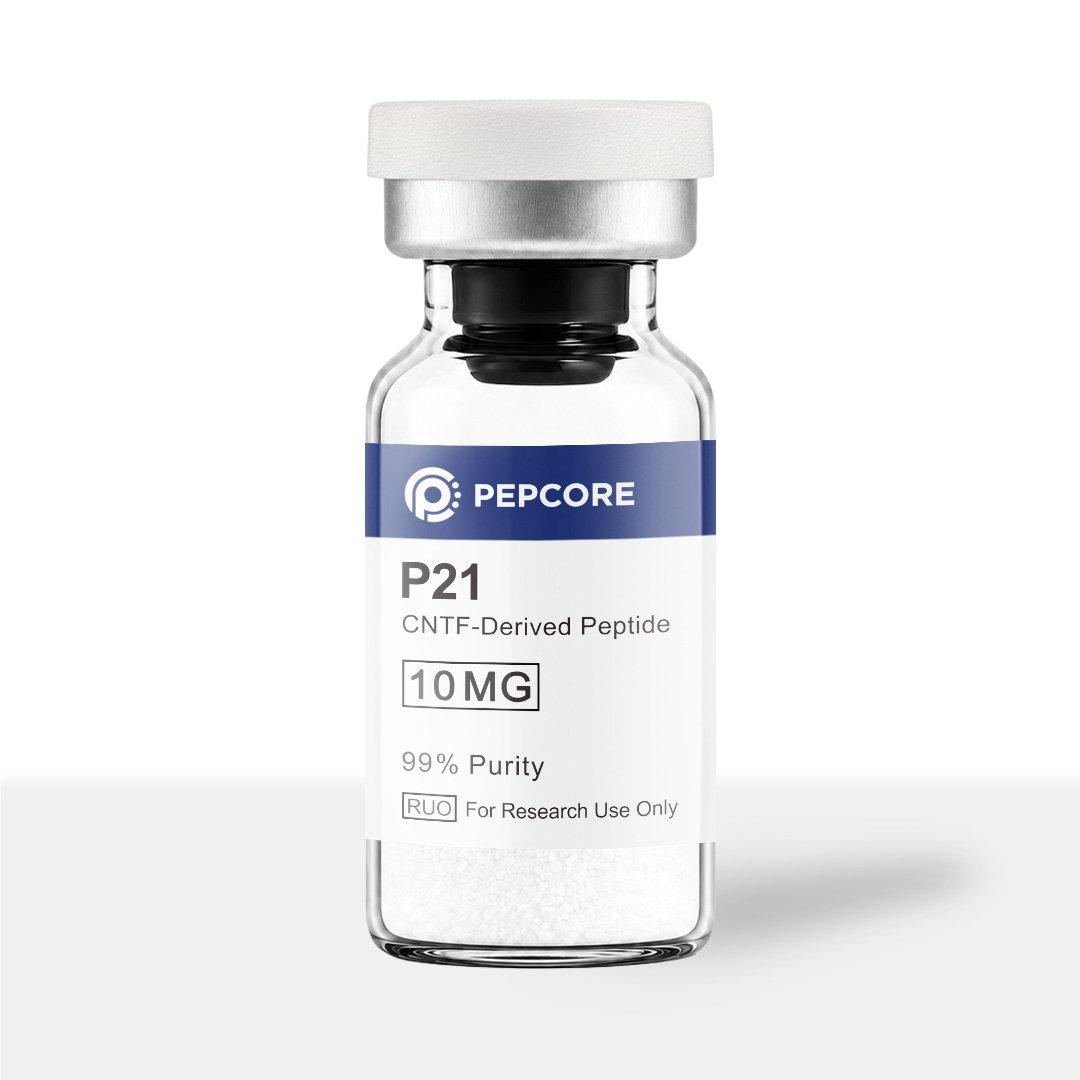
P21 10 mg
In Stock
Amount (mg)
Bacteriostatic Water
Insulin Syringes
Alcohol Swabs
Quantity
1
Price€59.00
Fast delivery, dispatched same day before 14:00
Tracked delivery, door to door
Shipped discreetly
Secure payments



Order before 14:00 for same-day shipping
Order now, ships today
OrderedToday
ShippedToday
Delivered24-25 November
P21, also called P021, is a synthetic peptide mimetic derived from CNTF, a protein involved in nerve-cell signaling. In a cultured human neuronal cell model with CDKL5 deficiency, P021 increased cell survival, proliferation and neuronal maturation under the tested conditions. These are cellular responses that help explain interest in the peptide's effects on nerve-cell development.
P21 keeps a short CNTF-derived core and adds an adamantane-containing end group. Researchers use this compact structure to study how chemical changes affect neurotrophic signaling: the signals that influence nerve-cell development and maintenance. Work follows neurite growth, neuronal markers and GSK3β signaling, with results depending on the cellular background. P021 did not change every measured response in otherwise unmodified comparison cells (Mottolese et al., 2024).
Research Applications
•Studied in nerve-cell development models
•Relevant in neuronal cell survival research
•Examined in nerve-cell growth and maturation studies
•Applied in growth-related neuronal signaling research
Supplied as a lyophilized powder for stability.
Scientific Background
CNTF stands for ciliary neurotrophic factor. P21 was designed from a short part of this larger protein rather than from its entire sequence. Its acetylated peptide core and modified terminal group give researchers a defined small molecule to compare with related peptide designs. Li et al., 2010.
The reference structure is commonly described as an adamantylated peptide mimetic. The bulky adamantane group changes the molecule's physical properties. Its presence is a structural feature; it does not establish a particular effect in people or make P21 equivalent to the complete CNTF protein. Baazaoui et al., 2017.
Human SH-SY5Y cells with CDKL5 deletion provide one published cellular setting. Investigators measured cell division, survival and acquisition of neuron-like features. The matching parental cell line allowed them to distinguish a response in the altered cells from a general increase in all cells. Mottolese et al., 2024.
Structure
ClassSynthetic CNTF-derived peptide mimetic
SequenceAc-Asp-Gly-Gly-Leu-Gly-NH₂; literature notation Ac-DGGL(A)G-NH₂
ModificationN-terminal acetylation; C-terminal amidation; adamantyl group on terminal glycine
FormulaC₂₇H₄₂N₆O₈
Molar mass578.67 g/mol
CASN/A
DatabasePubChem CID 56589645
SynonymsP021, Peptide 021, GLXC-21260
Mechanism of Action
Following cell survival and growth
In the CDKL5-deficient cell model, P021 increased the proportion of dividing cells and improved the measured survival response. These findings describe the cells in that experiment. Researchers compare both endpoints because more cells can reflect changes in division, survival or both; cell numbers alone do not identify the underlying route.
Examining neuronal maturation
Maturation concerns the features a developing cell acquires, including neuron-associated proteins and neurites, the extensions used to make connections. P021 changed these features in the published altered-cell model. Comparing morphology with molecular markers helps separate a shift in neuronal development from a simple change in cell count. Mottolese et al., 2024.
Connecting responses with signaling
GSK3β is an enzyme involved in several cellular signaling networks. The same study examined changes in its phosphorylation alongside P021 responses. This offers a mechanistic connection to investigate, while a phosphorylation measurement by itself does not prove a single direct target. The cell background remains important when comparing P021 with other neurotrophic research compounds.
References
•Li B et al. (2010). Design and experimental characterization of adamantane-containing neurotrophic peptides. PubMed
•Baazaoui N and Iqbal K (2017). P021 characterization in experimental neurotrophic-signaling research. PubMed
Research Use Disclaimer
This product is intended for in vitro laboratory research only. All information is provided for education and research reference. Not for personal use, diagnosis or treatment. Handling is restricted to trained and qualified professionals.
What is P21?
P21, also called P021, is a synthetic peptide mimetic derived from CNTF, a protein involved in nerve-cell signaling. It is supplied as a lyophilized powder for laboratory research use only.
What is P21 used for in research?
In research, P21 is studied in nerve-cell development models, in neuronal cell survival research as well as in nerve-cell growth and maturation studies. Related compounds in our Cognitive range include NA Semax and NA Selank.
Where can I buy P21?
P21 is available from Pepcore, shipped from the Netherlands to every European country with tracking. A certificate of analysis is available on request.
How is P21 reconstituted?
With bacteriostatic water, added slowly down the inside of the glass rather than onto the powder, then swirled gently, never shaken. Bacteriostatic water is optional when you order: you can add a 3 ml vial (+€4.99) or a 10 ml vial (+€12.99), or leave it out. Use our peptide calculator to work out the concentration for your vial size.
How is P21 stored, and how long does shipping take?
Lyophilized P21 is kept cool, dry and away from light. Once reconstituted, the solution is refrigerated at 2 to 8 °C, see our peptide stability guide. Orders leave the Netherlands the same or next business day: 1 to 2 business days to the Netherlands and Belgium, 2 to 7 to Germany, France, Spain, Italy and Luxembourg, 3 to 8 to the rest of the EU, free from €250, see shipping.
Amount (mg)10 mg
Bacteriostatic Water3 ml or 10 ml, optional
Insulin Syringes10× 1 ml insulin syringes, 10× 0.5 ml insulin syringes, None
Alcohol SwabsYes, No
TestingThird-party HPLC/MS
CASN/A
Netherlands & Belgium: 1-2 business days, €8.49-€12.99
Germany: 2-7 business days, €12.99
France, Spain, Italy & Luxembourg: 2-7 business days, €14.90
Rest of the EU: 3-8 business days, €14.90
Poland: 3-8 business days, €15.99
Sweden: 3-8 business days, €15.99
Switzerland, Norway, United Kingdom & other European countries outside the EU: 5-10 business days, €15.99
Canary Islands: 7-12 business days, €24.99
Free shipping on orders from €250
For laboratory and research use only.
Not for human or veterinary use, diagnosis, or treatment.
To be handled only by qualified personnel in a controlled lab setting.
By placing an order, you confirm you have read and agree to these research-use terms.


€59.00