Cognitive
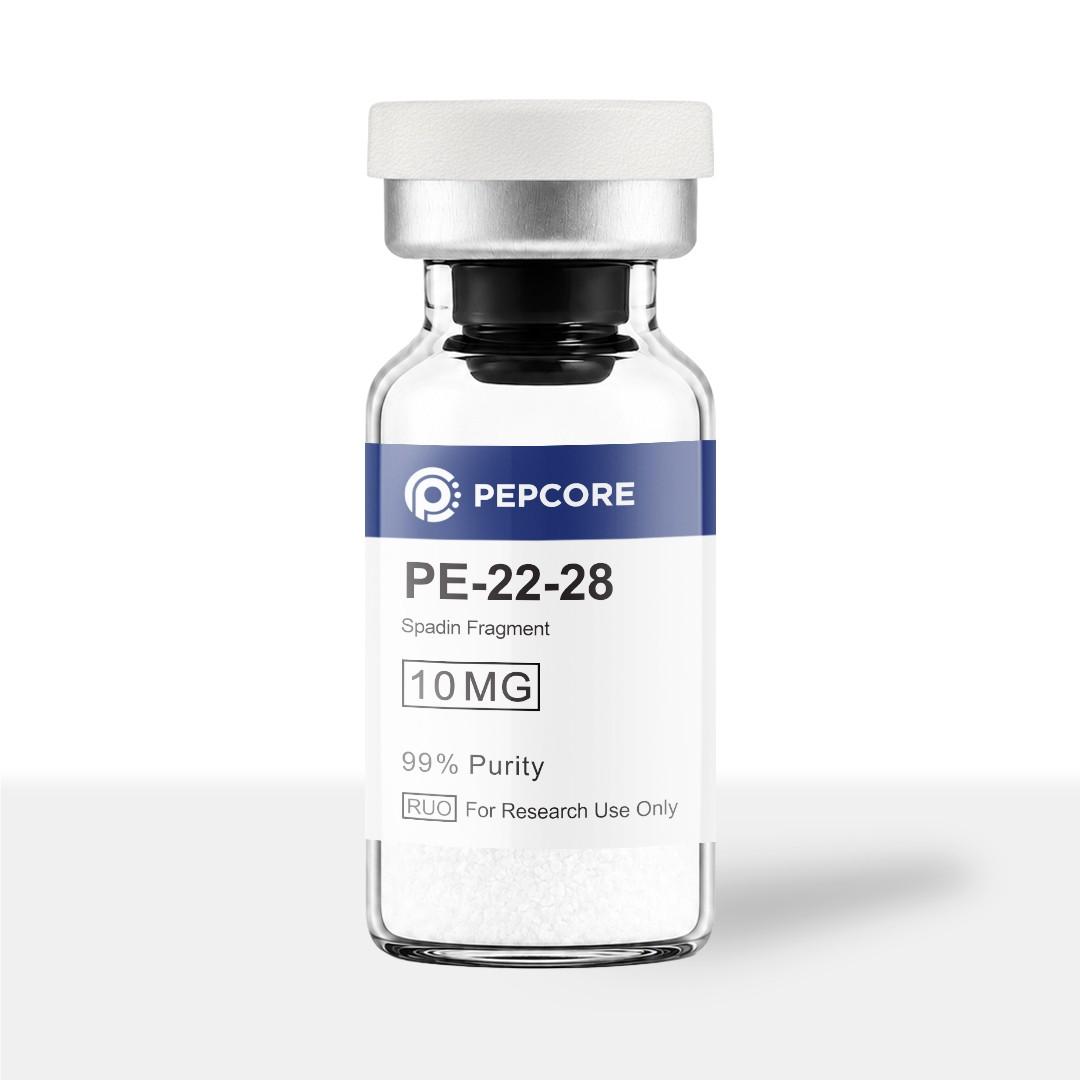
PE-22-28 10 mg
In Stock
Amount (mg)
Bacteriostatic Water
Insulin Syringes
Alcohol Swabs
Quantity
1
Price€59.00
Fast delivery, dispatched same day before 14:00
Tracked delivery, door to door
Shipped discreetly
Secure payments



Order before 14:00 for same-day shipping
Order now, ships today
OrderedToday
ShippedToday
Delivered24-25 November
PE-22-28 is a short 7-amino-acid fragment of spadin, a natural brain peptide. It blocks the TREK-1 potassium channel, a target linked to mood, and is used in mood, stress and brain-recovery research as a smaller, stronger version of the parent peptide.
PE-22-28 is studied for mood-related and neurogenesis effects in laboratory models, with the defining study reporting sub-nanomolar TREK-1 blockade and a longer window of action than spadin itself (Djillani et al., 2017, Frontiers in Pharmacology).
Research Applications
•Studied in mood and depression research models
•Relevant in research on neurogenesis and synapse formation
•Examined in stroke recovery and neuroprotection studies
•Applied in TREK-1 channel electrophysiology work
Supplied as a lyophilized powder for stability.
Scientific Background
TREK-1 is a two-pore-domain potassium (K2P) channel that helps set the resting membrane potential of neurons and is enriched in the prefrontal cortex, hippocampus, and dorsal raphe. Mice lacking the channel show a distinctive behavioural phenotype, making TREK-1 a target of wide interest in mood research.
Spadin, a peptide released from the sortilin propeptide, was identified as a natural TREK-1 blocker with rapid effects on hippocampal neurogenesis and CREB phosphorylation in mouse models. Its activity in vivo lasted roughly seven hours, prompting a search for shorter analogs.
PE-22-28 emerged from that workthe seven-residue fragment GVSWGLR kept the channel-blocking action of the parent, bound TREK-1 with far higher affinity (IC50 about 0.12 nM versus 40-60 nM for spadin), and stayed active for up to 23 hours in vivo.
Structure
Peptide ClassSynthetic spadin fragment (sortilin-derived heptapeptide)
Amino Acid SequenceGly-Val-Ser-Trp-Gly-Leu-Arg (GVSWGLR)
Molecular FormulaC₃₅H₅₅N₁₁O₉
Molecular Weight773.9 g/mol
CAS Number1801959-12-5
Mechanism of Action
TREK-1 Channel Blockade
PE-22-28 binds the TREK-1 (K2P2.1) potassium channel with sub-nanomolar affinity and inhibits its outward potassium current in patch-clamp studies on hTREK-1/HEK cells and neurons, the defining action of the spadin family.
Neuronal Depolarization and Serotonergic Firing
Closing a background potassium leak raises the resting membrane potential; in mouse models the parent peptide increased the firing rate of 5-HT neurons in the dorsal raphe nucleus, a downstream signature of TREK-1 inhibition.
Neurogenesis and Synaptogenesis
PE-22-28 induced hippocampal neurogenesis after four days in mouse models and raised PSD-95 expression in cortical neurons; spadin-class peptides also activate MAPK and PI3K signalling and increase BDNF expression.
Biphasic Modulation in Ischemia Models
The short analog mini-spadin (PE 22-28) showed a concentration-dependent, biphasic action on TREK-1 in a mouse focal ischemia model, with neuroprotective and plasticity-promoting effects reported during recovery.
Conclusion
PE-22-28 is the compact, high-affinity fragment of spadin, offering a selective research tool for TREK-1 electrophysiology, mood-related behavioural models, and neuroplasticity studies, with a longer window of activity than the parent peptide.
References
•Mazella J et al. (2010). Spadin, a sortilin-derived peptide, targeting rodent TREK-1 channels: a new concept in the antidepressant drug design. PLoS Biology. PubMed
•Devader C et al. (2015). In vitro and in vivo regulation of synaptogenesis by the novel antidepressant spadin. British Journal of Pharmacology. PubMed
•Djillani A et al. (2017). Shortened Spadin Analogs Display Better TREK-1 Inhibition, In Vivo Stability and Antidepressant Activity. Frontiers in Pharmacology. PubMed
•Pietri M et al. (2019). First evidence of protective effects on stroke recovery and post-stroke depression induced by sortilin-derived peptides. Neuropharmacology. PubMed
Research Use Disclaimer
This product is intended for research and laboratory use only. It is designed exclusively for in vitro research purposes. All information provided is for educational and research reference only. This product is not intended for human or animal use. It is not a drug, food, or cosmetic and must not be marketed, labeled, or used as such. Use and handling are restricted to trained and qualified professionals.
What is PE-22-28?
PE-22-28 is a short 7-amino-acid fragment of spadin, a natural brain peptide. It is supplied as a lyophilized powder for laboratory research use only.
What is PE-22-28 used for in research?
In research, PE-22-28 is studied in mood and depression research models, in research on neurogenesis and synapse formation as well as in stroke recovery and neuroprotection studies. Related compounds in our Cognitive range include NA Semax and NA Selank.
Where can I buy PE-22-28?
PE-22-28 is available from Pepcore, shipped from the Netherlands to every European country with tracking. A certificate of analysis is available on request.
How is PE-22-28 reconstituted?
With bacteriostatic water, added slowly down the inside of the glass rather than onto the powder, then swirled gently, never shaken. Bacteriostatic water is optional when you order: you can add a 3 ml vial (+€4.99) or a 10 ml vial (+€12.99), or leave it out. Use our peptide calculator to work out the concentration for your vial size.
How is PE-22-28 stored, and how long does shipping take?
Lyophilized PE-22-28 is kept cool, dry and away from light. Once reconstituted, the solution is refrigerated at 2 to 8 °C, see our peptide stability guide. Orders leave the Netherlands the same or next business day: 1 to 2 business days to the Netherlands and Belgium, 2 to 7 to Germany, France, Spain, Italy and Luxembourg, 3 to 8 to the rest of the EU, free from €250, see shipping.
Amount (mg)10 mg
Bacteriostatic Water3 ml or 10 ml, optional
Insulin Syringes10× 1 ml insulin syringes, 10× 0.5 ml insulin syringes, None
Alcohol SwabsYes, No
TestingThird-party HPLC/MS
CAS1801959-12-5
Netherlands & Belgium: 1-2 business days, €8.49-€12.99
Germany: 2-7 business days, €12.99
France, Spain, Italy & Luxembourg: 2-7 business days, €14.90
Rest of the EU: 3-8 business days, €14.90
Poland: 3-8 business days, €15.99
Sweden: 3-8 business days, €15.99
Switzerland, Norway, United Kingdom & other European countries outside the EU: 5-10 business days, €15.99
Canary Islands: 7-12 business days, €24.99
Free shipping on orders from €250
For laboratory and research use only.
Not for human or veterinary use, diagnosis, or treatment.
To be handled only by qualified personnel in a controlled lab setting.
By placing an order, you confirm you have read and agree to these research-use terms.


€59.00